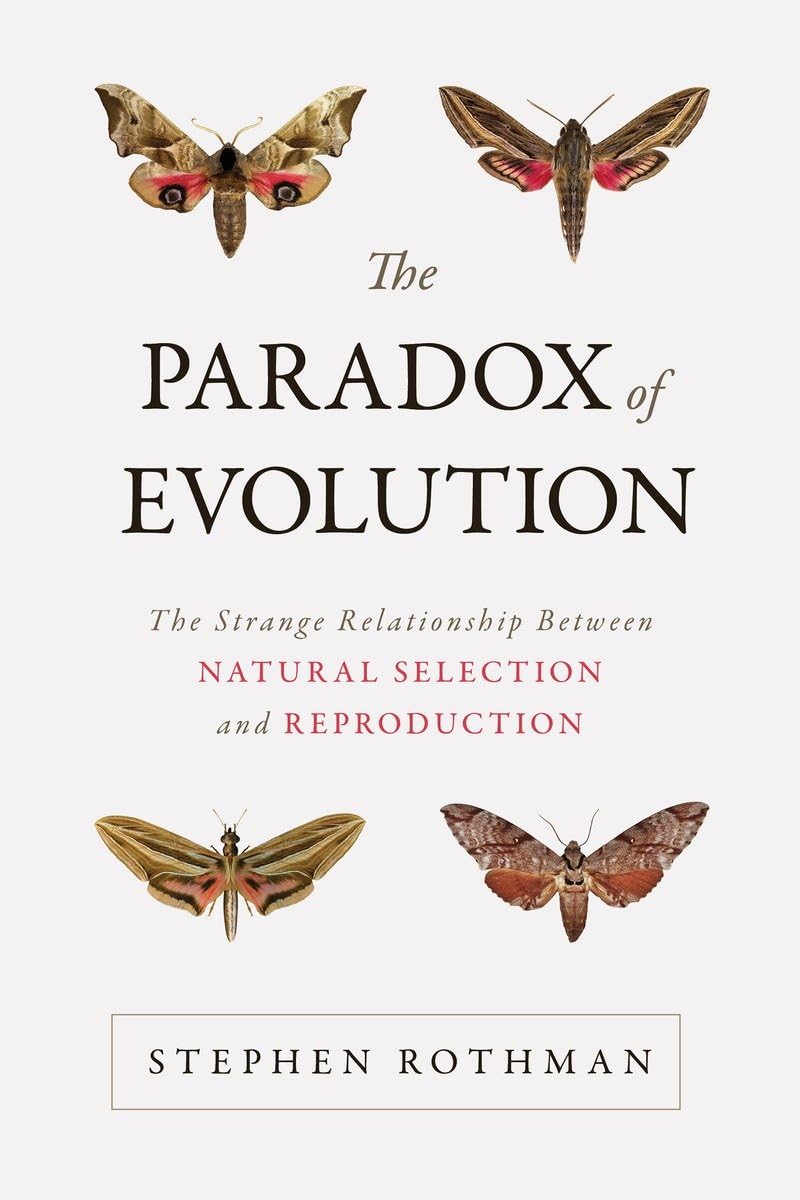
Paradox of Evolution: The Strange Relationship between Natural Selection and Reproduction
$17.00
by Stephen Rothman



This book examines a little-noted contradiction inherent in the two essential elements of Darwin's theory of biological evolution--natural selection and reproduction. Physiologist Stephen Rothman makes the revolutionary claim that the evolution of life's complex and diverse reproductive mechanisms is not the consequence of natural selection. In so doing, he exposes the deepest question possible about life's nature--its reason for being. In meticulously detailed but accessible terms he lays out the crux of the paradox and offers an intriguing solution within a naturalistic framework. In an ostensibly purposeless universe, somehow purposeful life has evolved. For all living things there are two overarching purposes: survival and the creation of new life. Natural selection is about the survival of existing life, but has no interest in life's future, about whether it persists or perishes. By contrast, reproduction is only about the future of life, and has no interest in existing life except as a means to that end. Where do these purposes come from? As Rothman demonstrates, at every level life is wired to react to danger. Counterintuitively, without the danger to its existence, life would not have come into being. As for reproduction, nature's destructive forces drive the creation of new life. Written with great clarity and informed by deep learning, this elegant, thoughtful work tackles some of the most challenging questions raised by the theory of evolution, while calling to mind Darwin's famous words from the conclusion of On the Origin of Species: "There is a grandeur in this view of life." ""Science thrives on penetrating questions of even its theoretical pillars. In this book, Rothman tackles a central pillar of evolutionary theory, reminding us that while we know evolution is a fact, there remains plenty to learn about this fascinating and universal process.” —Cameron M. Smith, PhD, professor of anthropology, Portland State University; author, The Fact of Evolution; and coauthor, The Top 10 Myths about Evolution Stephen Rothman, PhD, is professor emeritus in physiology, cell and tissue biology at the University of California, San Francisco. He is the author of seven previous books, including Life Beyond Molecules and Genes and Lessons from the Living Cell . The Paradox of Evolution The Strange Relationship between Natural Selection and Reproduction By Stephen Rothman Prometheus Books Copyright © 2015 Stephen Rothman All rights reserved. ISBN: 978-1-63388-072-6 Contents Preface, 11, Prologue, 13, SECTION I — DARWIN'S THEORY, Chapter 1. Two Mysteries — A Story of Nature and Science, 19, Chapter 2. A Most Extraordinary Theory — The Remarkable Impact of a Scientific Theory on Society, 25, Chapter 3. A Look inside Darwin's Theory — Is the Theory of Evolution by Means of Natural Selection Internally Consistent?, 31, Chapter 4. The Meaning of Natural Selection — Defining Natural Selection, 39, SECTION II — REPRODUCTION, Chapter 5. One for All — Did Natural Selection Produce the Mechanisms of Reproduction?, 53, Chapter 6. The Other Beginning — The Reproduction of Cells, 61, Chapter 7. Beyond Replicating Molecules and Reproducing Cells — Natural Selection and the Evolution of the Reproductive Mechanisms of Life, 67, SECTION III — SEXUAL SELECTION, Chapter 8. Iridescent Brilliance — Darwin Worries about Peacocks and Finds Sexual Selection, 83, Chapter 9. On the Importance of Small Differences — The Basis of Sexual Attraction, 91, Chapter 10. In the Eyes of the Beholder — Utility and Beauty in Sexual Attraction, 99, SECTION IV — PURPOSE, Chapter 11. A Great Contradiction — Teleology Rears Its Ugly Head, 115, Chapter 12. Purpose — Teleology Cannot Be Denied, 123, Chapter 13. Darwin's Teleology of Survival — A Scientific Basis for Purpose in Life, 129, Chapter 14. The Laws of Nature — Purpose from Physical Law, 143, SECTION V — PURPOSE AND REPRODUCTION, Chapter 15. The Purposes of Reproduction — Why Reproduction?, 159, Chapter 16. The Means — The Agency of Reproductive Selection, 167, Chapter 17. The Final Cause of Reproduction — What Caused Reproductive Evolution?, 181, Chapter 18. "For the Sake of Which ...", 189, Chapter 19. On Chairs and Carob Trees, 195, Coda, 201, Notes and Selected Readings, 221, Index, 237, CHAPTER 1 TWO MYSTERIES A Story of Nature and Science False facts are highly injurious to the progress of science, for they often endure long; but false views, if supported by some evidence, do little harm; and when this is done, one path towards error is closed and the road to truth is often at the same time opened. Charles Darwin, The Descent of Man, 1871 This is a book about two mysteries, one of nature, another of science. A mystery of nature is of course something that we do not understand about nature. A mystery of science is something unknown or unrevealed about the thinking and methods of its practitioners. Both mysteries have to do