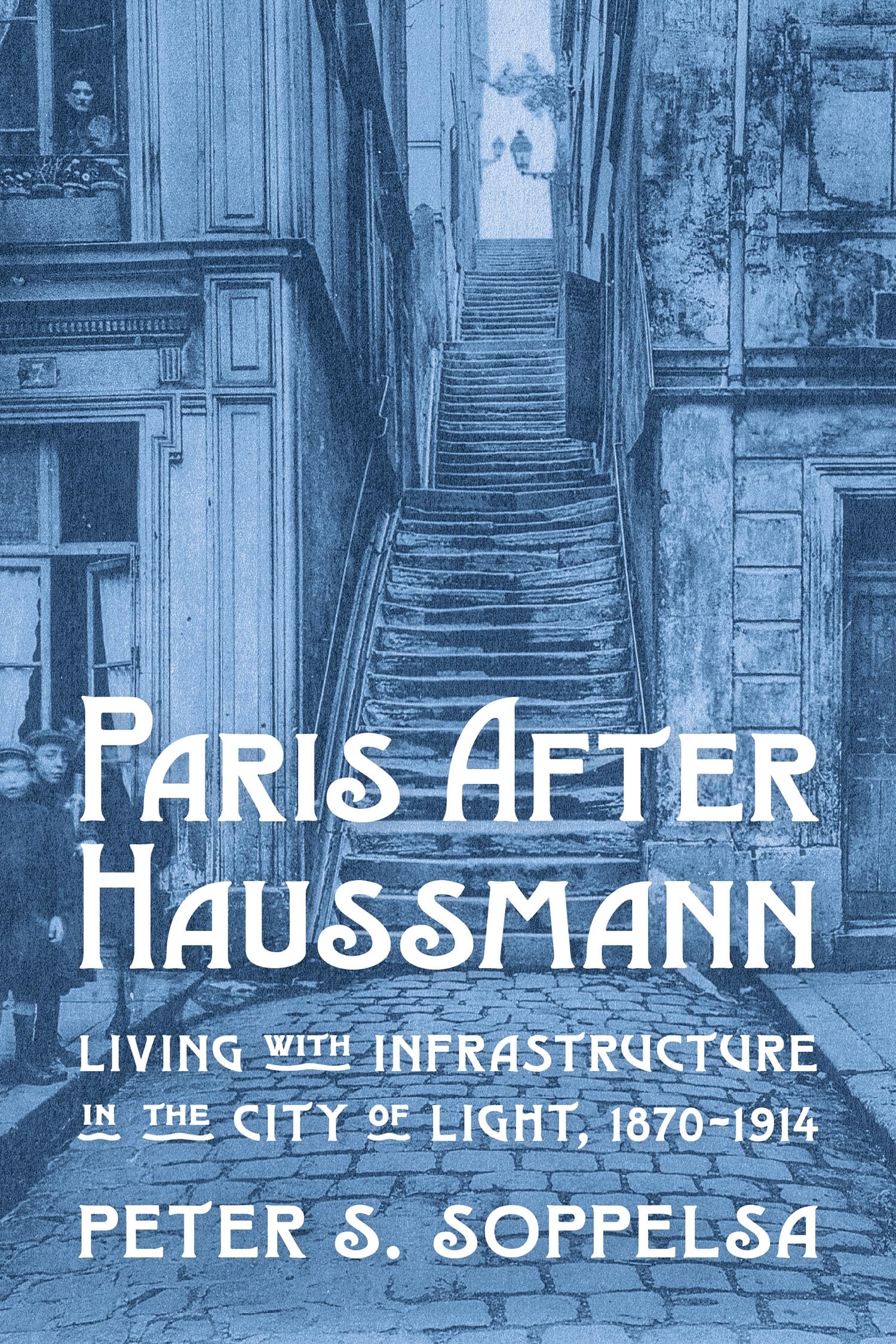
Paris After Haussmann: Living with Infrastructure in the City of Light, 1870–1914 (History of the Urban Environment)
$120.00
by Peter S. Soppelsa



Modern Paris is often hailed as a capital of urban infrastructure. Baron Georges-Eugène Haussmann’s rebuilding of Paris in 1853–1870, branded “Haussmannization,” helped define urban modernity for cities worldwide. But even as infrastructures expanded and modernized, some Parisians were left behind: as late as 1928, 18 percent of houses still lacked direct sewerage. Haussmannization often hid infrastructures behind walls and floors, under streets, or in peripheral districts. In the forty years after 1870, a period that Peter Soppelsa calls “secondary Haussmannization,” Parisians inverted them―revealed their hidden components to scrutinize their workings and costs for society, environment, and health―and in turn politicized them. Drawing on French government archives, engineers’ maps, the illustrated press, and a collection of over 100 photographic postcards, Soppelsa charts the diverse embodied, emotional, and everyday experiences of living with expanding urban infrastructures―streets, housing, tramways, subways, the water supply, sewers, and rivers―in Paris from 1870 to 1914. Parisians learned that infrastructures were not simply technical solutions for the social and environmental problems of city life but could also bring about new dangers and dependencies. This marvelous book provides critical insight into the relationships between technology, society, and the urban environment in a modernizing Paris. Peter S. Soppelsa lays bare the visible and invisible aspects of the infrastructure that shaped both the form and the human experience of the city’s vertical, spatial, and subterranean geographies. The result is an essential portrait of the uneven reach of Paris’s infrastructures of transportation, sanitation, and organization, which both reflected and reinforced novel inequalities. -- Richard C. Keller, University of Wisconsin–Madison Well-written and conceived, Paris After Haussmann presents an original perspective on the making of an iconic modern city, and will make an important contribution to historical studies of nineteenth-century Paris specifically, as well as the fields of French history, science and technology studies, and modern urban history more generally. -- Min Kyung Lee, Bryn Mawr College Paris after Haussmann offers key insight into the ideal and reality of living with urban modernity in the City of Light. Peter Soppelsa lays bare the entanglement of infrastructure, environment, health, and society. A groundbreaking analysis and a great read. -- Rosemary Wakeman, Fordham University Challenges the Myth of Paris as a Model Metropolis in which Infrastructures Deliver Universal Social Progress Peter S. Soppelsa is an assistant professor in the University of Oklahoma Department of History of Science, Technology, and Medicine. His research combines environmental and urban history with the history of technology to explore the past of infrastructures, public works, public health, and the everyday experience of urban environments and technologies.