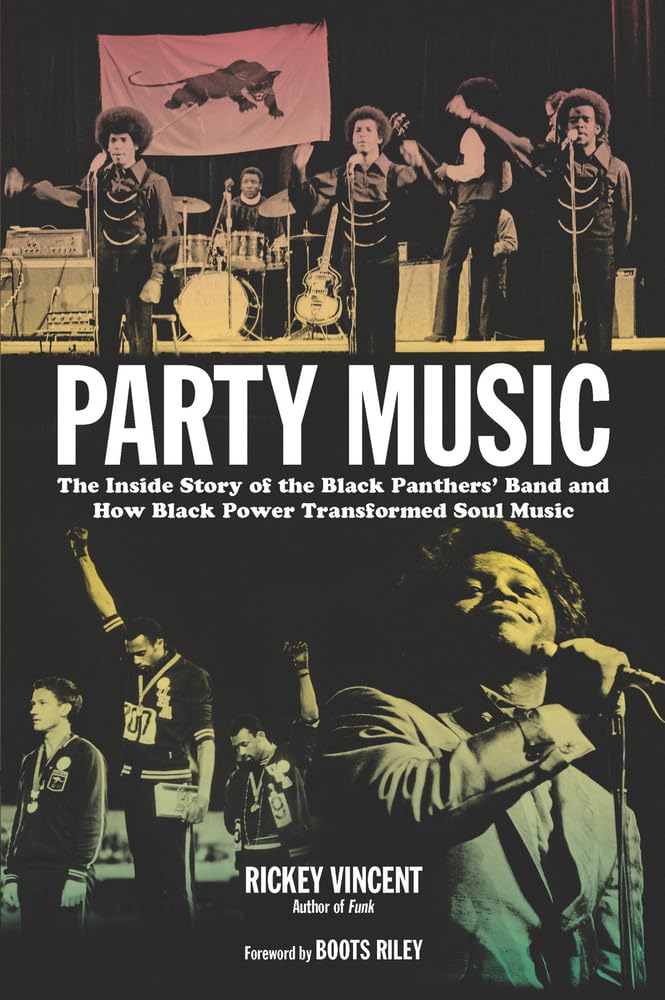
Party Music: The Inside Story of the Black Panthers' Band and How Black Power Transformed Soul Music
$11.36
by Rickey Vincent



Connecting the black music tradition with the black activist tradition, Party Music brings both into greater focus than ever before and reveals just how strongly the black power movement was felt on the streets of black America. Interviews reveal the never-before-heard story of the Black Panthers’ R&B band the Lumpen and how five rank-and-file members performed popular music for revolutionaries. Beyond the mainstream civil rights movement that is typically discussed are the stories of the Black Panthers, the Black Arts Movement, the antiwar activism, and other radical movements that were central to the impulse that transformed black popular music—and created soul music. "Comprehensive, complex, and revealing, Vincent’s nostalgic journey provides an insider’s look at a remarkable band and a piercing snapshot of black history." — Publishers Weekly "Apart from introducing a new name to many black music scholars, fresh interviews with the band and Party members feed an eye-of-the-hurricane account of this often-misrepresented time. Combined with Vincent’s beautifully readable style, the results are a definitive work on the late 60s black revolution and its previously neglected soundtrack." — Record Collector "A fascinating history of the Black Panthers, their house band and the music that inspired them. Rickey Vincent is well qualified to tell the story of the Black Panthers; his mother was a party member, his father a black politics historian and it's that combination of first-person insight and thorough research that makes this book so riveting. Like the Panthers, Vincent thinks outside the box, telling their story through the lens of The Lumpen, the Panthers' house band. ... Vincent takes each song played at a 1970 Oakland show as the springboard for discussion. For example: Their radical reworking of Sly And The Family Stones' 'Dance To The Music' leads to a brief history of Sly; the intelligent debate on the Bay Area counter culture revolution, the 10 point programme and so on." — MOJO , Four Stars Rickey Vincent is the author of Funk: The Music, The People, and the Rhythm of the One and has written for the Washington Post , American Legacy , and the Los Angeles Review of Books . He teaches at the University of California–Berkeley. Boots Riley is a rapper, producer, activist, and the lead vocalist of The Coup and Street Sweeper Social Club. Party Music The Inside Story of the Black Panthers' Band and How Black Power Transformed Soul Music By Rickey Vincent Chicago Review Press Incorporated Copyright © 2013 Rickey Vincent All rights reserved. ISBN: 978-1-61374-492-5 Contents Foreword by Boots Riley, Preface, Introduction: "Revolution in the Air", 1 "Party Music": The Story of the Lumpen, 2 "Power to the People": Bay Area Culture and the Rise of the Party, 3 "The Lumpen Theme": James Brown, the Rhythm Revolution, and Black Power, 4 "People Get Ready": Civil Rights, Soul Music, and Black Identity, 5 "For Freedom": Cultural Nationalism and the Black Panther Party, 6 "Bobby Must Be Set Free": Panther Power and Popular Culture, 7 "Ol' Pig Nixon": The Protest Music Tradition, Soul, and Black Power, 8 "Revolution Is the Only Solution": Protest Music Today and the Legacy of the Lumpen, Acknowledgments, Sources, Notes, Index, CHAPTER 1 "Party Music" The Story of the Lumpen As the backing band, the Freedom Messengers, winds down their final song in the Merritt College auditorium, the packed audience of hundreds of students, young radicals, and community members from the North Oakland area feel the anticipation building in the room. The lights go down, a drum roll starts, and a voice from the shadows bellows out: "Ladies and gentlemen, brothers and sisters. The Black Panther Party very proudly presents, [drum roll] ... "The Lumpen!" The sound of the band crashes in with a high energy rhythm and blues groove. The Lumpen members rush the stage and begin to step, kick, and spin — the show is off and running. This is how the Lumpen began their concert on November 10, 1970, as well as their many other shows during a ten-month span from midsummer 1970 to the spring of 1971. They were billed as "The Black Panther Party's Revolutionary Band," and like many of the community programs produced by the Black Panther Party at the time, they delivered the goods. The Lumpen represented the goals and ideals of the Party and performed their radicalized renditions of popular black music through some of the most tumultuous moments in the Black Panther Party's existence. This is their story. The story of the Lumpen began in San Jose, California, in 1968, just as the student uprisings that had been taking place at college campuses nationwide landed at the small South Bay campus of San Jose State University, fifty miles south of San Francisco. The cataclysmic events of that year — the murders of Nobel Peace Prize-winner Dr. Martin Luther King Jr. and presidential candida