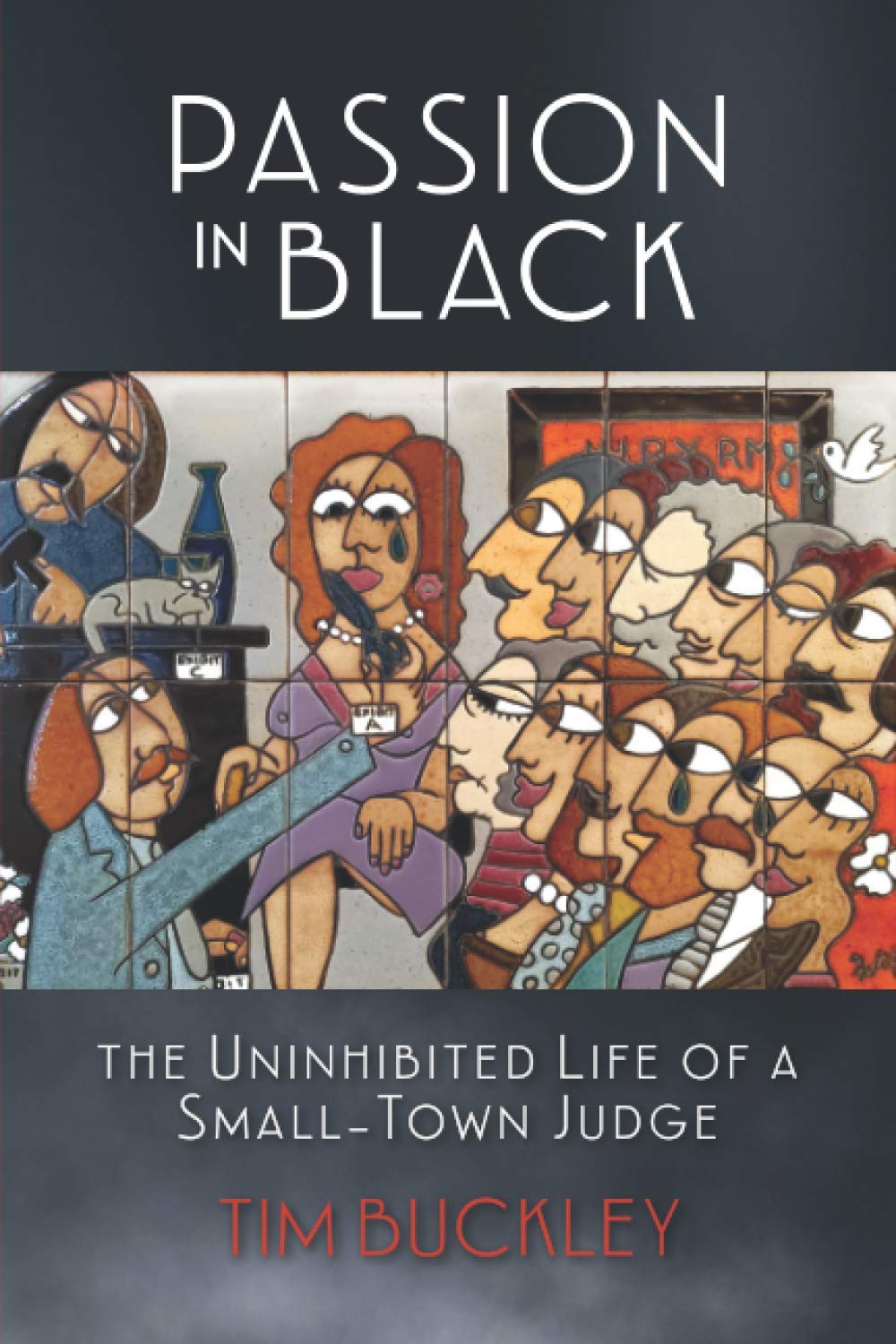



"You idiot! You sent the death threat to the wrong judge. I'm the judge you want to kill Don't confuse Judge Rosson with me. I'm the one who sentenced you." Originally conceived as a collection of anecdotes for the writer's children and grandchildren, "Passion in Black", is a comprehensive look at one man's life as a judge throughout a forty year career in California dispensing tough love to the unlovable and ministering to addicts and alcoholics. It is a remembrance of not only the job, but the people, places and lessons encountered along the way, told with humor, interspersed with irreverence and the appropriate amount of self-deprecation. From the local criminal whose frequent visits to court always began by greeting Judge Buckley by his first name, to the heart-rending stories of domestic violence and child abuse, or the occasional death threat; here are the tales of a small-town judge who has seen all manner of cases come before him, from traffic offenses to multiple murders and everything in between. This memoir contains stories from a man who loved his job, but always loved people most of all. "A retired judge recounts a long and eventful career in this memoir. Buckley was a judge for nearly 40 years, first appointed to the Hanford Justice Court in California in 1978 when he was only 32 years old. He would eventually serve on a superior court of appeals--a distinctive judicial experience that presented him with a diverse spectacle of highs and lows. As a small-county judge, he knew everyone and the locals all knew him, an intimacy that could prove helpful or impossibly awkward. In one instance, his daughter's soccer game was delayed when he served a bench warrant for the arrest of the referee. In a more serious episode, he was forced to sentence a friend--a police officer caught stealing drugs from an evidence locker--to prison. In a delightfully breezy, anecdotal style, the author candidly discusses the whole spectrum of his experience, from the grim--crimes like murder and rape--to the comically absurd. There are chapters entitled "Dumb Jurors," "Truly Dumb Defenses and Other Stupid People," and "Just Weird Shit." Still, lurking behind his often hilarious account of madcap experiences is a serious, unflinching, and occasionally melancholic reflection on human nature. Consider this apercu presented in a discussion of racial prejudice: "One of the sad realities of life is that it appears that everybody hates everybody else. There is so much prejudice in the world that it seems like the slightest affront can trigger a release of what was otherwise submerged deep within." His memoir is filled with this kind of insights--culled from experience rather than some abstract ideology, evenhanded and unbeholden to some partisan allegiance, and frankly articulated. The author approached his position of power with admirable humaneness and compassion. He had an "unpaid gig" for decades working in rehabilitation centers with people of all stripes who used drugs and with women who were the victims of domestic violence: "I enjoyed my role as a judge because I was in a position where I could actually try to make things better for both the victim and the defendant." Buckley is a sharp raconteur--he calls himself a "consummate bullshitter"--and he is as forthcoming in print as he was "confrontational in court." But this is more than a comic performance--he writes with great intelligence about complex subjects, like racial prejudice in the judicial system, and movingly about those victims whose grief haunted him. For example, he recounts one case in which a 14-year-old girl was brutally raped by three gang members as part of a lurid initiation rite. The suthor recollects her testimony with such unabashed but unsentimental emotion that readers cannot help but be moved. Despite his considerable judicial accomplishments, Buckley clearly doesn't write to impress but rather to share, to edify, to amuse, maybe even sometimes to vent. His reminiscence feels like an invitation to a conversation rather than a lecture, a letter to a friend with the expectation of a response. For all its free-wheeling informality, this is an impressively perspicacious memoir, brimming with insights and integrity. An engrossing, illuminating, and well-crafted judicial account." --Kirkus Reviews