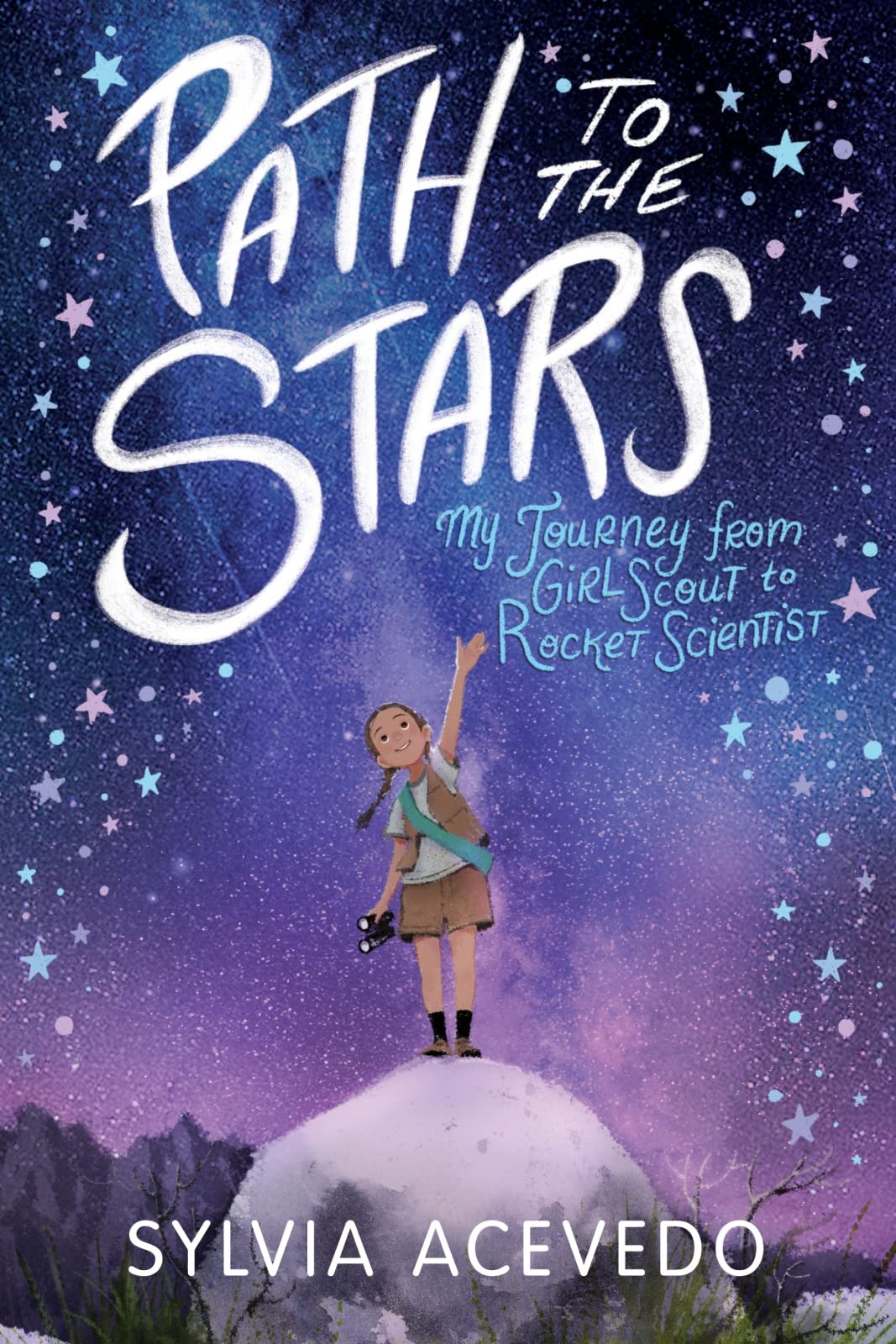
Path to the Stars: My Journey from Girl Scout to Rocket Scientist―A Latina Engineer’s Odyssey from the Brownies to NASA
$7.43
by Sylvia Acevedo



The inspiring memoir for young readers about a Latina rocket scientist whose early life was transformed by joining the Girl Scouts and who most recently served as the CEO of the Girl Scouts of the USA. A meningitis outbreak in their underprivileged neighborhood left Sylvia Acevedo's family forever altered. As she struggled in the aftermath of loss, young Sylvia's life transformed when she joined the Brownies. The Girl Scouts taught her how to take control of her world and nourished her love of numbers and science. With new confidence, Sylvia navigated shifting cultural expectations at school and at home, forging her own trail to become one of the first Latinx to graduate with a master's in engineering from Stanford University and going on to become a rocket scientist at NASA's Jet Propulsion Laboratory. Simultaneously available in Spanish! "This appealing page-turner helps fill the void of biographies on Latina women. Girls, boys, scouts, non- scouts—all will be inspired by Acevedo’s story." - Booklist (starred review) "Those seeking stories of female STEM trailblazers will find much to love here. Encouraging and uplifting." - Kirkus Reviews " A gem of an autobiography...The text is accessible, and the story of Acevedo’s life touches upon a number of salient points for readers including racism, gender roles, and educational inequality." - School Library Journal School Library Journal "Acevedo’s moving autobiographical account shines in its honesty, personal details, and inspirational message." - Horn Book Magazine Sylvia Acevedo is a rocket scientist and award-winning entrepreneur who served on the White House Commission for Educational Excellence for Hispanics and is the former CEO of the Girl Scouts of the US. Visit her online at sylviaacevedo.org and on Twitter @SylviaAcevedo. Chapter 1 Born in the Shadow of Mount Rushmore My Papá wasn’t much for telling stories. He liked facts and information. If you asked him about the Mexican Revolution or about the freezing point of water, he’d go on all day, sounding grown-up and important, like the men who read the news on television. Mami was the storyteller in our family—as long as the subject was people. I thought she must know everybody in the world—who their family was, where they came from, and what they did all day. Still, my father had one story that I always loved to hear. “Papá, tell me about the hospital!” I’d beg him. Sometimes it took a few tries, but he’d finally look up from his book. “The hospital,” he’d repeat, his voice thoughtful. “I drove by it every day, but I’d never gone inside. It was not far from Ellsworth Air Force Base, where we lived when I was stationed in South Dakota, less than an hour from Mount Rushmore.” He would always start by telling me about his time in the army. Papá was proud of his army service, so part of the story was about how he’d entered the army after the Korean War as a lieutenant in the Air Defense Artillery. “Your brother, Mario, was already two years old,” Papá would continue, finally getting to the important part of the story. “Once we knew the new baby was about to be born, I brought Mami to the hospital. We all went inside, even Mario. “The nurse told me Mami would need some time and I should come back later. So I went home to the base where we lived and left Mario with a neighbor. When I got back to the hospital, they said it would be a while before I could see your mother.” In those days, fathers stayed in a waiting room while their babies were being born, and new babies were usually brought to the nursery, not kept with their mothers. It was a long time before a nurse came out to tell Papá that Mami was fine, but she was asleep. The nurse said Papá could see his baby. When he got to the nursery, Papá looked through a big window and saw rows of metal cribs with clear plastic sides, each crib just big enough for one tiny infant. Some of the babies had blond hair, and some had brown hair or no hair at all. Nearly all of them had fair skin. Only one baby had very dark hair. “That was me!” I’d say. “I wasn’t even one day old.” I knew Papá had had no trouble picking me out in the nursery because I looked like him, even though he was a grown man in an army uniform and I was a little baby wrapped in a white blanket. He knew right away I was his. And I was sure that I knew right away that he was my Papá. Papá would nod at that point in the story, and sometimes he’d even smile. I’d wait for him to say something else, but usually his nose would go right back into his book. I was always excited to hear this story, but over the years, I came to understand more about what living in South Dakota had been like for Mami. Papá’s family was from Mexico, but he had grown up in Texas. He had gotten all of his schooling, including college, in the United States, and he spoke English well. After graduation, he was fulfilling his army ROTC commitment a