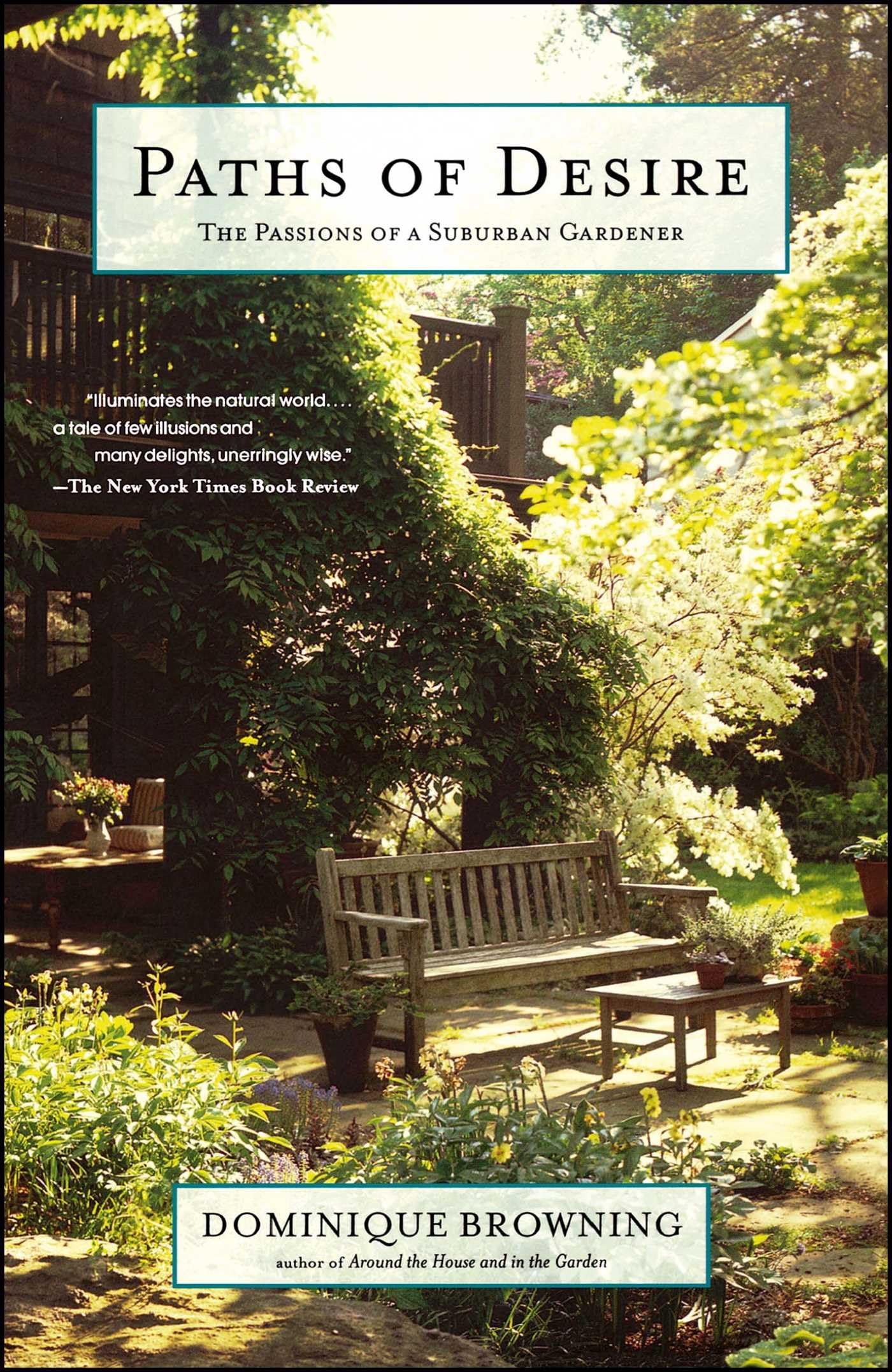



With the same warmth, wisdom, wit, and accessibility that readers have come to love and trust in her monthly column, House & Garden editor in chief Dominique Browning offers this lively, charming, and instructive story of restoring a neglected suburban garden. When a retaining wall in Browning's New York suburban garden collapsed, she was forced into action. Paths of Desire is the enchanting, amusing, and moving account of making a garden -- and confronting the essence of suburban gardening, with its idiosyncratic ecosystem. This meant struggling with depraved skunks and raccoons, marauding teenagers, plastic jungle gyms, toppling garbage cans, uncontrollable eyesores, potholed drives, and all the grinding, honking, and buzzing of the neighborhood. Browning's delightfully frank prose conveys the very sense of being deep in a garden, with all its organic smells and textures, and the myriad joys of deciding what to plant and watching as the vision is realized. It contains a rich store of advice and illustrative anecdotes for enthusiasts and novices alike, as Browning amusingly documents the missteps she took in the planning of her garden and the satisfactions of finally getting it right. In Paths of Desire she teaches us how to embrace our plots of land -- no matter their size, beauty, or proximity to the city -- and make them our own. But she also reminds us that the life of a garden can never be separated from the people who wander in and out of it: characters like the charming but useless children; the philosophical tree doctor and the band of Helpful Men; the neighbors -- legalistic on one side, aesthetically challenged on the other -- and, best and worst of all, the True Love. By the end of the book, Browning has transformed her garden -- and her life -- and has created a place of enchantment, which is most of all what a garden should be. Michael Pollan author of The Botany of Desire: A Plant's-Eye View of the World With this delightful book, Dominique Browning takes her rightful place in the ongoing over-the-back-fence conversation among American gardeners, that tribe of literate amateurs -- writers first, horticulturists second -- who limn whole worlds in the space of a suburban yard. Penelope Hobhouse garden historian and author of Gardens of Persia Dominique Browning celebrates her personal passion, making an engrossing and illuminating read. I loved the book. Dominique Browning has been the editor-in-chief of House & Garden since 1995. She was previously the editor of Mirabella , an assistant managing editor of Newsweek , and the executive editor of Texas Monthly . She lives in New York with her two teenage sons. TWO: GROUNDS FOR RENOVATION "The great way is very level; But people delight in torturous paths." -- Lao-tzu Te Tao Ching One day, soon after we had moved into the house, I walked out the back door from the kitchen and saw a couple of mysterious plants poking, with great determination, their way out from the edge of the driveway. Fugitives from a buried bed. I had never seen such plants in my life. Two strong stalks of dusty green with thick leaves ranked up the sides, they grew taller and taller -- I felt like Jack watching his beans rise -- until they reached a height of five feet. The stalks were noble and erect, as if they were flagpoles from which would unfurl heraldic banners. Then the stalks began to bloom, a profusion of blossoms up and down their length of a mottled, breathtaking, unnameable blue. A Botticelli blue. A blue close to the clearest depths of southern seas, or the celestial orbs frescoed on the ceilings of old churches. And then again, a blue that lay closer to the inky mauve of a slow dusk. The color was shifting, changeable. This was my introduction to the aristocratic delphinium. For years afterward, I searched the garden catalogs to find a flower that resembled the ones that seemed to have come down to my backyard from the heavens; I figured out that they were a hybrid of the elatum group, but I have faltered in finding the color, which hovers elusively, winking at me, somewhere between the "Blue Nile" and "Bruce." It is like that blue spot in the middle of the darkness behind your eyeballs, the so-called Blue Pearl at the heart of meditation, that the seeker finds only upon transcending time and place and the need to scratch an itch. I have read about it, but will never find it. I had seen the mythic delphinium; I was soon to lose it forever. Those flowers that appeared at the back of the driveway came bearing a message, I was sure. It was time to start a new bed in the back. That was how we came to rip out the parking lot. Parking lot? you say. It was an unusual landscaping feature, to say the least, for a suburban backyard -- at least in those days. It was an extension of the driveway, tucked around behind the kitchen at the back of the house, paved and fenced off from the rest of the yard. A beautiful old pink rose, with trunks as th