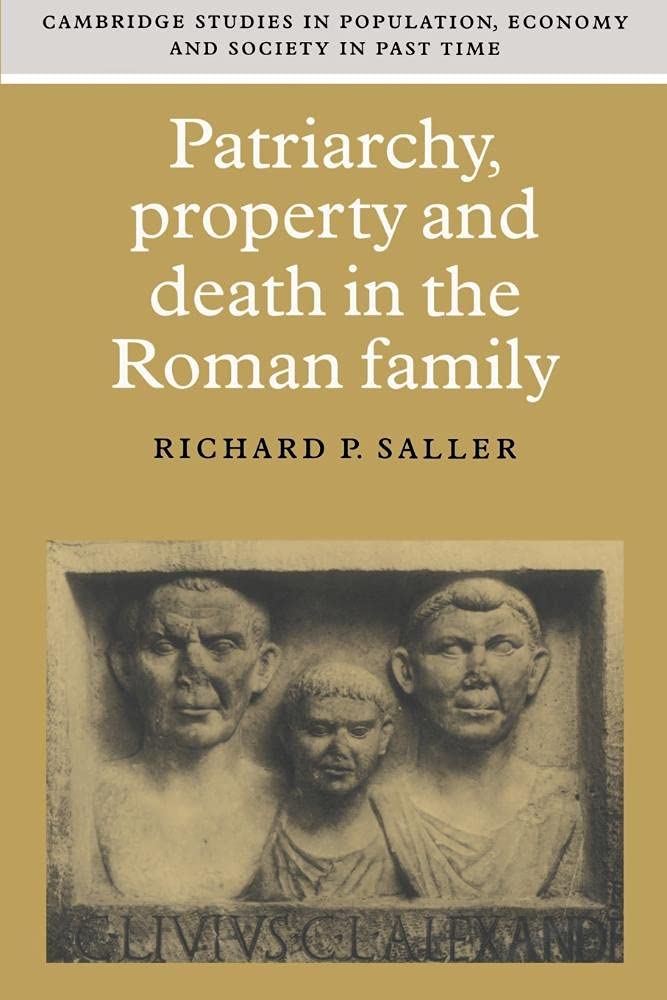
Patriarchy, Property and Death in the Roman Family (Cambridge Studies in Population, Economy and Society in Past Time, Series Number 25)
$45.93
by Richard P. Saller



The Roman father has traditionally provided the pattern of patriarchy in European thought. This book shows how the social realities and cultural representations diverged from this paradigm. Demographic analysis and computer simulation demonstrate that before adulthood most Romans lost their fathers by death. Close reading of Latin texts reveals Roman fathers as devoted and loving, and not harsh, exploitative masters of slaves. The demographic and cultural contexts deepen our understanding of how the patrimony was transmitted. "...a remarkable book, impressive in its command of diverse materials and methodologies and certain to inspire further advances." American Historical Review "The current prominence of the Roman family as a field of research is due in large part to a series of stimulating studies written over the last decade by Richard P. Saller, whose already considerable achievements now culminate in a book of great importance for historians of Roman society....[A] remarkable book, impressive in its command of diverse materials and methodologies and certain to inspire further advances." Keith Bradley, American Historical Review "This is clearly a book that historical demographers and European family historians, as well as scholars of classical history, will want to add to their libraries. However, it is also a book that offers students of the modern family much to think about." Caroline Brettell, Amercan Journal of Sociology This innovative study of the patriarchy belies the accepted notion of the father figure as tyrannical and exploitative. Used Book in Good Condition