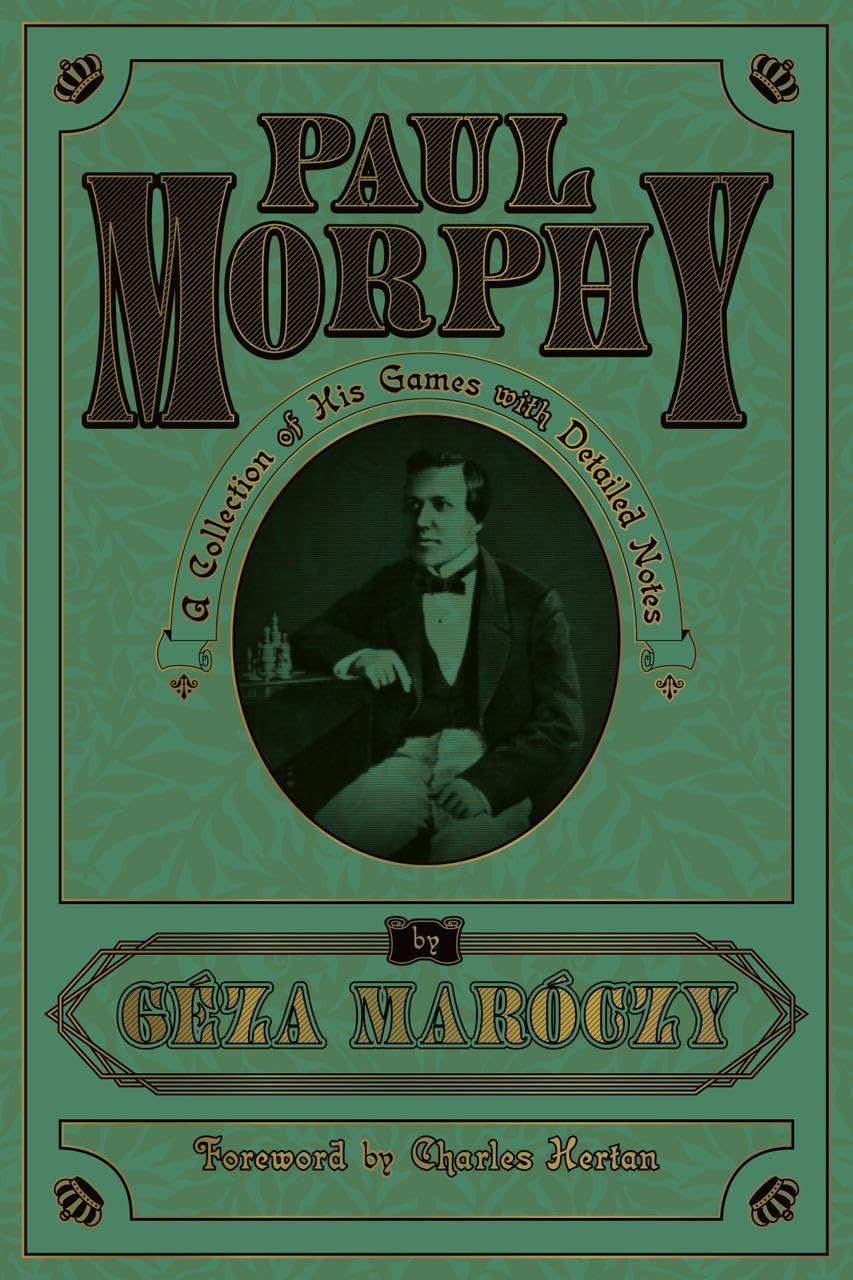



The Sheer Enjoyment of Paul Morphy In the middle of the nineteenth century, a soft-spoken young man from New Orleans would upend the conventional chess world. Perplexing positional pressure coupled with breath-taking combinations would leave him virtually in a class by himself. In 1909, Hungarian Grandmaster Géza Maróczy - himself a world-class player in the first decade of the 20th century - penned a wonderful compendium of all-known games of the American champion. The book, in German, was an instant success. And now (finally!) it is available in English. The book contains over 400 games by Morphy, most deeply annotated by Maróczy. He uses a light hand when explaining the logical and positional concepts of the games, while not overlooking the historical background and context in which they were played. In addition, a brief section on Morphy’s endgame skill has been added by GM Karsten Müller and a look from "a modern perspective" has been provided by GM Valeri Beim. Maróczy's subtle, often poetic insights regarding Morphy’s greatness provide an indispensable perspective… Why read Maróczy's magnum opus today? There are of course several good reasons, from a historical standpoint the book is a must-read… From a chess perspective, a complete collection of Morphy’s games makes a very deep impression… In short, there are a host of good reasons for chess lovers to celebrate Maróczy's classic Paul Morphy, not the least of which is the sheer enjoyment of watching the incomparable maestro at play. – From the Foreword by Charles Hertan, author of The Real Paul Morphy Hungarian Grandmaster Geza Maroczy (1870-1951) was among the elite of the chess world at the end of the 19th and beginning of the 20th century. In fact, in 1906, he and Emanuel Lasker had agreed to a title match, but the details could not be finalized. Capablanca noted that Maroczy was “one of the greatest masters of his time.” (204) Morphy – Anderssen Game One December 20, 1858 Evans Gambit 1.e4 e5 2.Nf3 Nc6 3.Bc4 Bc5 4.b4 Bxb4 5.c3 Ba5 6.d4 exd4 7.0-0 Nf6 [diagram] This response of the king’s knight to White’s castling, after the previous advance of the white d-pawn, was a line generally recognized in Morphy’s time. Today it is considered inadequate because of the attack (formerly regarded as unsatisfactory at this juncture) with 8.Ba3. In contrast, the so-called “compromised” variation 7…dxc3 (game 105) would appear to be the best play. 8.e5 Much stronger here is 8.Ba3!, as Morphy, too, tried in one of his later games (game 245). 8…d5 9.Bb5 There is nothing better; on 9.exf6 there follows 9…dxc4 10.fxg7 Rg8 11.Bg5 Qd5 12.Re1+ (12.Nd2 Bf5 13.Qa4 b5 14.Qa3 Bxc3) Be6 13.Nbd2 Rxg7 14.Ne4 Kf8 15.Bh6 dxc3 16.Qc1 Qh5 17.Nf6 Qg6 18.Ng5 Ke7, and White does not have a sufficient attack to outweigh the sacrificed pawns. 9…Ne4 [diagram] 10.cxd4 On 10.Nxd4, there might follow 10…Bd7 11.Bxc6 bxc6 12.Ba3 c5 13.Nb3 Ba4. Or 10.Ba3 Bd7 11.Qb3 (11.Bxc6 Bxc6 12.cxd4 Qd7 is better for Black) 11…Bxc3 12.Nxc3 Nxc3 13.Bxc6 bxc6 14.Nxd4. The best play here is 10.Qa4 0-0 11.Bxc6 Bxc3 12.Nxc3 Nxc3 13.Qc2 bxc6 14.Nxd4 c5, and White has very good chances to draw. 10…0-0 Safer is 10…Bd7. Black offers to return the pawn so that he can wrest the attack from his opponent. 11.Bxc6 bxc6 12.Qa4 With this maneuver White does win a pawn, but he soon finds himself in an unfavorable position, as the queen is diverted far from the game. 12…Bb6 13.Qxc6 Bg4 14.Bb2 White already has to contend with difficulties – the pawn on d4 is weak. On 14.Be3, 14…f6 could follow, with a strong game. 14…Bxf3 15.gxf3 Ng5 16.Nd2 [diagram] 16…Re8 Much more energetic is 16…Nh3+ 17.Kh1 (17.Kg2 Qh4 18.Rad1 Rae8, with …Re6 next) 17…Qh4 18.Qxd5 Nxf2+ 19.Kg2 Qg5+, winning a piece. 17.Kh1 Nh3 18.f4! Morphy defends himself as best he can. 18…Qh4 19.Qxd5 Nxf2+ 20.Kg1 On 20.Kg2, 20…Nd3 would be even more decisive. 20…Nd3 21.Bc3 Nxf4 22.Qf3 Nh3+ 23.Kh1 Ng5 24.Qg2 Rad8 24…h6 25.Nf3 Qe4 can be considered. [diagram] 25.Rg1 Here Morphy misses the possibility of a draw with 25.Nf3 Nxf3 26.Qxf3 Rd7 27.Rad1, or 26…Bxd4 27.Qxf7+ (better is 27.Bxd4 Qxd4 28.Qxf7+ Kh8 29.Rad1) 27…Kh8 28.Rf4 Qxf4 29.Qxf4 Bxc3 30.Rb1 Bxe5 31.Qc4 Bd4 32.Rd1 Bb6 33.Rxd8. Black stands rather better. 25…h6 26.Raf1 26.Nf3 is inadequate because of 26…Qh3 27.Nxg5 Qxg2+ 28.Kxg2 (28.Rxg2 hxg5 29.Rd1 Rxe5, or 29.Rd2 f6 30.exf6 gxf6 31.Rf1 Rf8 32.d5 Kg7 33.h4 Be3)