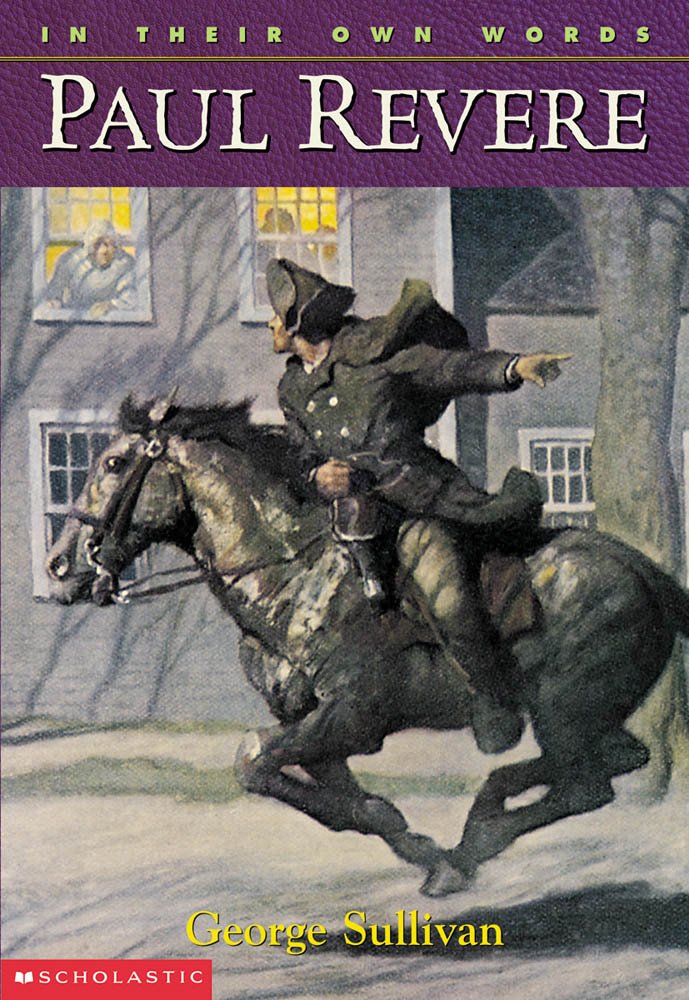



On April 16, 1776, Paul Revere made his famous Midnight Ride. In Their Own Words, Paul Revere brings this legendary ride to life like never before.Excerpts from Paul's own account of that night will excite young readers: I turned my horse very quick, and Galloped towards Charlestown neck, and then pushed for the Medford Road. The one who chased me, endeavoring to Cut me off, got into a Clay pond, near where the new Tavern is now built. I got clear of him . . . Children will also discover that Paul was active in many of the pivotal eventsthat led to the Revolution. A member of the Sons of Liberty, Paul was assigned to guard the tea ship that docked in Boston Harbor. When the ship would not turn back, Paul participated in the Boston Tea Party: Rally Mohawks! Bring out your axes, And tell King George we'll pay no taxes On his foreign tea . . . Our Warren's there, and bold Revere With hands to do and words to cheer For Liberty and lawsChildren will see Paul's sketch of the Boston Massacre that was used in the trial of the British soldiers involved in the event.. They will also find out about other famous Americans that Paul knew. Through his numerous rides as messenger, Paul became acquainted with many of the members of the Continental Congress, particularly John Hancock and Sam Adams.In Their Own Words: Paul Revere also tells the story of a successfulbusinessman. Paul was an accomplished silversmith. He cast the first bellmade in America, and opened a gun powder factory in Massachusetts during the Revolution. He was asked to design and print money for the ContinentalCongress, and he opened the first copper rolling mill in the country.In Their Own Words: Paul Revere concludes by describing the ways inwhich this remarkable figure is remembered today and tells children howthey can find out more about Paul Revere. Grade 4-6-These titles have "reluctant reader" written all over them. They are decently packaged with well-chosen and credited photographs, but the large-print, generously spaced text is written in short, choppy sentences, losing the narrative flow and the drama of history well told. In Lewis and Clark, the expedition is said to be traveling "mostly north" toward the Gates of the Mountains, after their portage of the Great Falls on the Missouri River, an egregious geographical error. Even more bizarre is the use of the term "Chopponish" for the much more commonly known Nez Perce. Expedition journals used the uncommon appellation, but there is no footnote explaining the connection. Unfortunately, in telling about the expedition's various encounters with Native Americans, Sullivan emphasizes the potentially threatening, unfriendly, and fearsome aspects. Paul Revere also contains factual errors but suffers even more from oversimplification. There is no discussion of the American colonial system as context for the independence movement and revolution; events such as the First Continental Congress are mentioned with no explanation. For a title on Lewis and Clark that is truly "in their own words" see Peter and Connie Roop's Off the Map: The Journals of Lewis and Clark (Walker, 1993), and for an excellent, accessible history, Rhoda Blumberg's The Incredible Journey of Lewis and Clark (Morrow, 1995) is hard to beat. Jean Fritz's And Then What Happened, Paul Revere? (Coward-McCann, 1973) remains a favorite account of the silversmith's daring role in revolutionary America. Given the sloppy effort, these titles are marginal. Nancy Collins-Warner, Neill Public Library, Pullman, WA Copyright 2001 Reed Business Information, Inc. Acclaim for Helen Keller and Abraham Lincoln: In Their Own Words biographies focus on famous people who left a record of their own lives. Beginning with an explanation of the difference between primary and secondary sources, Sullivan seamlessly interweaves information about his subject with excerpts from primary sources. In the case of Helen Keller, Sullivan uses her autobiographical works; for Lincoln, he draws on speeches and letters. Both Keller and Lincoln have been covered in numerous biographies for young people (Sullivan's own Picturing Lincoln was published last fall), but these volumes are worthwhile. The short chapters, large print, simple vocabulary, straightforward narrative, and attractive illustrations, as well as the addition of the subjects' own words, make them fine choices for early-grade biographies. They fit nicely between David Adler's Picture Book Biography series books and more challenging volumes such as Russell Freedman's classic Lincoln: A Photobiography (1987). --Booklist ... These may not be unique biographies, but they are still well written, fast moving, and highly readable, squeezed into a small format that should appeal to many students. Both books feature black-and-white photos and reproductions, a useful index, a short bibliography of primary and secondary sources, and a short list of further readings, along with places to contact for further infor