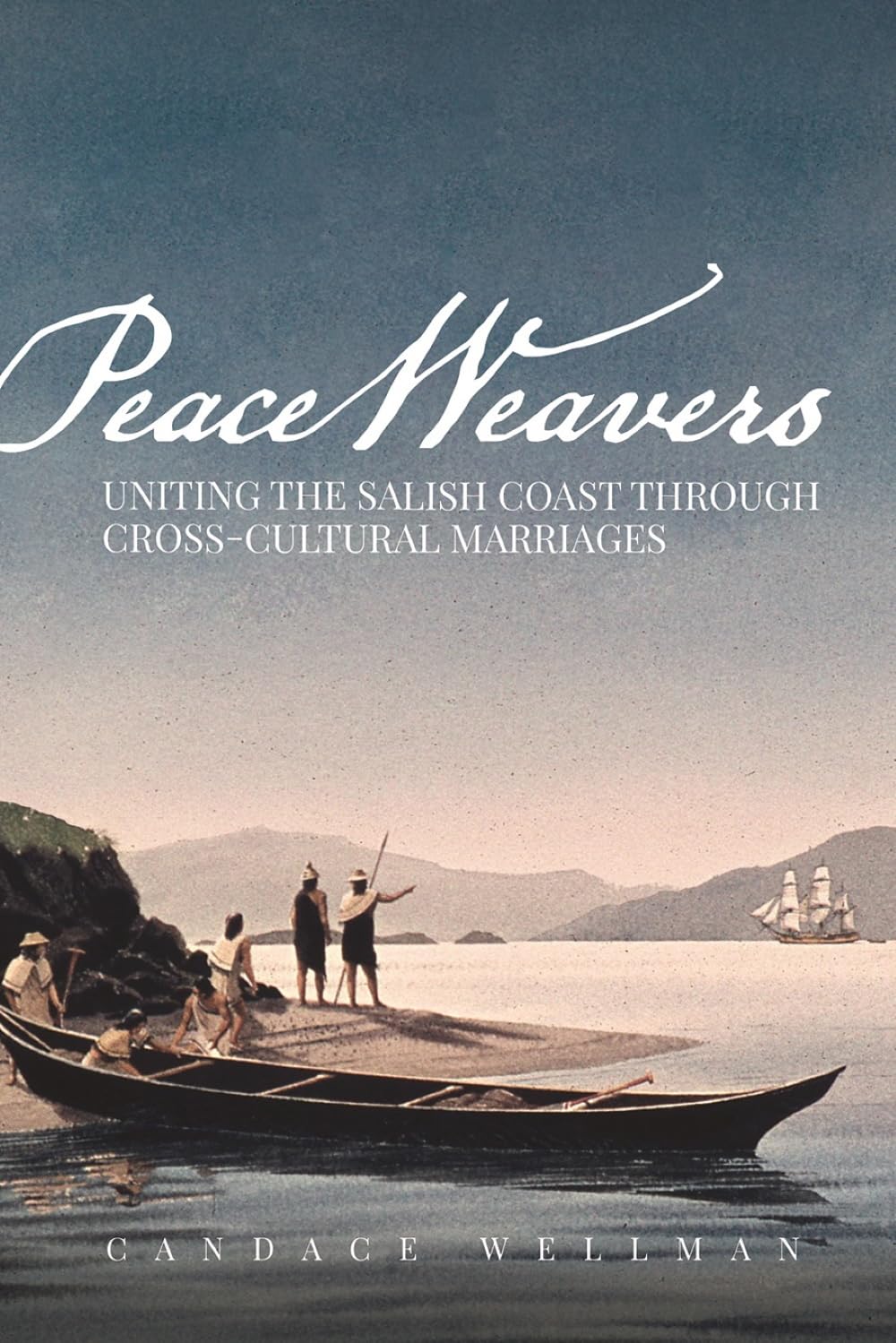
Peace Weavers: Uniting the Salish Coast Through Cross-Cultural Marriages
$27.95
by Candace Wellman



Throughout the mid-1800s, Coast and Interior Salish families arranged strategic cross-cultural marriages, and these alliances played a crucial role in regional settlement and spared Puget Sound's upper corner from the tragic conflicts other regions experienced. Although accounts of the men exist in a variety of records, the contributions of their native wives remain unacknowledged. Author Candace Wellman hopes to shatter stereotypes surrounding these relationships. The four women profiled--Caroline Davis Kavanaugh (Samish-Swinomish), Mary Fitzhugh Lear Phillips (S'Klallam), Clara Tennant Selhameten (Lummi-Duwamish), and Nellie Carr Lane (Sto:lo)--exhibited exceptional endurance, strength, and adaptability. Remembered as loving mothers and good neighbors, they ran successful farms, nursed and supported family members, served as midwives, and operated profitable businesses. They visited relatives and attended ancestral gatherings, often with their children. Each woman's story is uniquely her own, but together they and other intermarried women left lasting legacies. They were peace weavers. "Historians of Native America, as well as those interested in the history of early intermarriage between white Americans and Native Americans, will find this book especially interesting. By focusing on the lives of four Coast Salish women, Wellman provides intimate knowledge of their lives. Every marriage is uniquely described, with detailed stories from archival research and family history filling in information on their lives." Deanne Grant (Pawnee), Native American and Indigenous Studies Association Journal , 2018. "By focusing on four women, Wellman was able to ... investigate many heady topics that seem to be evergreen: the purpose of marriage, and what it means to marry outside of your race and culture." "These women had complex, rich lives, and their own stories to tell." Martin McClellan, Seattle Review of Books (see online interview) 6/25/2017. "Wellman addresses what she views as an intentional and unacceptable oversight...She chose to detail the lives of four extraordinary women... Recommended for readers interested in the history of western Washington." Library Journal, 4/6/2017. "A unique, informative, exceptionally well researched, impressively written, organized and presented study, "Peace Weavers: Uniting the Salish Coast Through Cross-Cultural Marriage" is an original and seminal work of outstanding scholarship. Featuring maps, illustrations, two appendices, thirty-six pages of Notes, a twelve page Bibliography, and a five page Index, "Peace Weavers" is unreservedly and enthusiastically recommended ..." Helen Dumont, Midwest Book Review, August 2017 "Candace Wellman's intricate history of the lives of four Coast Salish women represents an important addition to the scholarship on communities built around intermarriage between early settler men and indigenous women.... erased from town histories and replaced with narratives of the first White woman as community mother. " "[Wellman] demonstrates that to erase or simplify the contributions of Native women and their intermarried families is to leave major gaps in Western history." Western Historical Quarterly, Summer 2018. Winner of the 2018 national WILLA Award for scholarly nonfiction by the organization Women Writing the West, Peace Weavers began as a two-year local history project. It became an 18-year project to tell the life stories of indigenous women stereotyped as "unknowable" and "unimportant" to the development of new communities in the West. Starting from 22, I winnowed the biographies down to four over the years, as I strove to give a true picture of both parties. The husbands included a nephew of Jefferson Davis, an Irish sheriff, a Territorial Supreme Court justice, county officials, legislators, and the son of one of America's most famous early Methodist missionaries. I included the legacies of each woman that we see today, from community churches to doctors, sports stars, fishermen, a traditional tribal chief, and many more. Each of the four women played a part in the meshing of a new community and accomplished surprising things. This was not an isolated occurrence but happened in many western communities before early historians excised them from written history. Written in narrative form for general readers, yet thoroughly endnoted for those who wish to dig deeper, I hope that readers will enjoy discovering this new perspective on how communities began, starting when the "West" was anything past the Eastern Seaboard. And that they will feel the stereotypes melt away. See back cover content Strategic cross-cultural marriages between Coast and Interior Salish families and pioneer men played a crucial role in mid-1800s regional settlement and spared Puget Sound's upper corner from tragic conflicts. Accounts of the husbands exist in a variety of records, but the native wives' contributions remained unacknowledged. Combin