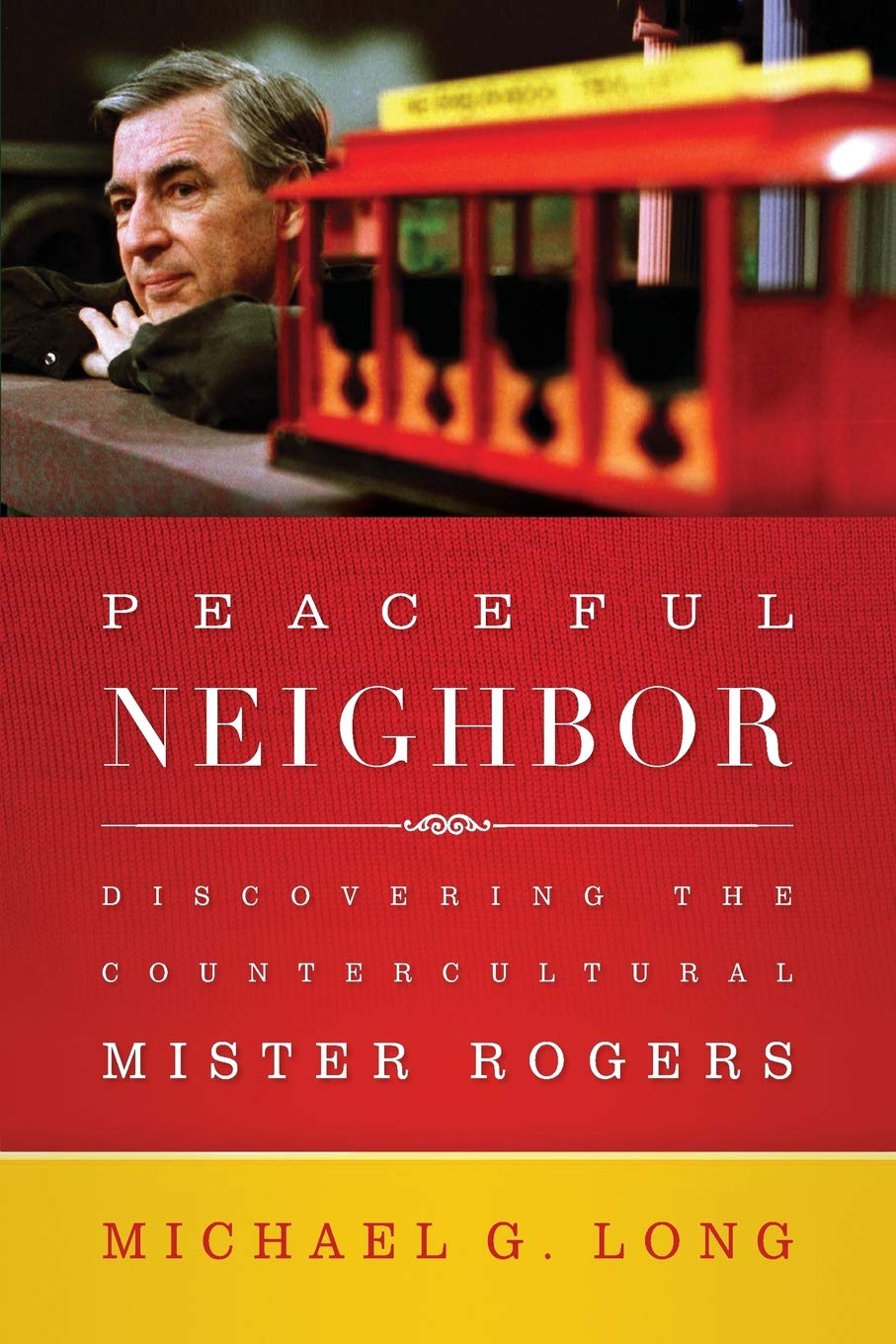



Fred Rogers was one of the most radical pacifists of contemporary history. We do not usually think of him as radical, partly because he wore colorful, soft sweaters made by his mother. Nor do we usually imagine him as a pacifist; that adjective seems way too political to describe the host of a children's program known for its focus on feelings. We have restricted Fred Rogers to the realm of entertainment, children, and feelings, and we've ripped him out of his political and religious context. Rogers was an ordained Presbyterian minister, and although he rarely shared his religious convictions on his program, he fervently believed in a God who accepts us as we are and who desires a world marked by peace and wholeness. With this progressive spirituality as his inspiration, Rogers used his children's program as a platform for sharing countercultural beliefs about caring nonviolently for one another, animals, and the earth. To critics who dared call him “namby-pamby,â€� Rogers said, “Only people who take the time to see our work can begin to understand the depth of it.â€� This is the invitation of Peaceful Neighbor, to see and understand Rogers's convictions and their expression through his program. Mister Rogers' Neighborhood, it turns out, is far from sappy, sentimental, and shallow; it's a sharp political response to a civil and political society poised to kill. "Long shows how, in addition to helping children cope with personal concerns about sibling rivalry, sharing, and fears, Fred Rogers led them gently through moral/ethical explorations of the some of the most complex societal concerns of the late 20th century, like the harms of war and the necessity of peace, as well as hunger, greed, and the environmental costs of consumption." --Susan Linn, Ed.D., Director of Campaign for a Commercial-Free Childhood and author of The Case for Make Believe: Saving Play in a Commercialized World "The urban legend says that Mr. Rogers was a hero because he was a ninja-like Army Ranger. Michael Long, more rightly, demonstrates that Fred Rogers is a hero because he was a seemingly ordinary man with convictions of peace who sought to use his television program to help children experience the love of God. Parents and church leaders will be inspired by Rogers' wisdom to carry his true legacy to the next generation." --Steve Johnson, Family Ministry Consultant with the National Center on Biblical Parenting "We know Mr. Rogers was a gentle soul, but we did not know, until Michael Long's Peaceful Neighbor , that Rogers' nonviolence was shaped by his profound theological convictions. In this insightful book, Long makes clear that peace is a challenge to the imagination, and helps us imagine peace through his eloquent portrayal of Fred Rogers." --Stanley Hauerwas, Gilbert T. Rowe Professor Emeritus of Divinity and Law, Duke Divinity School Michael G. Long is Associate Professor of Religious Studies and Peace and Conflict Studies at Elizabethtown College. He is also the author or editor of several books on civil rights, religion and politics, and peacemaking in mid-century America, including Beyond Home Plate: Jackie Robinson on Life after Baseball; First Class Citizenship: The Civil Rights Letters of Jackie Robinson ; Gay Is Good: The Life and Letters of Gay Rights Pioneer Franklin Kameny; I Must Resist: Bayard Rustin's Life in Letters; Marshalling Justice: The Early Civil Rights Letters of Thurgood Marshall; and Martin Luther King, Jr. on Creative Living. Peaceful Neighbor Discovering the Countercultural Mister Rogers By Michael G. Long Westminster John Knox Press Copyright © 2015 Michael G. Long All rights reserved. ISBN: 978-0-664-26047-7 Contents Acknowledgments, ix, Introduction: Just the Way He Was: Meeting the Real Mister Rogers, xi, Part One: War and Peace in the Neighborhood, 1. "Isn't Peace Wonderful?": Against the Vietnam War, for Gandhi, 3, 2. "War Isn't Nice": Against the Arms Race, for Peaceful Imagination, 9, 3. "I Like You": Against the Cold War, for Puppet Détente, 21, 4. "Just the Way You Are": A Theology of Peace, 27, 5. "It's Okay to Be Angry": A Psychology of Peace, 45, 6. "A Gross Form of Abuse": From the Persian Gulf War to the War on Terror, 63, Part Two: Peace as More Than the Absence of War, 7. "A Black Brother": Race and Diversity, 81, 8. "Food for the World": Tears for Hungry Children, 99, 9. "I'm Tired of Being a Lady": Tough Girls, Sensitive Boys, 119, 10. "He Understood": Homosexuality and Gay Friends, 143, 11. "I Love Tofu Burgers and Beets": Animals and Mothers, 157, 12. "Take Care of This Wonderful World": Peace on Earth, 169, Conclusion: The Compassion of Fred Rogers, 177, Notes, 183, Index, 197, CHAPTER 1 "Isn't Peace Wonderful?" Against the Vietnam War, for Gandhi Just three weeks before the national launch of Mister Rogers' Neighborhood in February 1968, Ho Chi Minh and his advisers in North Vietnam marked Tet, the Vietnamese l