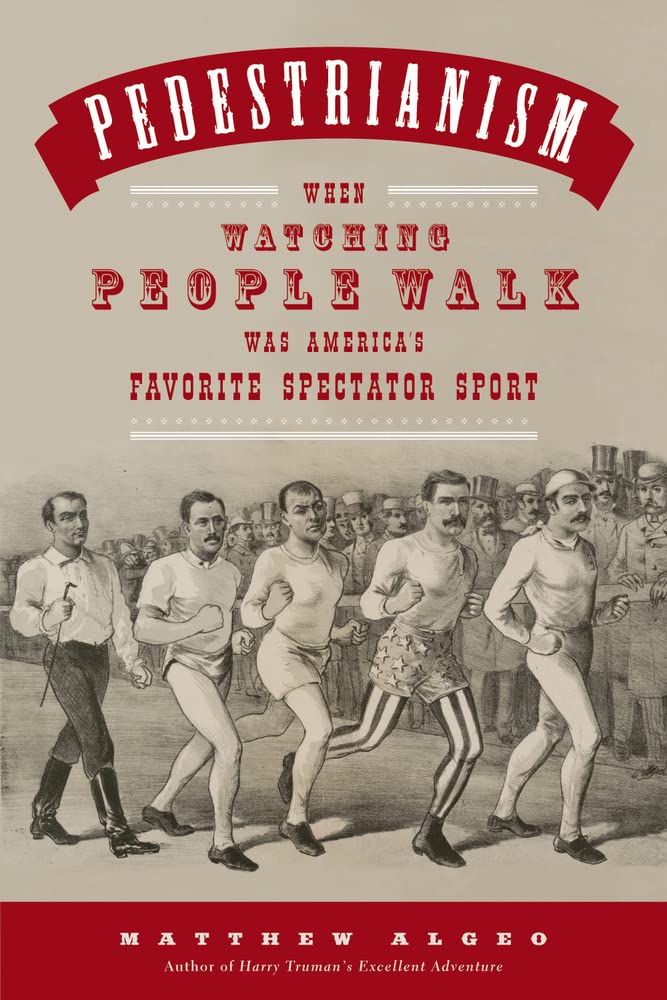
Pedestrianism: When Watching People Walk Was America's Favorite Spectator Sport
$15.22
by Matthew Algeo



Strange as it sounds, during the 1870s and 1880s, America’s most popular spectator sport wasn’t baseball, boxing, or horseracing—it was competitive walking. Inside sold-out arenas, competitors walked around dirt tracks almost nonstop for six straight days (never on Sunday), risking their health and sanity to see who could walk the farthest—500 miles, then 520 miles, and 565 miles! These walking matches were as talked about as the weather, the details reported from coast to coast. This long-forgotten sport, known as pedestrianism, spawned America’s first celebrity athletes and opened doors for immigrants, African Americans, and women. The top pedestrians earned a fortune in prize money and endorsement deals. But along with the excitement came the inevitable scandals, charges of doping—coca leaves!—and insider gambling. It even spawned a riot in 1879 when too many fans showed up at New York’s Gilmore’s Garden, later renamed Madison Square Garden, and were denied entry to a widely publicized showdown. Pedestrianism: When Watching People Walk Was America’s Favorite Spectator Sport chronicles competitive walking’s peculiar appeal and popularity, its rapid demise, and its enduring influence, and how pedestrianism marked the beginning of modern spectator sports in the United States. “Matthew Algeo’s ‘Pedestrianism: When Watching People Walk Was America’s Favorite Spectator Sport’ (Chicago Review) is one of those books which open up a forgotten world so fully that at first the reader wonders, just a little, if his leg is being pulled.” — The New Yorker “Algeo brings to life an inspiring and fascinating account of human endurance from athletes centuries ahead of their time.” —Rory Coleman, International Performance Coach, ULTRA-marathoner and Guinness World Record holder "An entertaining biography, step by step, of a diversion in the earliest days of today’s sports industry." — Kirkus Reviews “This book offers a fascinating take on what was once ‘America’s favorite spectator sport’...The overall writing style is captivating and treats its obscure subject matter with zest. Readers interested in lesser-known aspects of American history and tradition will be fascinated with the stories of the major players of this oft-forgotten pastime.” — Library Journal “Algeo’s mastery of the time period and his approachable writing style turn an obscure pocket of sports history into an interesting weekend read.” —Chicago Book Review Matthew Algeo is the author of Harry Truman's Excellent Adventure , The President Is a Sick Man , and Last Team Standing . An award-winning journalist, Algeo has reported from three continents for public radio’s All Things Considered , Marketplace , and Morning Edition . Pedestrianism When Watching People Walk Was America's Favorite Spectator Sport By Matthew Algeo Chicago Review Press Incorporated Copyright © 2014 Matthew Algeo All rights reserved. ISBN: 978-1-61374-397-3 Contents Preface, 1 Whiskey in His Boots or He's the Man, 2 Walking Fever or Perhaps a Foreigner Could Do It, 3 The Expo or Not an Absorbingly Entrancing Sport, 4 Coca or Nature Should Not Be Outraged, 5 Rematch or Not Silly Little Female Cigarettes Either, 6 The Astley Belt or More Talked About Than Constantinople, 7 Pedestriennes or Pioneers, 8 Terrible Blows or a Crackling was Heard, 9 Comeback or a Game Old Ped, 10 Black Dan or a Dark Horse, 11 Anti-Pedestrianism or Bodily Exercise Profiteth Little, 12 The National Pastime or King of Harts, 13 Hippodroming or the Suspicion Was Very General, 14 Bicycles and Baseball or Too Free Use of Stimulants, Epilogue: The Last Pedestrians or Now About Everybody Rides, Acknowledgments, Chronology, Sources, Bibliography, Index, CHAPTER 1 WHISKEY IN HIS BOOTS or HE'S THE MAN It all began with a wager. One day in the autumn of 1860, two friends were enjoying a meal together when the conversation turned to the upcoming presidential election. One of the friends, a door-to-door bookseller named Edward Payson Weston, believed Abraham Lincoln would lose the election. The other, George Eddy, was convinced Lincoln would win. So they made a bet. The stakes were unusual: whoever lost the bet would have to walk from the State House in Boston to the Capitol in Washington, a distance of some 478 miles, in ten consecutive days, arriving in time to witness the inaugural ceremony on the following March 4. It was a lark, really — just banter between friends. "I do not suppose that either of us at that time had the remotest idea of ever attempting such a task," Weston later recalled. Eddy, for his part, later confessed that, if Lincoln had lost, he would "most decidedly have preferred to get excused." But after Lincoln's victory, Weston decided to see if he was up to the task. As a test, he walked from Hartford to New Haven, Connecticut, on New Year's Day 1861, stopping at houses to distribute book catalogs along the way. He covered the di