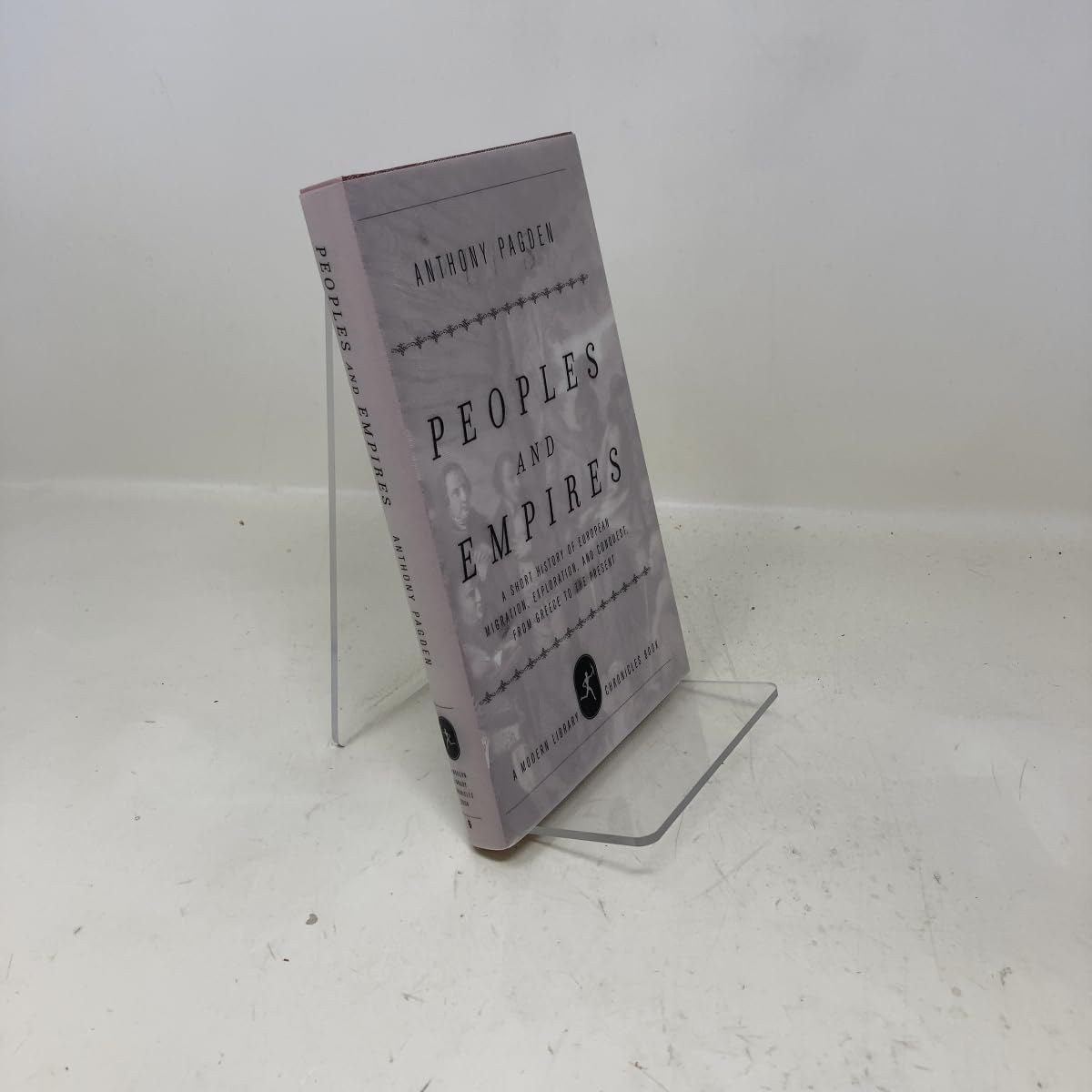
Peoples and Empires: A Short History of European Migration, Exploration, and Conquest, from Greece to the Present (Modern Library Chronicles)
$21.98
by Anthony Pagden



Peoples and Empires is the story of the great European empires – the Roman, the Spanish, the French, the British – and their colonies, and the back-and-forth between “us” and “them,” culture and nature, civilization and barbarism, the center and the periphery. It relates the history of how conquerors justified conquest, and how colonists and colonized changed each other. It’s about how we came to think about world divisions the way we do. Written by the man who has been called the world’s foremost historian of human migration, Peoples and Empires will become a seminal work. Pagden's (Lords of All the World: Ideologies of Empire in Spain, Britain and France 1500-1800; European Encounters with the New World) elegant series of essays, connected by his theories on European efforts at empire, does not so much define empire as discuss the evolution of the phenomenon. Pagden looks at our needs for travel and for cities, needs that he sees as necessary requisites of an empire. Alexander the Great created Europe's first empire, which was held together largely by his personality. In trying to imitate Alexander, the Romans created the model for all time. Politically, all European countries with ambitions of empire have imitated Rome, and the Catholic Church reinforced this model in the spiritual realm. Pagden's chapters on the Spanish Empire are exemplary, yet the chapter on slavery and the admission that this institution irreparably stains Europe's empires allows him to discuss the demise of empire, the rise of nationalism, and the directions in which these developments could take civilization. Recommended as a good overview for general readers. Clay Williams, Hunter Coll., New York Copyright 2001 Reed Business Information, Inc. The most recent installment in the Modern Library Chronicles is another digestible account of a complex historical subject. This objective overview of European empire building and colonization commences with the diffusion of Greek civilization and traces the subsequent evolution of the ensuing Roman, Spanish, French, and British empires. More interesting than how those empires physically expanded is the insightful discussion on what motivated individual men and entire nations to migrate and conquer. Although responsible for horrific human suffering and the inevitable curtailment of certain freedoms, European empires often became bastions of cultural diversity and afforded both the colonists and the colonized unique educational, economic, and social opportunities that might otherwise never have been enjoyed. This engrossing chronicle of the history of European imperialism mirrors, to a certain extent, the history of modern Western civilization. Margaret Flanagan Copyright © American Library Association. All rights reserved "In Peoples and Empires Anthony Pagden accomplishes the impossible: two thousand years of empire compressed into two hundred pages, without sacrifice of detail or lucidity. The breadth of vision is phenomenal." -- Roy Porter Peoples and Empires is the story of the great European empires ? the Roman, the Spanish, the French, the British ? and their colonies, and the back-and-forth between ?us? and ?them,? culture and nature, civilization and barbarism, the center and the periphery. It relates the history of how conquerors justified conquest, and how colonists and colonized changed each other. It?s about how we came to think about world divisions the way we do. Written by the man who has been called the world?s foremost historian of human migration, Peoples and Empires will become a seminal work. Anthony Pagden was educated in Santiago de Chile, London, Barcelona, and Oxford. He has been a publisher in Paris and a translator in Rome. In the past eighteen years, he has been the reader in intellectual history at Cambridge, a fellow of Kings College, and a visiting professor at Harvard, and he is currently Harry C. Black Professor of History at Johns Hopkins University. He is a regular contributor to The Times Literary Supplement , The New Republic , and The New York Times . 1. The First World Conqueror The story of the empires of the peoples of Europe begins in ancient Greece. For the Greeks, who devised the vocabularies with which we still think about how to live our lives, were also, as they described themselves, "extreme travelers." The Cyclopes, one of whom devours Odysseus's crew, are the embodiment of barbarism, because, among their other defects, they know nothing of navigation and have never left their island home. Travel, as we know, broadens the mind. The first person to have made the connection between voyaging (plane) and wisdom (sophia) was supposedly Solon, who also gave the Athenians their laws, and thus created the first true political society in European history. Subsequent Greek history is filled with wanderers in search of knowledge. Sometime in the fifth century B.C., Herodotus, the "father of history," traveled well beyond the limits of his wor