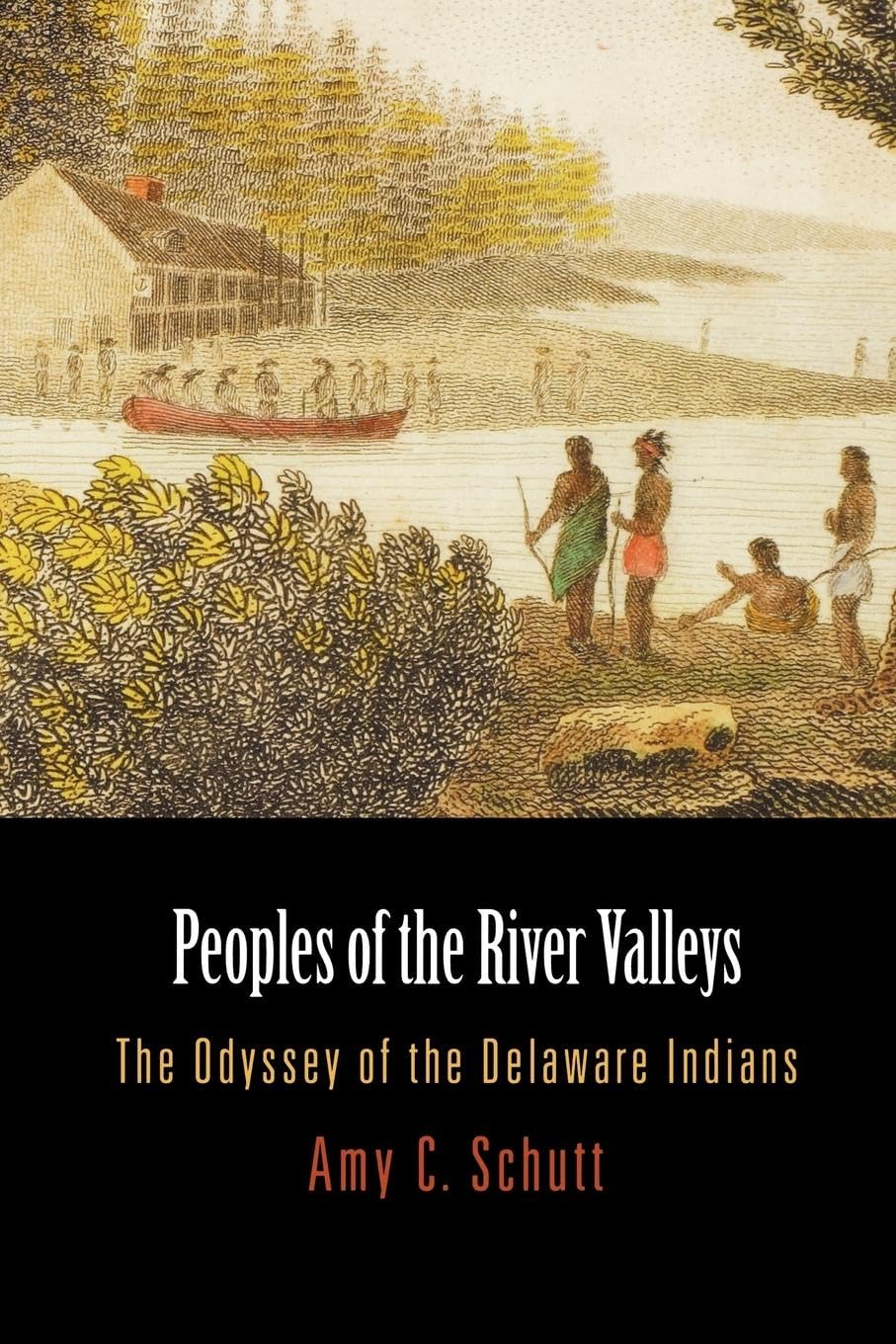
Peoples of the River Valleys: The Odyssey of the Delaware Indians (Early American Studies)
$22.90
by Amy C. Schutt



Seventeenth-century Indians from the Delaware and lower Hudson valleys organized their lives around small-scale groupings of kin and communities. Living through epidemics, warfare, economic change, and physical dispossession, survivors from these peoples came together in new locations, especially the eighteenth-century Susquehanna and Ohio River valleys. In the process, they did not abandon kin and community orientations, but they increasingly defined a role for themselves as Delaware Indians in early American society. Peoples of the River Valleys offers a fresh interpretation of the history of the Delaware, or Lenape, Indians in the context of events in the mid-Atlantic region and the Ohio Valley. It focuses on a broad and significant period: 1609-1783, including the years of Dutch, Swedish, and English colonization and the American Revolution. An epilogue takes the Delawares' story into the mid-nineteenth century. Amy C. Schutt examines important themes in Native American history—mediation and alliance formation—and shows their crucial role in the development of the Delawares as a people. She goes beyond familiar questions about Indian-European relations and examines how Indian-Indian associations were a major factor in the history of the Delawares. Drawing extensively upon primary sources, including treaty minutes, deeds, and Moravian mission records, Schutt reveals that Delawares approached alliances as a tool for survival at a time when Euro-Americans were encroaching on Native lands. As relations with colonists were frequently troubled, Delawares often turned instead to form alliances with other Delawares and non-Delaware Indians with whom they shared territories and resources. In vivid detail, Peoples of the River Valleys shows the link between the Delawares' approaches to land and the relationships they constructed on the land. Amy C. Schutt teaches history at the State University of New York College at Cortland. Prologue "Sachems from nine different places" One day in early January 1633 a Dutch crew of seven men on a whaling vessel called the Squirrel traveled up the Delaware River. Along the way the crew traded with the Indian inhabitants of the area. The Squirrel anchored at the mouth of Newton Creek in the area of present-day Gloucester City, New Jersey, where it was boarded by more than forty Indians, with "a portion of them" commencing "to play tunes with reeds." A sachem attempted to give "an armful of beaver-skins" to the Dutch, an offer that would have signaled the construction of a relationship between allies and trading partners. Suspecting the Indians of recently attacking an English crew, the Dutch refused the gift, which their visitors may have interpreted as a call to war. Indeed, the Dutch accompanied their refusal with a warlike pronouncement, commanding the Indians "to go ashore immediately" or else the sailors "would shoot them all." The Indians, who came from nearby Mantua Creek, possibly did not take this threat seriously since they significantly outnumbered the Dutch. They also may have known that the Dutch were in a weak position without Native assistance. The Squirrel 's crew had used up all their "stock-fish," and their supply of porridge was dwindling. Their survival depended on obtaining food from Indians. Probably used to trading with ships coming down from Manhattan, the Indians did not give up on building a friendly relationship with the Dutch, who might provide access to a variety of European goods. After the Mantua Creek sachem was rebuffed, a leader named Zee Pentor from "the Armewanninge, another but neighboring nation," tried to reopen channels with the Squirrel 's sailors. Through his intervention, a second meeting was set near the Dutch Fort Nassau in the country of the Armewanninge (or Arrowamex) just below Newton Creek. The following day Indians poured into Fort Nassau, with "more and more constantly coming." After the crowd had gathered, "nine chiefs, sachems from nine different places" set out from the fort in a dugout canoe, "a boat hollowed out of a tree," to meet the Dutch aboard the Squirrel . The crew remained suspicious, but the sachems calmed their fears. David de Vries, a Dutch witness of the event, wrote, "The nine seated themselves in a circle and called us to them, saying they saw that we were afraid of them, but that they came to make a lasting peace with us." This time the Indians successfully presented their gift of peltry. Through a designated speaker, "they made us a present of ten beaver-skins," De Vries reported. They seemed to follow a prescribed ritual, with the speaker carrying out "a ceremony with each skin, saying in whose name he presented it." The goal, the speaker explained, "was for a perpetual peace," to ensure that the Dutch would "banish all evil thoughts" and would know that the Indians "had now thrown away all evil." These few days in the winter of 1633 offer a glimpse at alliance building between Indians and