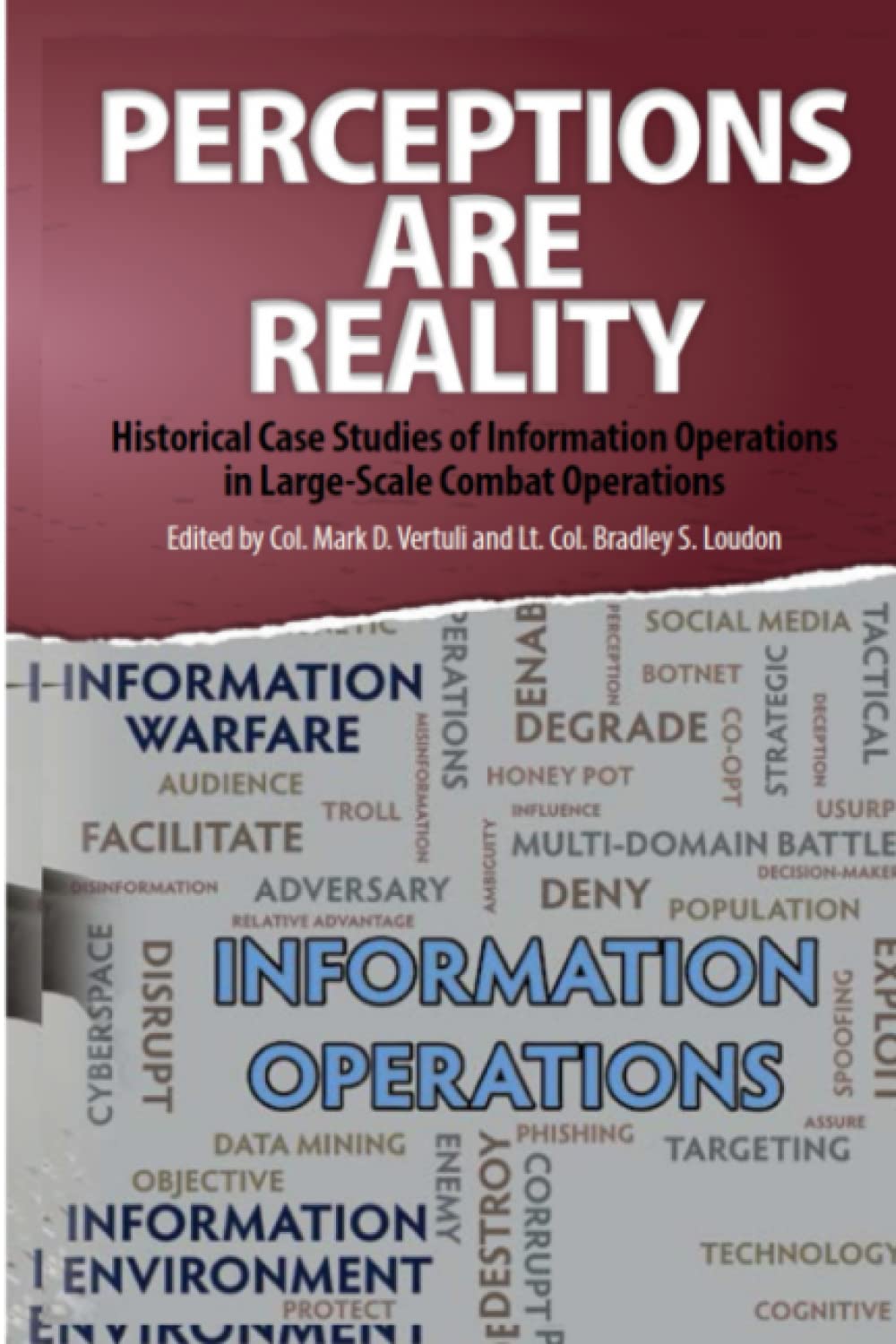
Perceptions Are Reality: Historical Case Studies of Information Operations in Large-Scale Combat Operations
$17.24
by Mark D. Vertuli



Perceptions Are Reality This book is also available as an Audiobook. Historical Case Studies of Information Operations in Large-Scale Combat Operations Arguably information operations (IO) is one of the most misunderstood and misused terms in Army doctrine—to the point it has largely become a ubiquitous term of reference that lacks the necessary clarity of purpose and application for the majority of the Army. I am sure that if several Army leaders and Soldiers were asked to define information operations in their own words, one would receive several differing—and often conflicting— interpretations. Multiple changes to Army doctrine concerning information operations after it emerged as a concept from Command and Control Warfare (C2W) more than 25 years ago have contributed to this confusion. The definition of IO has changed three times in the last 11 years alone: from a focus on five core capabilities to information engagement (2007), to inform and influence activities (2011), to its current incarnation focusing on information-related capabilities (2016). As the Army shifts its doctrinal focus to large-scale combat operations (LSCO) against peer and near-peer adversaries, the purpose of this volume is to help leaders and Soldiers visualize and understand information operations through the lens of historical case studies. In both Joint and Army doctrine, information operations is defined as “the integrated employment, during military operations, of information-related capabilities in concert with other lines of operation to influence, disrupt, corrupt, or usurp the decision-making of adversaries and potential adversaries while protecting our own.”2 In more general terms, information operations support the commander’s ability to achieve a position of relative advantage through activities in the information environment (the physical, informational, and cognitive dimensions) to influence the adversary’s will to fight; disrupt, corrupt, or usurp its capabilities to collect, process, and disseminate information; and ultimately manipulate (deceive) or disrupt an adversary decision-maker’s understanding of the operational environment. Field Manual (FM) 3-0, Operations does a very good job describing the broad scope of possible information-related capabilities and effects in the information environment. However, over the course of the last 17 years of counterinsurgency and counterterrorism operations, information operations has become synonymous in many minds with themes and messages, psychological operations (PSYOP)/military information support operations (MISO), or strategic communications/ communications strategy and its larger purpose has become lost. Three lessons—dare I say themes—are interwoven throughout the historical case studies of information operations during large-scale combat operations: (1) the focus is the information regardless of the capabilities employed to effect it; (2) successful information operations are operations—integrated, synchronized, resourced and commander-led from inception to execution; and (3) information operations are, at their core, adversary/enemy-focused operations conducted to gain a relative advantage for friendly decision-makers. “It Is All about the Information”