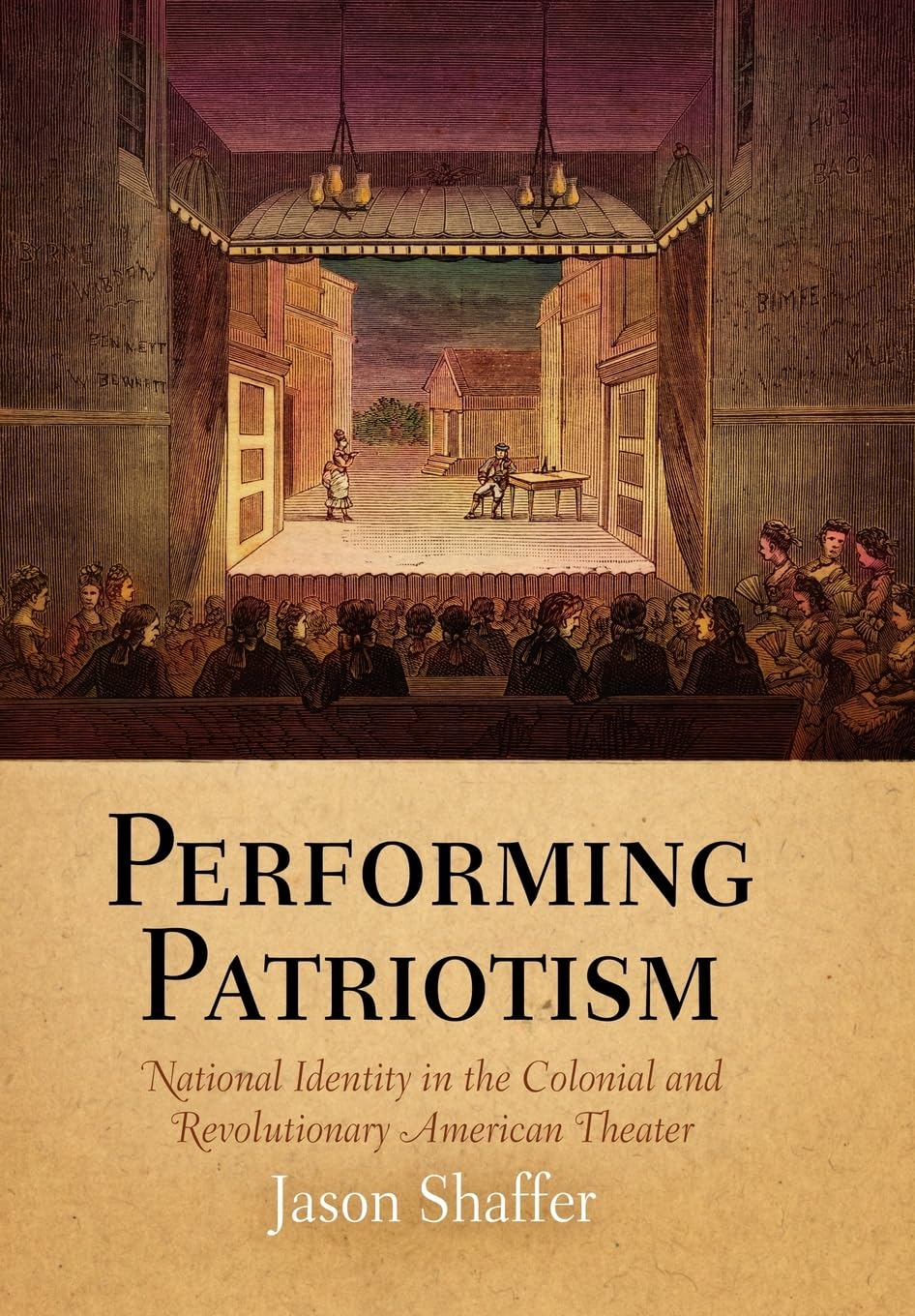
Performing Patriotism: National Identity in the Colonial and Revolutionary American Theater (Early American Studies)
$65.96
by Jason Shaffer



Selected by Choice magazine as an Outstanding Academic Title During the eighteenth century, North American colonists began to display an increasing appetite for professional and amateur theatrical performances and a familiarity with the British dramatic canon ranging from the tragedies of Shakespeare, Addison, and Rowe to the comedies of Farquhar, Steele, and Gay. This interest sparked demand for both the latest hits of the London stage and a body of plays centered on patriotic (and often partisan) British themes. As relations between the crown and the colonies soured, the texts of these plays evolved into a common frame of reference for political arguments over colonial policy. Making the transition to print, these arguments deployed dramatic texts and theatrical metaphors for political advantage. Eventually, with the production of American propaganda plays during the Revolution, colonists began to develop a patriotic drama of their own, albeit one that still stressed the "British" character of American patriotism. Performing Patriotism examines the role of theatrical performance and printed drama in the development of early American political culture. Building on the eighteenth-century commonplace that the theater could be a school for public virtue, Jason Shaffer illustrates the connections between the popularity of theatrical performances in eighteenth-century British North America and the British and American national identities that colonial and Revolutionary Americans espoused. The result is a wide-ranging survey of eighteenth-century American theater history and print culture. "Jason Shaffer has written a much-needed transatlantic account of the theater of the eighteenth-century British North American colonies and the early U.S. and its relationship to imperial and revolutionary politics." ― Sandra M. Gustafson, University of Notre Dame "An engrossing genealogy of patriotism in early American theater. . . . The author looks at the way theater shaped-and was shaped by-America's transformation from province to colony to sovereign nation." ― Choice Jason Shaffer is Associate Professor of English at the United States Naval Academy. Prologue Over the long July Fourth holiday weekend in 2000, The Patriot , one of the action movie star Mel Gibson's periodic forays into costume drama, premiered in multiplex theaters across the United States. Like Gibson's earlier movie Braveheart (1995), which was based on the legend of the medieval Scottish rebel William Wallace, The Patriot features Gibson as an insurrectionist, a frontier partisan waging a guerilla war from the margins against the corrupt English imperial center. In The Patriot , Gibson plays an American revolutionary, Benjamin Martin, also known among the British officer corps as "The Ghost." Martin is loosely based on two American patriot officers from the southern colonies: Brigadier General Francis Marion, "The Swamp Fox," a legendarily elusive guerilla commander from South Carolina whose band of partisans was noted for its use of guerilla tactics against the British, and Brigadier General Daniel Morgan, a Virginia officer known for his physical courage, his common touch with enlisted soldiers, and his use of tactical deception in engineering the American victory at the battle of the Cowpens in 1781. The film's depiction of the American Revolution articulates a series of dramatic and cultural conventions common in eighteenth-century America while also, perhaps quite unintentionally, reflecting a number of trends in scholarship of the Revolutionary era. Although The Patriot is indisputably a "popcorn" movie that takes significant liberties with early American history, its melodramatic revisions of that history yield some surprising connections to the ways that the participants in that history viewed themselves, as well as the ways that those who study them today view the Revolution and the culture that gave rise to it. The film is by no means a reliable document of Revolutionary history, but it captures many important elements of the mythology of the Revolution—both as that mythology was fashioned in the eighteenth century, and as it is refashioned now by scholars and purveyors of popular historical narratives. While both of Benjamin Martin's historical models were enthusiastic partisans, Gibson's character, a South Carolinian planter with a modest estate and a member of the provincial assembly, is at best a reluctant revolutionary. He is a widower, the audience quickly learns, an essentially private man wholly devoted to his five children and his land (which he tills himself, aided, implausibly, by free black laborers). Like both Marion and Morgan, however, Martin is a veteran of the Seven Years' War, having fought in the southern conflict of 1760-61 known as "The Cherokee War." As soldiers in this gruesome campaign, Martin and his men massacred a combined force of French and Cherokees in retaliation for their having slain a grou