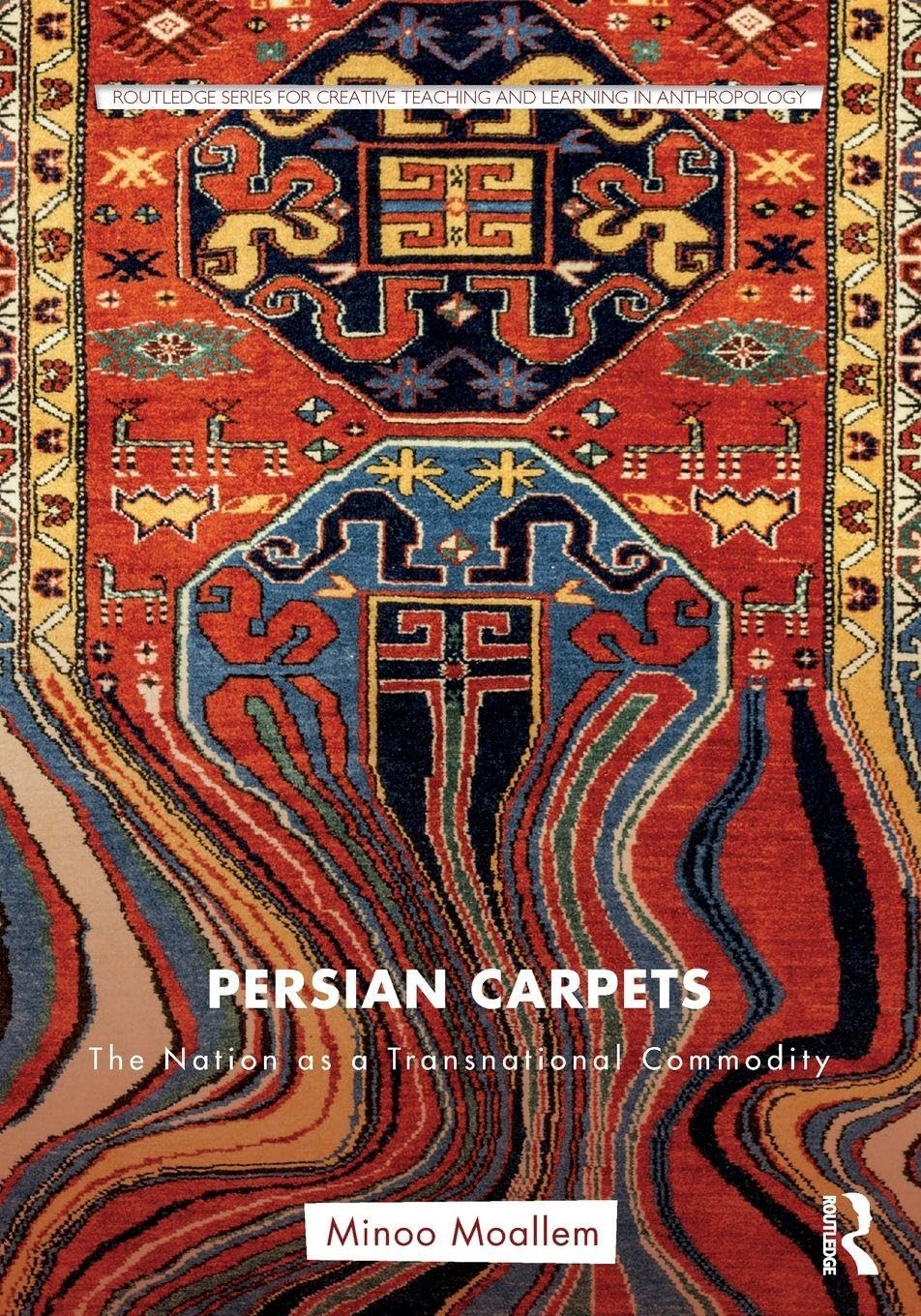
Persian Carpets: The Nation as a Transnational Commodity (Routledge Series for Creative Teaching and Learning in Anthropology)
$55.99
by Minoo Moallem



Persian Carpets: the Nation As a Transnational Commodity tracks the Persian carpet as an exotic and mythological object, as a commodity, and as an image from mid-nineteenth-century England to contemporary Iran and the Iranian diaspora. Following the journey of this single object, the book brings issues of labor into conversation with the politics of aesthetics. It focuses on the carpet as a commodity which crosses the boundaries of private and public, religious and secular, culture and economy, modern and traditional, home and diaspora, and art and commodity to tell the story of transnational interconnectivity. Bringing transnational feminist cultural studies, ethnography, and network studies within the same frame of reference, this book sheds light on Orientalia as civilizational objects that emerged as commodities in the encounter between the West and the many directly or indirectly colonized Middle Eastern and West Asian cultures, focusing on the specific example of Persian carpets as some of the most extensively valued and traded objects since colonial modernity. Minoo Moalem offers a fascinating discussion of the Persian carpet as a site of identity, aesthetic object, and modern commodity. In a genealogical account that traces the history of Persian carpets as imperial and civilizational objects in the mid-nineteenth century to national and diasporic commodities today, she insightfully explores the affective experiences and material conditions that undergird the history of their production and consumption. -- Ali Behdad, Professor and John Charles Hillis Chair, Literature, University of California, Los Angeles and author of Camera Orientalis: Reflections on Photography of the Middle East "I admire the rare convergence in Minoo Moallem's Persian Carpets ofquestions of political economy, materialist history, and the aestheticand sensuous lives of commodities. The book promises to be essentialreading for feminist scholars of connoisseurship and consumer capitalism in the making of empire." -- Parama Roy, Professor, English, University of California, Davis "In this eye-opening journey, Minoo Moallem offers an astute genealogical reading of the shifting production, consumption, and representation of the Persian carpet from the imperial era to the present. Her perceptive analysis reveals how an object of exotic Orientalia was transformed into a national identity-marker, only to subsequently turn into a home-making icon for a diasporic community. Transcending multiple binarisms - East/West, tradition/ modernity, nation/diaspora -the book is an illuminating study of transnational interconnectivities shaped within and across borders." -- Ella Shohat, Professor, Middle Eastern and Islamic Studies, New York University, and author of Taboo Memories, Diasporic Voices "Persian Carpets redirects the magic flight of Orientalist fantasies into Iranian village workshops, commercial factories, merchant bazaars, African mosques, connoisseurs' vaults, world fair pavilions, museum displays, cinema screens, Internet auction sites as well as homes - both modest and ostentatious - blessed by their woven beauty around the world. With a keen sense of the carpet as art, craft, commodity, and cultural icon, Moallem sheds light on the role carpets play in defining gender, class, religion, ethnicity andnation as well as transnational identities in diaspora. A model ofinterdisciplinary inquiry, this book speaks to scholars as well asgeneral readers interested in taking a fresh look at the carpets undertheir feet." -- Gina Marchetti, Professor, Comparative Literature, University of Hong Kong "This marvelous book is a welcome contribution to the literature on cultural commodification, to recent debates on affect and materiality, and to classic debates on Orientalism, spectacle and labor. It is also a highly original effort to link the problems of diasporic subjectivity to the subject of the trade in long-distance luxury goods. It will be of great interest to anthropologists and cultural historians as well as to scholars concerned with the sublime dimensions of global commodity chains." -- Arjun Appadurai, Paulette Goddard Professor, Media, Culture, and Communication, New York University Minoo Moallem is Professor of Gender and Women’s Studies at the University of California at Berkeley.