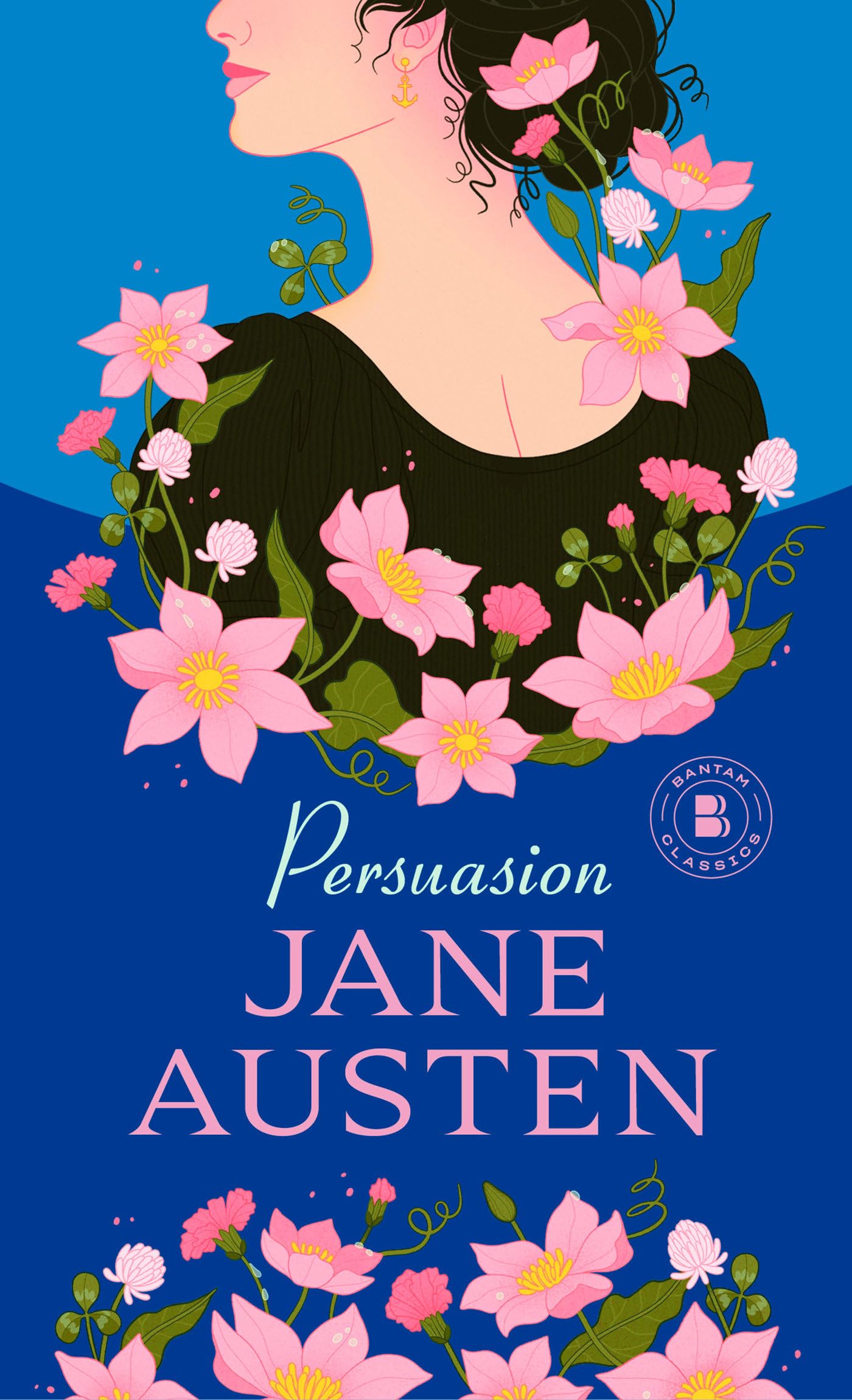



Jane Austen’s last completed novel, a brilliantly insightful story of regret, second chances, and the courage to follow our hearts Anne Elliot is twenty-seven and unmarried—by all accounts a spinster in her time—seemingly doomed to spend the rest of her life waiting on her image-obsessed father and extravagant older sister; attempting to maintain their once lavish, now dwindling family estate; and occasionally babysitting the children of her married younger sister. It wasn’t always this way, though. When Anne was nineteen, she was in love with and engaged to Frederick Wentworth, a man with no money and few prospects. Anne’s well-meaning family and friends convinced her that a young heiress like herself could do better, so she broke off the engagement. But when chance brings Wentworth and Anne together again eight years later, he is now an accomplished naval captain with an impressive fortune, and Anne must face her feelings for him that remain and consider how different her life could have been if only she hadn’t been so easily persuaded by others. “Critics, especially [recently], value Persuasion highly, as the author’s ‘most deeply felt fiction,’ ‘the novel which in the end the experienced reader of Jane Austen puts at the head of the list....' Anne wins back Wentworth and wins over the reader; we may, like him, end up thinking Anne’s character ‘perfection itself.’” –from the Introduction by Judith Terry Introduction by Judith Terry From the Hardcover edition. Introduction by Judith Terry "From the Hardcover edition. Though the domain of Jane Austen’s novels was as circumscribed as her life, her caustic wit and keen observation made her the equal of the greatest novelists in any language. Born the seventh child of the rector of Steventon, Hampshire, on December 16, 1775, she was educated mainly at home. At an early age she began writing sketches and satires of popular novels for her family’s entertainment. As a clergyman’s daughter from a well-connected family, she had an ample opportunity to study the habits of the middle class, the gentry, and the aristocracy. At twenty-one, she began a novel called “The First Impressions” an early version of Pride and Prejudice . In 1801, on her father’s retirement, the family moved to the fashionable resort of Bath. Two years later she sold the first version of Northanger Abby to a London publisher, but the first of her novels to appear was Sense and Sensibility , published at her own expense in 1811. It was followed by Pride and Prejudice (1813), Mansfield Park (1814), and Emma (1815). After her father died in 1805, the family first moved to Southampton then to Chawton Cottage in Hampshire. Despite this relative retirement, Jane Austen was still in touch with a wider world, mainly through her brothers; one had become a very rich country gentleman, another a London banker, and two were naval officers. Though her many novels were published anonymously, she had many early and devoted readers, among them the Prince Regent and Sir Walter Scott. In 1816, in declining health, Austen wrote Persuasion and revised Northanger Abby , Her last work, Sandition , was left unfinished at her death on July 18, 1817. She was buried in Winchester Cathedral. Austen’s identity as an author was announced to the world posthumously by her brother Henry, who supervised the publication of Northanger Abby and Persuasion in 1818. Chapter One SIR WALTER Elliot, of Kellynch Hall, in Somersetshire, was a man who, for his own amusement, never took up any book but the Baronetage; there he found occupation for an idle hour, and consolation in a distressed one; there his faculties were roused into admiration and respect, by contemplating the limited remnant of the earliest patents; there any unwelcome sensations, arising from domestic affairs, changed naturally into pity and contempt, as he turned over the almost endless creations of the last century-and there, if every other leaf were powerless, he could read his own history with an interest which never failed-this was the page at which the favourite volume always opened: ELLIOT OF KELLYNCH HALL Walter Elliot, born March 1, 1760, married, July 15, 1784, Elizabeth, daughter of James Stevenson, Esq. of South Park, in the county of Gloucester; by which lady (who died 1800) he has issue Elizabeth, born June 1, 1785; Anne, born August 9, 1787; a still-born son, Nov. 5, 1789; Mary, born Nov. 20, 1791. Precisely such had the paragraph originally stood from the printer's hands; but Sir Walter had improved it by adding, for the information of himself and his family, these words, after the date of Mary's birth-"married, Dec. 16, 1810, Charles, son and heir of Charles Musgrove, Esq. of Uppercross, in the county of Somerset,"-and by inserting most accurately the day of the month on which he had lost his wife. Then followed the history and rise of the ancient and respectable family, in the usual terms: how it had been first sett