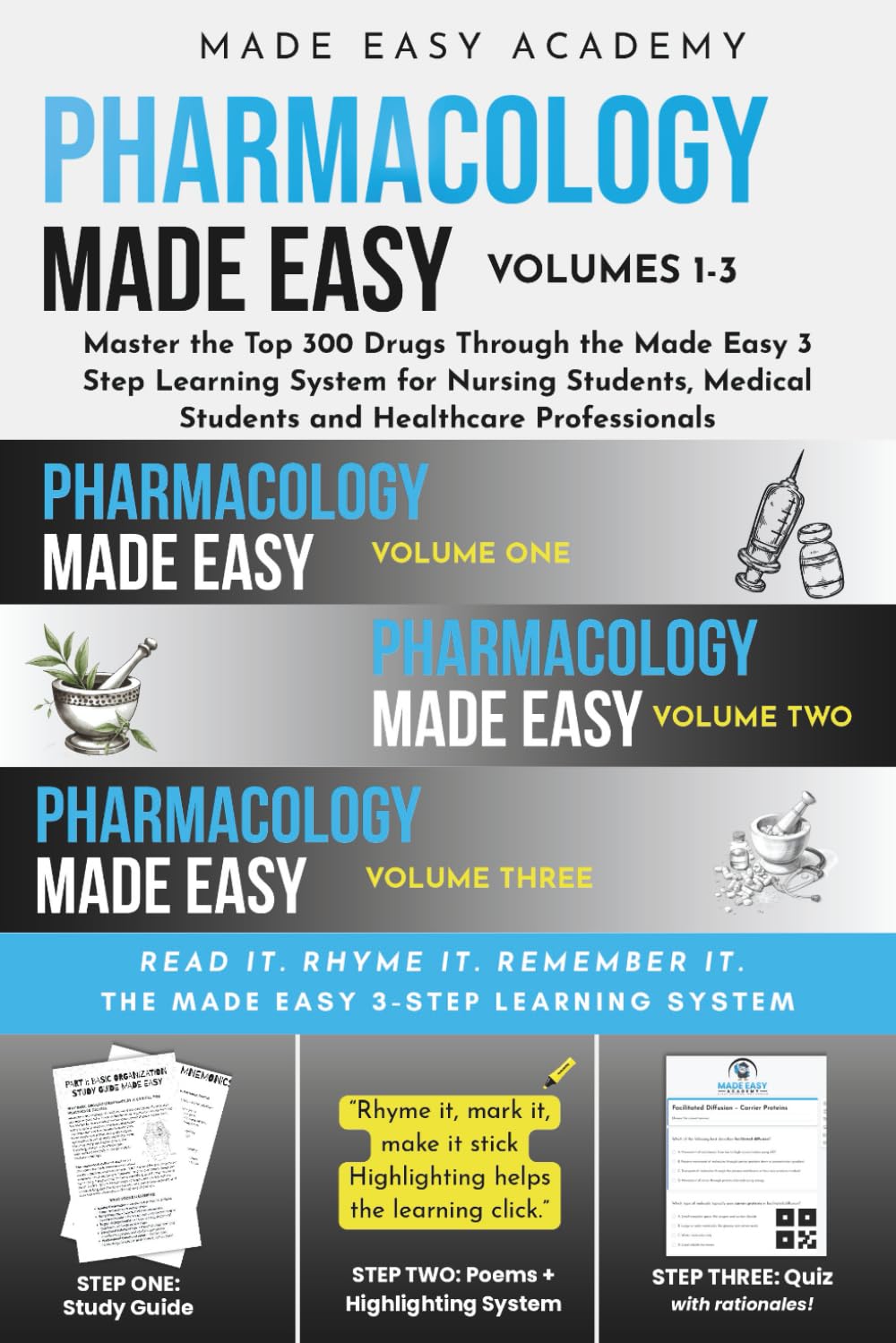
Pharmacology Made Easy, Vol 1-3: Master the Top 300 Drugs Through the Made Easy 3 Step Learning System for Nursing Students, Medical Students & ...
$44.95
by Made Easy Academy



Master 300+ Essential Medications in 3 Simple Steps (Volumes 1-3 Complete Bundle) Pharmacology doesn't have to burn you out. This complete 3-volume bundle covers the top 300 medications organized by body system—cardiovascular, endocrine, CNS, respiratory, and more—so drug knowledge builds logically, not randomly. Perfect for NCLEX, ATI, HESI A2, PANCE, USMLE, FNP board, nursing school pharmacology, medical school exams, clinical rotations, board review and pharmacology finals. Every medication includes a color-coded rhyming poem, study guide, mind map, and clinical quiz designed to make complex pharmacology actually stick. What's Included: 300+ essential medications organized by therapeutic system - Color-coded rhyming poems for every drug (mechanism, indications, side effects, contraindications) - Study guides organizing drugs into logical therapeutic families - Mind map templates and clinical quizzes with detailed rationales (via QR code) Format Notes: Ebook has study guides embedded; Paperback/Hardcover accesses them via QR code.\ The Made Easy 3-Step Learning System STEP 1: SIMPLIFY Start with the Study Guide—your pharmacological GPS. Instead of drowning in random drug names, you'll see the organizational framework first: Why these medications matter clinically - Drug class breakdowns (learn beta-blockers as a family, not isolated drugs) - Mnemonics & clinical pearls for safe patient care - Mastery checklist to track progress Then use Mind Map templates : Drug Class Maps – organize any medication category visually - Comparison Charts – see related drugs side-by-side (ACE inhibitors vs ARBs, loop vs thiazide diuretics) The Result: Your brain learns drug relationships faster when you understand the map before memorizing the territory. STEP 2: VISUALIZE Transform each poem into a color-coded medication reference. Use the 5-color highlighting system : 🟦 BLUE = Drug Names & Classes 🟩 GREEN = Mechanisms & Therapeutic Effects 🟥 RED = Side Effects & Warnings 🟨 YELLOW = Dosing, Labs & Monitoring 🟪 PURPLE = Interactions & Special Populations The Result: Scanning a highlighted poem becomes like flipping through a color-coded drug reference—in memorable rhyme form. Your brain engages both verbal (rhyme/rhythm) and visual (color/pattern) memory pathways simultaneously—making pharmacology stick twice as well. STEP 3: PRACTICE Lock it into long-term memory with active recall. Scan the QR code for clinical application quizzes: Real-world scenarios testing drug class identification, side effects, patient education - Detailed rationales explain the why behind every answer - Practice retrieval—the most powerful learning tool The Result: You're not just memorizing drug names. You're practicing clinical reasoning and building safe medication knowledge you'll use daily. With spaced repetition, pharmacology moves into long-term storage and becomes clinical intuition. Why This Works The Made Easy Method is built on proven educational psychology: Cognitive Load Theory: Learn drugs as therapeutic families - Dual Coding Theory: Engage verbal AND visual memory - Advance Organizers: See the framework before details - Spaced Repetition: Retrieve information actively to lock it in This isn't light and playful just to be cute. It's neuroscience-backed pharmacology designed to make 300 medications stick—without burning you out. Study → Visualize → Practice. Repeat. Retain.