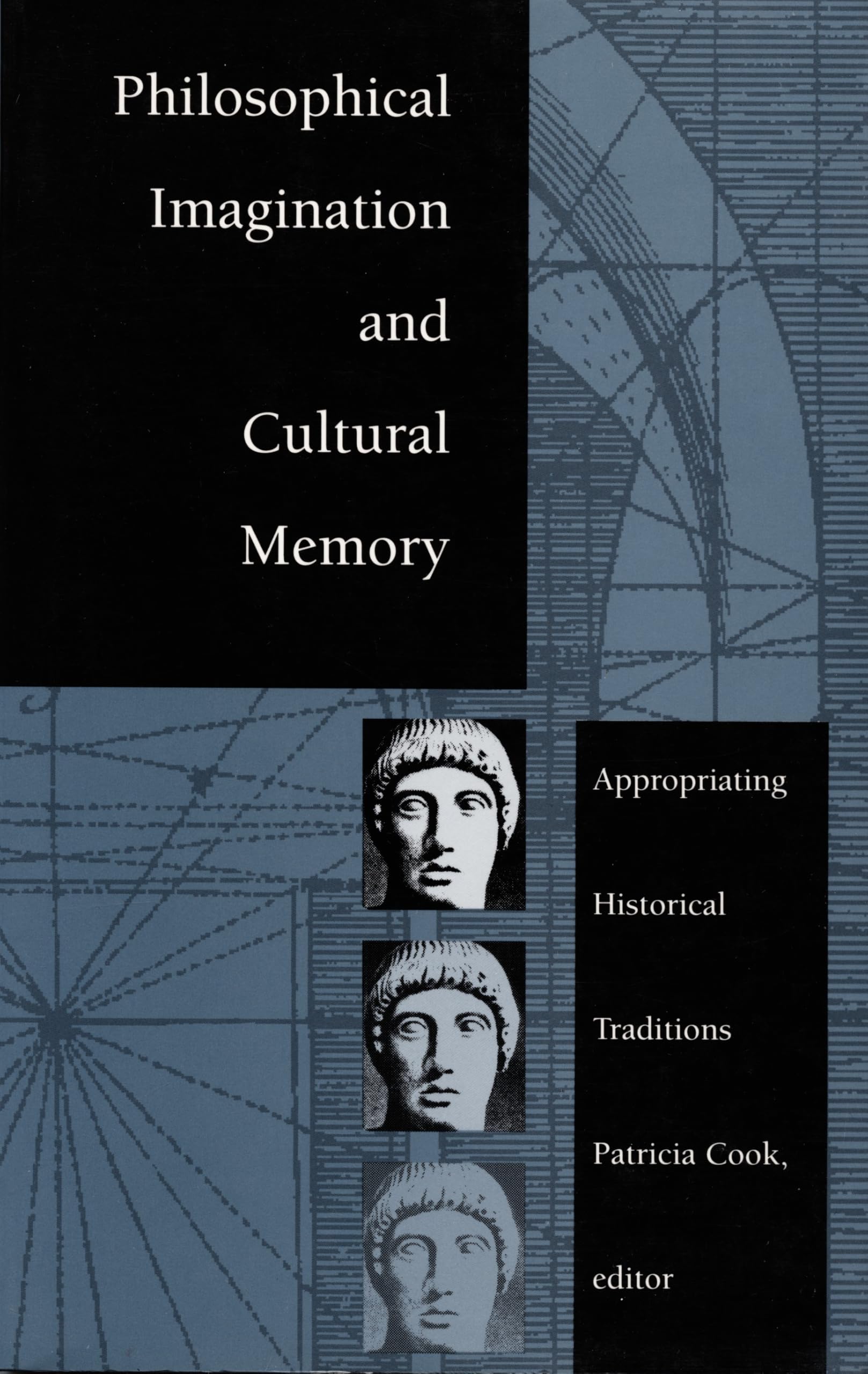
Philosophical Imagination and Cultural Memory: Appropriating Historical Traditions
$34.95
by Patricia Cook



Does philosophy have a future? Postmodern thought, with its rejection of claims to absolute truth or moral objectivity, would seem to put the philosophical enterprise in jeopardy. In this volume some of today's most influential thinkers face the question of philosophy's future and find an answer in its past. Their efforts show how historical traditions are currently being appropriated by philosophy, how some of the most provocative questions confronted by philosophers are given their impetus and direction by cultural memory. Unlike analytic philosophy, a discipline supposedly liberated from any manifestation of cultural memory, the movement represented by these essays demonstrates how the inquiries, narratives, traditions, and events of our cultural past can mediate some of the most interesting exercises of the present-day philosophical imagination. Attesting to the power of historical tradition to enhance and redirect the prospects of philosophy these essays exemplify a new mode of doing philosophy. The product of a National Endowment for the Humanities Summer Institute in 1990, it is the task of this book to show that history can be reclaimed by philosophy and resurrected in postmodernity. Contributors . George Allan, Eva T. H. Brann, Arthur C. Danto, Lynn S. Joy, George L. Kline, George R. Lucas, Jr., Alasdair MacIntyre, Robert C. Neville, John Rickard, Stanley Rosen, J. B. Scheenwind, Donald Phillip Verene Philosophical Imagination and Cultural Memory Appropriating Historical Traditions By Patricia Cook Duke University Press Copyright © 1993 Duke University Press All rights reserved. ISBN: 978-0-8223-1322-9 Contents Acknowledgment, Introduction, Philosophy and Cultural Memory, Philosophical Imagination and the History of Philosophy, Perspectives on the Significance of Cultural Memory, Cultural Memory and Textual Interpretation, Part I: Philosophy and Cultural Memory, Traditions and Transitions, Two Sources of Philosophical Memory: Vico Versus Hegel, Part II: Philosophical Imagination and the History of Philosophy, Are Philosophical Problems Insoluble? The Relevance of System and History, Modern Moral Philosophy: From Beginning to End?, Refutation, Narrative, and Engagement: Three Conceptions of the History of Philosophy, Part III: Perspectives on the Significance of Cultural Memory, The Shape of Artistic Pasts: East and West, Humanism and the Problem of Traditions in Seventeenth-Century Natural Philosophy, The Symbiotic Relation of Philosophy and Theology, Part IV: Culture Memory and Textual Interpretation, The Six Silences of a Grecian Urn, Changing Russian Assessments of Spinoza and Their German Sources, 1796–1862, Tradition and Intertextual Memory in James Joyce's Ulysses, Plato's Quarrel with the Poets, Selected Bibliography for Further Reading, Index, Contributors, CHAPTER 1 George Allan Traditions and Transitions This is a time, it would seem, when whirl is king. The vast complexity of the world overwhelms us not because the complexity is so ponderous but because it changes so rapidly. Now this, now that: baffling us by its unprecedented surprises, confusing our purposes by constantly undermining our assumptions and scattering our efforts into a thousand unconnected gestures. We are no longer sure who we are or why. Or so it often seems, and the more so the more we find ourselves struggling with the fundamentals of our lives, with matters of birth and development and death, of the meaning of our dreams and the significance of our deeds. I The traditional role of a cultural tradition is to provide us with the resources we need to stave off the rule of whirl. It provides us with a way of taking things so that they do not surprise or overwhelm. It tells us what to expect and why, even when what is to be expected is some overwhelming surprise, some fundamental challenge to our hopes, our purposes, our havings and our doings. Our tradition wraps us in a world that discloses itself for us in ways we can comprehend and with which we can therefore cope. We never simply experience things; we always experience them as something. We take the distant patch of dark as trees, the whispered words as a friend's advice, the lump as cancerous, the war as a vindication of our national destiny. This structure is triune: a given; something else able to serve as a sign of it; an interpreter who takes the sign as meaning that given. The philosopher C. S. Peirce calls this structure Thirdness and says it is the necessary condition for every intelligible experience. Sheergivenness, which he calls Secondness, is a possible mode of experience, the bare "there" of an intruding otherness, such as my being unexpectedly hit on the head from behind. Unless I am too stunned to do so, my immediate response is to take the intrusion as a sign of something else: as an object falling on me or thrust on me, as a tree branch I had overlooked, as a club swung to knock me out