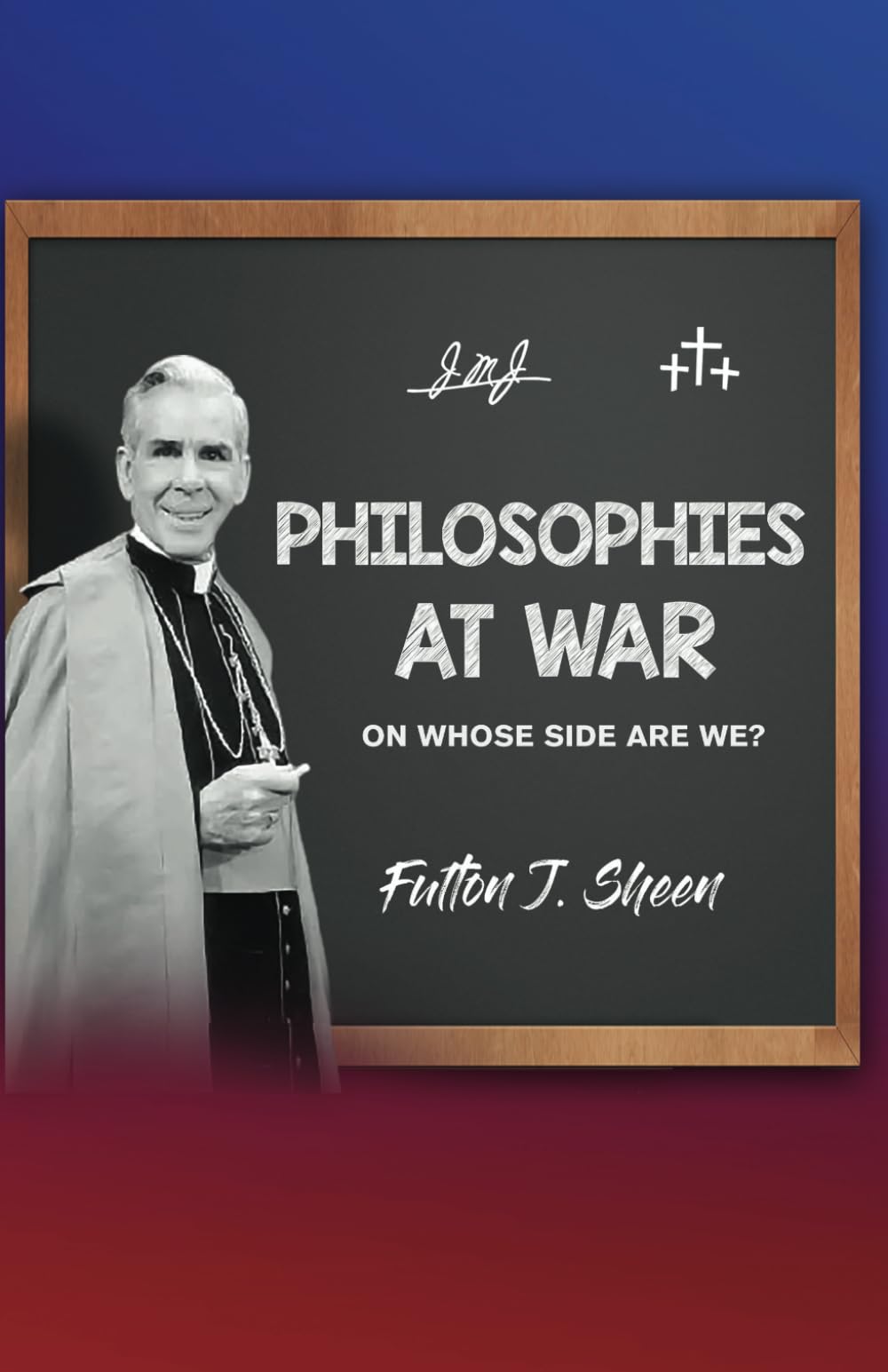



Philosophies at War On Whose Side Are We? In this book are contained a collection of Sheen’s Catholic Hour radio addresses that were heard by millions of listeners each week. These reflections are a series of short essays that addressed the many concerns of the listeners of his day during the war. Sheen answers questions about the things we are fighting against and the things we are fighting for. He speaks of war, revolution, democracy and peace and asks the question of whose side we are on? His were some of the most clearly delineated investigations into the underlying causes of the war combined with an entirely sound and hopeful program for winning both the war and the even more important peace are found in them. These powerful reflections can be most heartily recommended for their wise counsel, sane and penetrating analysis, and logical conclusions. In ‘ The Philosophies of War ’, Sheen addresses the vexation felt by a great mass of people who were frankly dissatisfied with the ephemeral and superficial commentaries about the war. Like a master surgeon, Sheen applied the sharp scalpel of his crystal-clear logic to lay open the sources of the world’s infection. Sheen writes, “There are two ways of looking at the war: one as a journalist, the other as a theologian. The journalist tells you what happens; the theologian not only why it happens, but also what matters. Our approach is from the divine point of view, first of all, because it is the only explanation which fits the facts; secondly, because the American people who have been confused by catchwords and slogans are seeking an inspiration for a total surrender of their great potentialities for sacrifice, both for God and country.” Sheen is firm in his conviction that real peace cannot be declared, it must be made. It is with peace-making and the fundamental conditions on which peace must be based that this book is concerned. In its seven forceful and readable chapters, it challenges the theory of many planners today who posture that military allies are necessarily political allies; it affirms that a common hatred can make nations allies, but only a common love can make them neighbors; it denies the primacy of action over reason, in the sense that the will of the state is that which makes a state right; and it contends that utility does not establish justice, but it is justice which makes utility. With the same lucid and persuasive reasoning that has made him outstanding both as a writer and as a lecturer, Sheen continues to challenge people of goodwill to unite for the preservation of personal rights, freedom of conscience, human justice, and civilization itself – all of which are in danger in the present conflict. Here, one will recognize the urgency of Sheen’s subject matter, and will find pillars of peace and promise in his far-sighted principles. Archbishop Fulton J. Sheen’s destiny was encrypted in his name, for in the Gaelic language Fulton means war and Sheen means peace . Sheen’s lifelong goal was to establish peace, but in that call, he inevitably came up against many obstacles toward that noble ideal. It is as though his very name foretold the kind of life he was to have: an uninterrupted warring against the powers of darkness to promote the peace of Christ’s kingdom. Table of Contents of the book Philosophies at War INTRODUCTION WAR AND REVOLUTION THE THINGS WE ARE FIGHTING AGAINST BARNACLES ON THE SHIP OF DEMOCRAY THE REVOLUTION OF MAN MAN’S CHRISTIAN CHARACTER CONSPIRACY AGAINST LIFE DEOCRACY IN EDUCATION THE NEED OF AN ABSOLUTE THE ROOTS OF DEMOCRACY AND PEACE ON WHOSE SIDE ARE WE? As Applicable Today as it Was Eighty Years Ago Although this text is marked by its placement in history, it ranks with great resonance to me as I continue to consider the current state of the Western World. In the early and mid-twentieth century, the world faced two wars in which the West was required to admit the fallacies of Classical Liberalism, Socialism, Marxism, and Fascism. It was a period in which the West had a chance to remove the polluting barnacles from its belly as it strove for what seemed to be a Common Good. However, as Sheen astutely points out, the question still remains to be answered, "Once we have usurped the philosophies of our enemies, what will we replace them with?" Today, we still have not wholly answered that question, although we have in many ways continued to replace them with the very philosophies of our enemies, albeit in slow and insidious ways. The fundamental questions for the West in these days of societal turmoil are specifically those which seek the central ontological and moral Truths of our existence. In the sixty years since the cessation of World War II, we have still not completely answered them but have instead lapsed into something of a slightly directed materialism which ultimately has left us without a firm rooting in conviction. It is little wonder that the West is falling to other