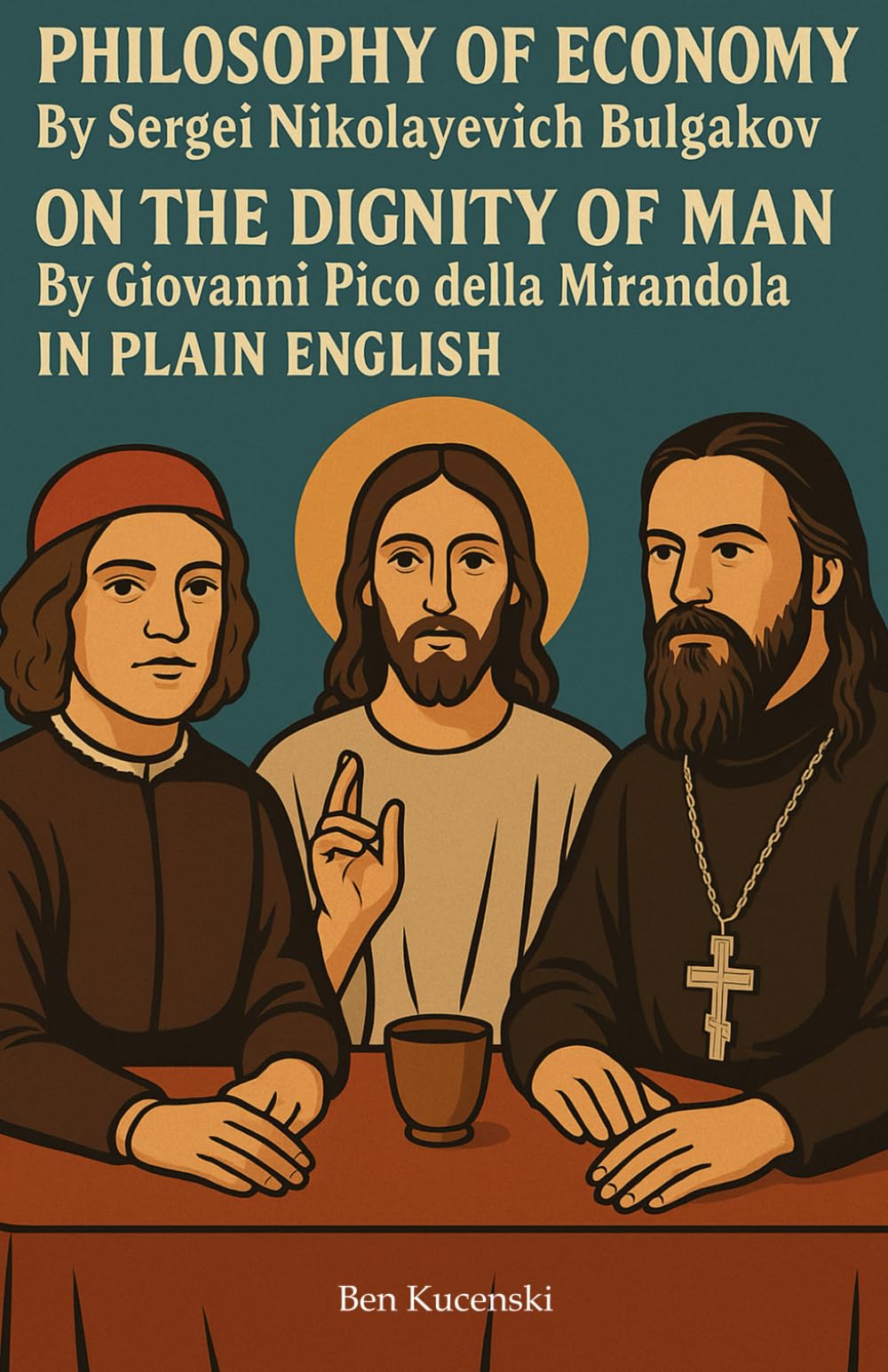
Philosophy of Economy By Sergei Nikolayevich Bulgakov On the Dignity of Man By Giovanni Pico della Mirandola In Plain English
$14.99
by Sergei Nikolayevich Bulgakov



Philosophy of Economy by Sergei Nikolayevich Bulgakov (translated and adapted into plain English) This groundbreaking work brings Sergei Bulgakov’s Philosophy of Economy (1912) into clear, modern English for today’s reader. More than a study of economics, Bulgakov’s book is a profound meditation on the human condition, Christianity, and the spiritual meaning of economic life. Bulgakov confronts the dominant worldview of his time— economic materialism , or what he calls “economism”—which insists that human worth is measured by wealth and labor. In a way that feels strikingly relevant today, he warns against the dogma of capitalism that treats people as mere functions of production and consumption. Yet instead of rejecting economic life, he seeks to redeem it through philosophy and faith , showing how the Christian worldview offers a deeper understanding of work, wealth, and freedom. The author situates economy within three levels of meaning: Scientific-empirical (the study of markets and production), - Critical-transcendental (examining how we know and think about economy), - Metaphysical-religious (revealing how economic life fits into God’s creation). Bulgakov insists that Christianity cannot be reduced to private spirituality or moral platitudes—it must also illuminate the very structure of human economic life. Drawing on the Church Fathers and Russian Orthodoxy, he presents a vision where work, wealth, and creation become part of a cosmic struggle between life and death, freedom and necessity, spirit and matter. This modern English edition makes Bulgakov’s prophetic insights accessible for the first time to a broad audience. Whether you are interested in philosophy, theology, or critiques of capitalism, this book provides a rare fusion of Christian wisdom and economic thought that speaks powerfully to our age.