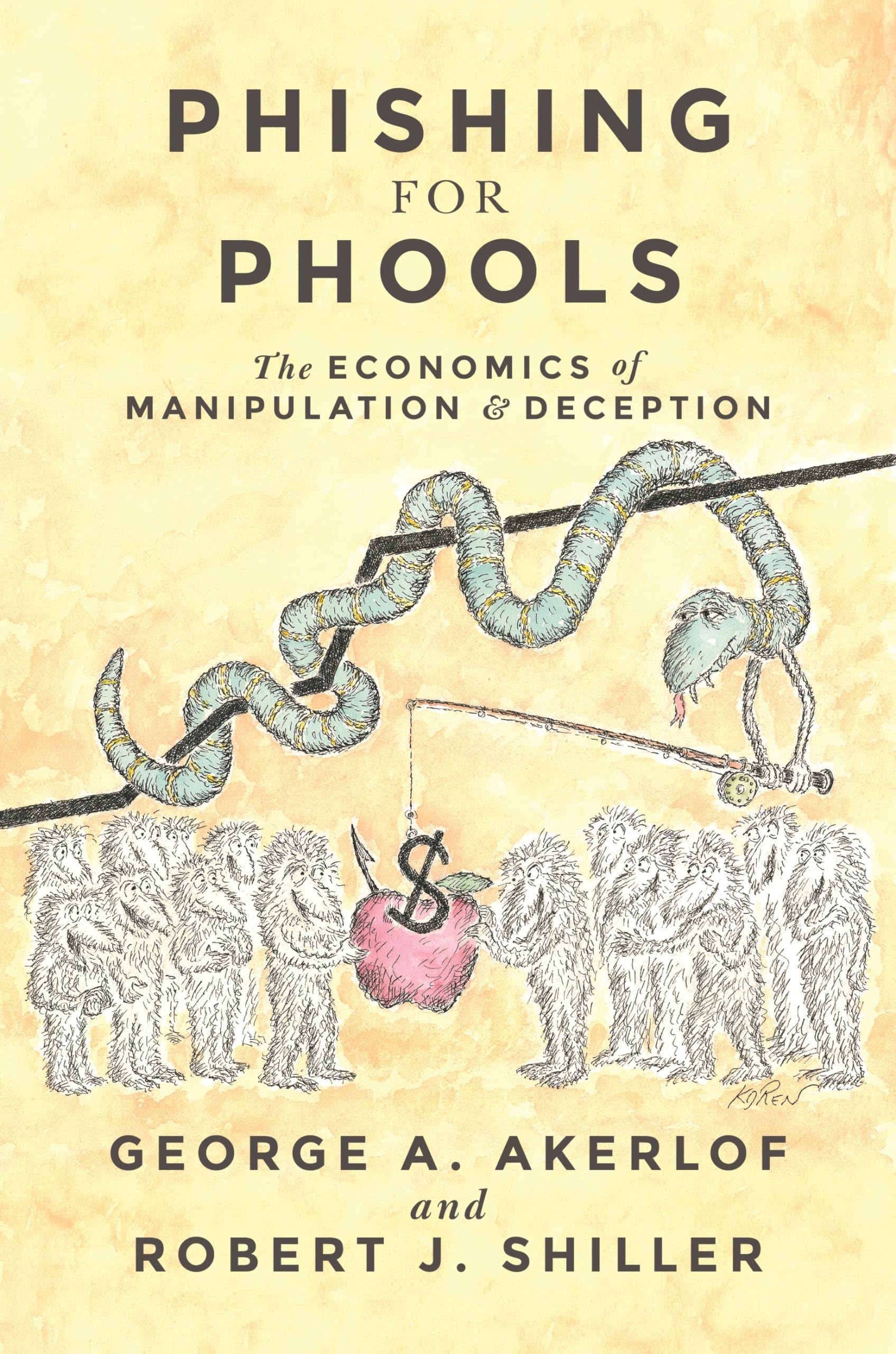
Phishing for Phools: The Economics of Manipulation and Deception
$11.79
by George A. Akerlof



Why the free-market system encourages so much trickery even as it creates so much good Ever since Adam Smith, the central teaching of economics has been that free markets provide us with material well-being, as if by an invisible hand. In Phishing for Phools , Nobel Prize–winning economists George Akerlof and Robert Shiller deliver a fundamental challenge to this insight, arguing that markets harm as well as help us. As long as there is profit to be made, sellers will systematically exploit our psychological weaknesses and our ignorance through manipulation and deception. Rather than being essentially benign and always creating the greater good, markets are inherently filled with tricks and traps and will "phish" us as "phools." Phishing for Phools therefore strikes a radically new direction in economics, based on the intuitive idea that markets both give and take away. Akerlof and Shiller bring this idea to life through dozens of stories that show how phishing affects everyone, in almost every walk of life. We spend our money up to the limit, and then worry about how to pay the next month's bills. The financial system soars, then crashes. We are attracted, more than we know, by advertising. Our political system is distorted by money. We pay too much for gym memberships, cars, houses, and credit cards. Drug companies ingeniously market pharmaceuticals that do us little good, and sometimes are downright dangerous. Phishing for Phools explores the central role of manipulation and deception in fascinating detail in each of these areas and many more. It thereby explains a paradox: why, at a time when we are better off than ever before in history, all too many of us are leading lives of quiet desperation. At the same time, the book tells stories of individuals who have stood against economic trickery―and how it can be reduced through greater knowledge, reform, and regulation. "George A. Akerlof, Co-Winner of the 2001 Nobel Prize in Economics" "Robert J. Shiller, Co-Winner of the 2013 Nobel Prize in Economics" "One of The Times Literary Supplement’s Books of the Year 2016, chosen by Paul Collier" "Selected for Bloomberg View’s “The Writing that Shaped Economic Thinking in 2016”" "Winner of the 2016 Gold Medal in Economics, Axiom Business Book Awards" "One of Foreign Affairs’ Best Economic, Social, and Environmental (Economics) Books of 2016" "Honorable Mention for the 2016 PROSE Award in Economics, Association of American Publishers" "One of The Independent’s Best Economics Books 2015" "One of LinkedIn’s Best Business Books of 2015" "One of BusinessInsider.com’s Best Business Books of 2015" "One of Legal Theory Bookworm’s Books of the Year 2015" "Longlisted for the Financial Times and McKinsey Business Book of the Year 2015" "[Akerlof and Shiller] want to go far beyond behavioral economics, at least in its current form. They offer a much more general, and quite damning, account of why free markets and competition cause serious problems. . . . They are intellectual renegades. . . . Akerlof and Shiller make a convincing argument that phishing occurs because of the operation of the invisible hand, not in spite of it. . . . [This] extraordinary book tells us something true, and profoundly important, about the operation of the invisible hand." ---Cass Sunstein, New York Review of Books "No question, Phishing for Phools is a radical book. It may also be a radically important one." ― Fortune "I highly recommend this, even for those who might disagree with the authors' outlook. Their case studies are illuminating, and their insights on the way markets work are fascinating. When you consider the sorry state of the personal finances of the median working age family in the United States today, it's hard to disagree with their central thesis that our current system isn't working properly." ---John Reeves, The Motley Fool, USA Today "Entertaining, readable and provocative." ---John Lanchester, London Review of Books "A needed call for skeptical economics and financial mindfulness." ― Nature "Using compelling examples of flawed decision making from advertising, health care and personal finances, the authors identify our rational weak spots and arm readers with the ability to resist manipulation." ― Scientific American Mind "As you would expect, it's a very clearly written book with tons of examples. And it makes a simple and powerful point about the fragility of the normative, welfare economics conclusions economists tend to draw." ---Diane Coyle, The Enlightened Economist "Akerlof and Shiller present convincing evidence of how tobacco, pharmaceutical, and liquor companies and politicians weasel a chapter of their own into our life stories, abusing the mutual storytelling--with all its signs and wonders--that is elemental to our humanity." ---Peter Lewis, Barnes & Noble Review "With accessible language and everyday examples, Shiller and Akerlof are taking on the powerful belief th