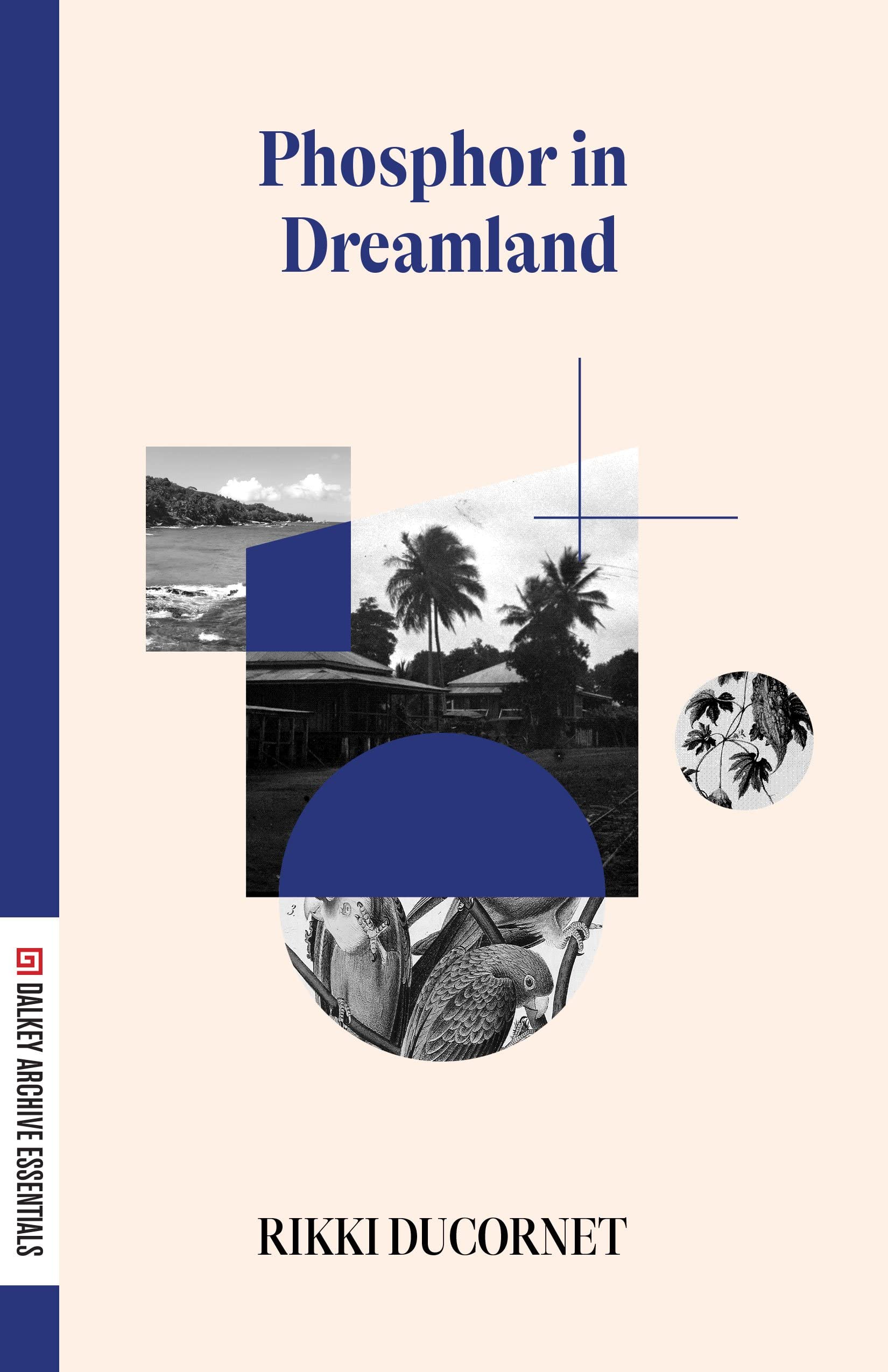



Wildly comic, erotic, and perverse, Rikki Ducornet’s dazzling novel, Phosphor in Dreamland , explores the relationship between power and madness, nature and its exploitation, pornography and art, innocence and depravity. Set on the imaginary Caribbean island of Birdland, the novel takes the form of a series of letters from a current resident to an old friend describing the island’s seventeenth-century history that brings together the violent Inquisition, the thoughtless extinction of the island’s exotic fauna, and the amorous story of the deformed artist-philosopher-inventor Phosphor and his impassioned, obsessional love for the beautiful Extravaganza. The Jade Cabinet , Ducornet’s novel that was a finalist for the National Book Critics Circle Award, was described by one reviewer as “Jane Austen meets Angela Carter via Lewis Carroll.” Phosphor in Dreamland can be described as Jonathan Swift meets Angela Carter via Jorge Luis Borges. This is Ducornet at her magical best. “Rikki Ducornet’s new novel is a delicious, spellbinding masterpiece. The exercise of her extravagant imaginative powers is rigorous, the richness of her writing concentrated to trenchant effect, and her enchanting narrative conducted with great intensity and seriousness. Phosphor’s bewildering, bewildered career deserves a constellation in the firmament of literary heroes.”—Harry Mathews “Rikki Ducornet can create an unsettling, dreamlike beauty out of any subject. In the heady mix of her fiction, everything becomes potently suggestive, resonant, fascinating. She exposes life’s harshest truths with a mesmeric delicacy and holds her readers spellbound.” —Joanna Scott “Rikki Ducornet is imagination's emissary to this mundane world.” —Stephen Sparks, Point Reyes Books “Ducornet is a novelist of ambition and scope.” —The New York Times “Linguistically explosive. . . . One of the most interesting American writers around.” —The Nation Rikki Ducornet is a transdisciplinary artist. Her work is animated by an interest in nature, Eros, tyranny and the transcendent capacities of the creative imagination. She is a poet, fiction writer, essayist, and artist, and her fiction has been translated into fifteen languages. Her art has been exhibited internationally, most recently with Amnesty International’s traveling exhibit I Welcome, focused on the refugee crisis. She has received numerous fellowships and awards including an Arts and Letters Award from the American Academy of Arts and Letters, the Bard College Arts and Letters Award, the Prix Guerlain, a Critics’ Choice Award, and the Lannan Literary Award for Fiction. Her novel The Jade Cabinet was a finalist for the National Book Critics Circle Award. 1 Several hundred years ago, the mendicant scholar Fogginius was roused from the depths of nightmare by a hellish bawling. Fogginius leapt up from his bed—in truth a worn, woolen cape sewn into a sack and stuffed with shredded shirts—and threw aside his door, or rather, the crusted board which kept the wild hogs from relieving themselves in his rooms. There, upon the overturned kettle he used as a threshold, lay an abandoned human infant, soiled, clubfooted, and with crossed eyes. Fogginius washed it, stared fiercely into its transverse gaze, and in the manner of the times swaddled it so tightly that it could not thrash but only howl—as helpless as a sausage damned with a thwarted consciousness. This done, he christened it Nuno Alfa y Omega. But because of the infant’s apparent luminosity, he called it Phosphor. Fogginius was disliked. A deaf man, whom the scholar had cured of a coughing fit by stuffing his ears with breadcrumbs and pars- ley, daily damned him; another, whose beehives Fogginius had smeared with dung, hated and feared him. Nevertheless, up until the arrival of Professor Tardanza from Cordova, and Phosphor’s maturity, he was the only scholar in Birdland, and his the island’s only library—a wormy collection of books stuffing a trunk not large enough to bathe in. The books had been packed along with that woolen cape and those nightshirts which, a full three decades later, served the saint as mattress. In his youth, Fogginius had been enthralled by Birdland’s unique bestiary. The island claimed a feathered serpent, a voiceless dog, a silent cat, and large albino spiders sporting pink bristles. After many years of trial and error, he had taught himself the ambiguous art of taxidermy and so was able to save the skins of almost anything he chose, although he was not an artist and was incapable of reconstructing any creature convincingly. For example, Fogginius’ snakes did not diminish towards the tail, but instead—as a specimen on display in the municipal museum demonstrates—grew progressively fatter. So zealous was the scholar and so thorough that all the living creatures within three kilometers of his hovel had utterly vanished by the time my story begins. Only their skins remained—thousands upon thousands of them—decomposin