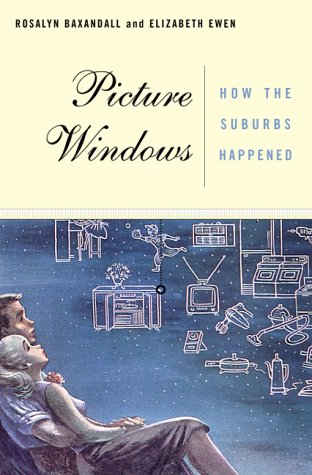



In Picture Windows, Baxandall and Ewen shatter naïve stereotypes of suburban life, replacing them with a clear and compelling historical analysis that situates the development of the suburbs in relation to the pivotal issues of postwar American life. They examine the years from World War II to the present, chronicling the transformation of rural lands into tidy, uniform subdevelopments that promised all of the comforts of postwar technology.The building of the suburbs, the authors argue, was conducted in the context of heated debates over the American standard of living, visionary planners and architects' attempts to solve the housing crisis,” women's liberation, and racial segregation. Baxandall and Ewen use interviews with hundreds of residents of three Long Island suburbs to weave together a story about suburbs past and present, and ultimately to insist on the centrality of suburban experience in the second half of the twentieth century. This fascinating study of the suburbs of Long Island, New York (and by analogy, those across America) arose from the authors' daily commute from Manhattan to SUNY Old Westbury, which is near Levittown, one of the earliest and perhaps the most famous of American suburbs. Initially they had imagined suburbia "as an anaesthetized state of mind, a no place dominated by a culture of conformity and consumption." Their research quickly taught them otherwise. While Picture Windows does document a growing obsession with middle-class consumer goods, like the televisions that came with 1950 houses at Levittown, it disrupts the myth of suburban serenity to reveal "a rich and stormy history" of political and social conflict. The planners and visionaries of suburbia, as the authors attest, tried to create a place "where ordinary people, not just the elite, would have access to affordable, attractive modern housing in communities with parks, gardens, recreation, stores, and cooperative town meeting places." Shunning the "snobbery" of cultural critics who deplored the "neat little toy houses on their neat little patches of lawn," Baxandall and Ewen find much to celebrate in the burgeoning suburbs. Most of those who flocked to the new towns had been crowded into city slums during the depression and war; they never questioned the architectural conformity of the suburbs, but only rejoiced in the chance of owning their own brand-new homes, places empty of anyone else's memories and rich with potential. Picture Windows is a quintessentially American story, told with skill and conviction. --Regina Marler American studies professors Baxandall and Ewen of State University of New York at Old Westbury came to their Long Island campus as urban snobs; they soon discovered neither the place nor their students fit their stereotypes. This "culture shock" produced their study of suburban America. The authors examine the growth of the robber barons' Gold Coast on Long Island's north shore but are more interested in the post^-World War II development of such working-and middle-class South Shore suburbs as Levittown and Roosevelt. They trace reformer patterns for suburban communities tested in the 1930s, then describe the intense battle waged by Sen. Joseph McCarthy and the real estate and construction industries to ensure private builders (not government) would control the postwar housing boom. Pioneers explain how they humanized the mass construction efforts of Levitt and others, and then dealt with issues like integration. In the late '90s, the suburbs are receiving new immigrants, and the authors question whether, with no significant public role in housing, these aging communities can meet these new needs. Mary Carroll A scholarly but vigorous study of the forces that made the US a nation of suburbs. Colleagues Baxandall and Ewen (American Studies/SUNY, Old Westbury) organize their history, which reaches back to the 1920s, around three leading themes: the debate over who should be responsible for developing the suburbs opened by the explosion of the American population and fueled by the automobile; the relation between abstract ideas and specific places; and the attempt by many Americans of different backgrounds to claim the well-advertised national dream of democracy and prosperity. Having staked out as their prime territory the suburbs of Long Island, whose mass-produced Levittown is universally agreed to be the quintessential suburban community, they devote most of their attention to the first and last of these goals. Though their writing is studded with scholarly footnotes, their citations of earlier writers and suburban denizens (many of them interviewed half a century after they moved out to paradise) are lively, and their story is absorbing and often revelatory. The authors trace the crazy quilt of present-day Nassau County communities to the days of the robber barons, who actively promoted land-use policies designed to keep their estates from being overrun by urban rabble. They discov