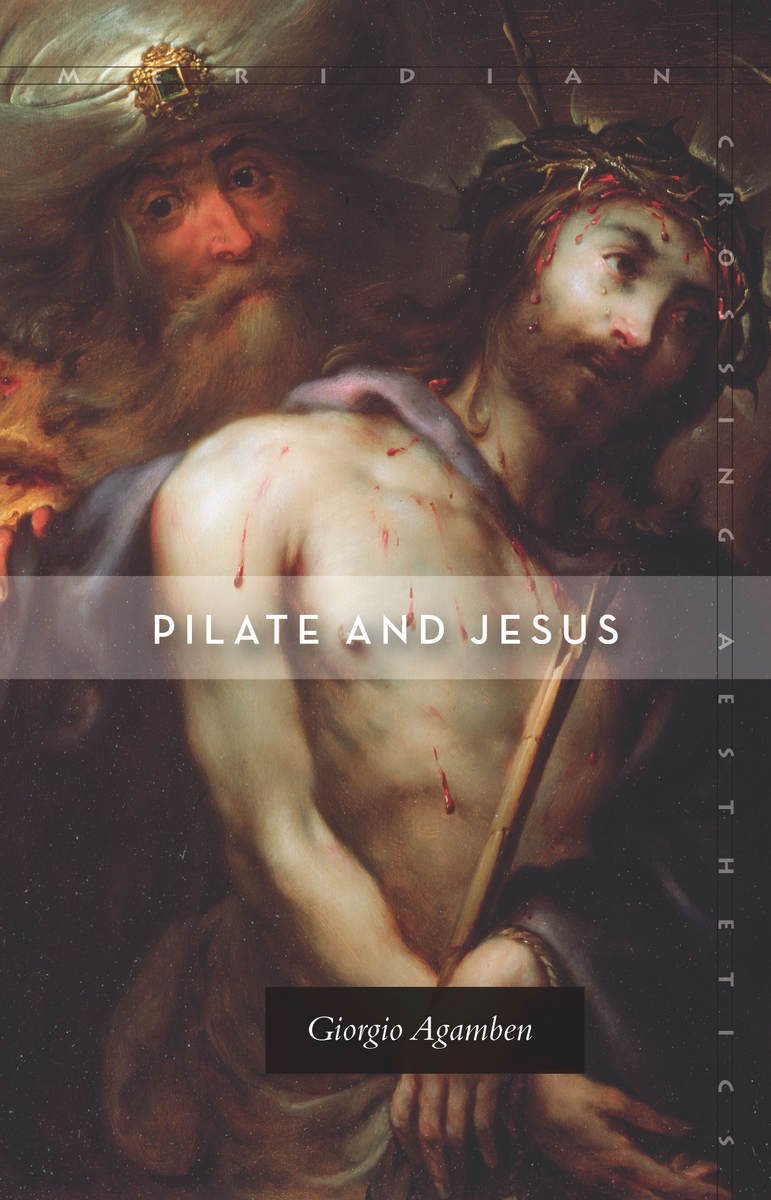



Pontius Pilate is one of the most enigmatic figures in Christian theology. The only non-Christian to be named in the Nicene Creed, he is presented as a cruel colonial overseer in secular accounts, as a conflicted judge convinced of Jesus's innocence in the Gospels, and as either a pious Christian or a virtual demon in later Christian writings. This book takes Pilate's role in the trial of Jesus as a starting point for investigating the function of legal judgment in Western society and the ways that such judgment requires us to adjudicate the competing claims of the eternal and the historical. Coming just as Agamben is bringing his decades-long Homo Sacer project to an end, Pilate and Jesus sheds considerable light on what is at stake in that series as a whole. At the same time, it stands on its own, perhaps more than any of the author's recent works. It thus serves as a perfect starting place for readers who are curious about Agamben's approach but do not know where to begin. Giorgio Agamben is a contemporary Italian philosopher and political theorist whose works have been translated into numerous languages. His most recent title with Stanford University Press is Opus Dei (2013). Pilate and Jesus By Giorgio Agamben, Adam Kotsko STANFORD UNIVERSITY PRESS Copyright © 2013 Nottetempo All rights reserved. ISBN: 978-0-8047-9454-1 Contents Acknowledgments, § Pilate and Jesus, Glosses, Bibliography, CHAPTER 1 1. The symbolon, the "creed" in which Christians summarize their faith, contains, alongside those of the "Lord Jesus Christ" and the "Virgin Mary," a single proper name, completely extraneous—at least in appearance—to its theological context. What is more, this man is a pagan, Pontius Pilate: staurothenta te huper hemon epi Pontiou Pilatou, "crucified for our sake under Pontius Pilate." The "creed" that the Fathers had formulated at Nicea in 325 did not include this name. It was added in 381 by the Council of Constantinople, by all evidence in order to also fix the historical character of Jesus's passion chronologically. "The Christian Credo," it has been observed, "speaks of historical events. Pontius Pilate belongs there essentially. He is not just a pitiful creature who oddly ended up there" (Schmitt, 930/170). That Christianity is a historical religion, that the "mysteries" of which it speaks are also and above all historical facts, is taken for granted. If it is true that the incarnation of Christ is "a historical event of infinite, non-appropriable, non-occupiable singularity" (ibid.), the trial of Jesus is therefore one of the key moments of human history, in which eternity has crossed into history at a decisive point. All the more urgent, then, is the task of understanding how and why this crossing between the temporal and the eternal and between the divine and the human assumed precisely the form of a krisis, that is, of a juridical trial. 2. Why precisely Pilate? A formula of the type Tiberiou kaesaros —which one reads on the money coined by Pilate and which has in its favor the authority of Luke, who so dates John's preaching (Luke 3:1)—or sub Tiberio (as Dante has Virgil say: "born sub Iulio," Inferno 1.70) would certainly have been more in keeping with common usage. If the Fathers assembled at Constantinople preferred Pilate to Tiberius, the prefect—or, as Tacitus preferred to call him ( Annals XV, 44), in one of the few extrabiblical testimonies that mention his name, "the procurator" of Judea—to Caesar, it is possible that over their undoubted chronographic intention there prevailed the importance that the figure of Pilate has in the narrative of the Gospels. In the punctilious attention with which John above all, but also Mark, Luke, and Matthew describe his hesitations, his evasions and changing opinion, literally relating his words, which are at times decidedly enigmatic, the evangelists reveal perhaps for the first time something like the intention to construct a character, with his own psychology and idiosyncrasies. It is the vividness of this portrait that caused Lavater to exclaim in a 1781 letter to Goethe: "I find everything in him: heaven, earth, and hell, virtue, vice, wisdom, folly, destiny, liberty: he is the symbol of all in all." One can say, in this sense, that Pilate is perhaps the only true "character" of the Gospels (Nietzsche defined him in The Antichrist as "the only figure— Figur —of the New Testament who merits respect," §46), a man of whom we know the passions ("he was greatly amazed," Matthew 27:14; Mark 15:5; "he was more afraid than ever," John 19:8), the resentment and skittishness (as when he shouts at Jesus, who is not responding to him: "Do you refuse to speak to me [ emoi ou laleis Do you not know that I have power to release you, and power to crucify you?"), the irony (at least according to some, in the notorious reply to Jesus: "What is truth?" John 18:38), the hypocritical scruples (testimony of which is