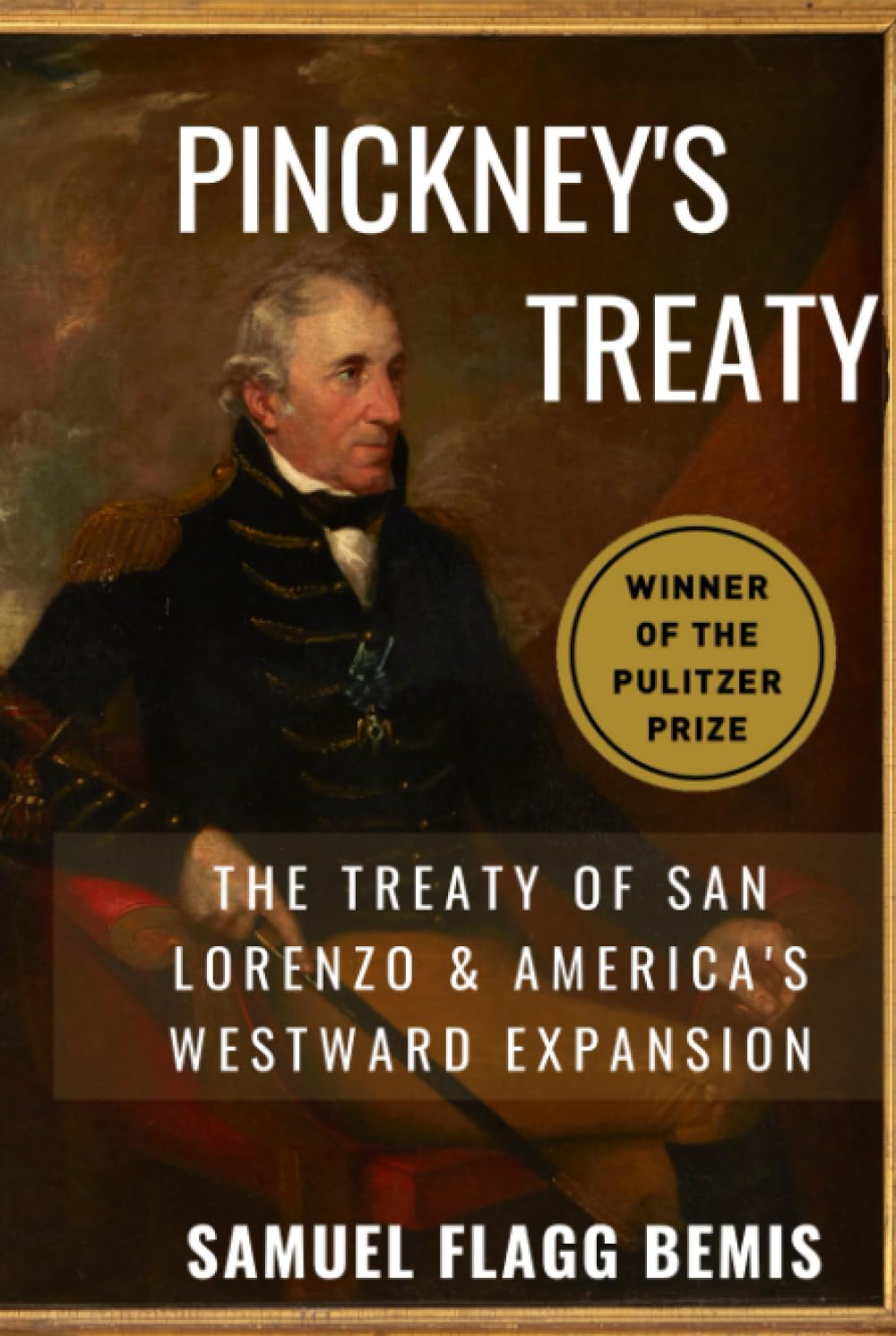
Pinckney's Treaty: The Treaty of San Lorenzo & America's Westward Expansion (WINNER OF THE PULITZER PRIZE)
$36.99
by Samuel Flagg Bemis



Winner of the Pulitzer Prize in Non-Fiction American statesman, diplomat, and soldier Thomas Pinckney held many titles in his lifetime. He fought in the American Revolutionary War and served as a Major General in the War of 1812, presided over the state convention which ratified the US Constitution, served as the Governor of South Carolina and as a Congressman, was appointed by President George Washington as U.S. minister to Great Britain, and was even the Federalist candidate for vice president in 1796. Yet his most notable achievement is one which has been scarcely researched or remembered: his work as envoy to Spain and the negotiation of the Treaty of San Lorenzo. Prior to 1795, the U.S. border extended to the Mississippi River, but its southern stretch remained in Spanish territory. Spanish officials - reluctant to encourage U.S. trade and settlement in a strategic frontier area - kept the Mississippi River closed to American shipping. Moreover, both Spain and the United States claimed portions of the present-day states of Alabama and Mississippi, and earlier negotiations to resolve the territorial disputes had broken off inconclusively. The two nations were in a stalemate – thus it became Pinckney’s mission to negotiate a treaty to define the border between Spain and the United States. Bragg outlines in this landmark, award-winning work Pinckney’s efforts to secure the treaty – from Presidents Washington, Adams, and Jefferson to John Jay and King Charles IV of Spain. Pinckney ultimately triumphed – and hardly has there been a treaty so universally applauded. Signed on October 27, 1795, the treaty represented a critical diplomatic success, which resolved territorial disputes which granted American ships the right to free navigation of the Mississippi River as well as duty-free transport through the port of New Orleans. It likewise enabled and encouraged American settlers to continue westward expansion, and made frontier areas more attractive and lucrative. Diplomatically, the treaty marked a reverse in Spanish policies that attempted to maintain a strong buffer region in North America – and paved the way for further American dominance over the next two centuries. This meticulously researched, accessible work outlines the events that led up to the signing of the treaty – and the impact afterwards. A microcosm of the sign of the times, this is must reading for any student of American history and diplomacy. About the Author: Samuel Flagg Bemis (1891 – 1973) was an American historian and biographer. A graduate of Harvard, he taught at Yale University for many years. He was also President of the American Historical Association and a specialist in American diplomatic history. He was awarded two Pulitzer Prizes – once for this work, and a later award for a biography of John Quincy Adams.