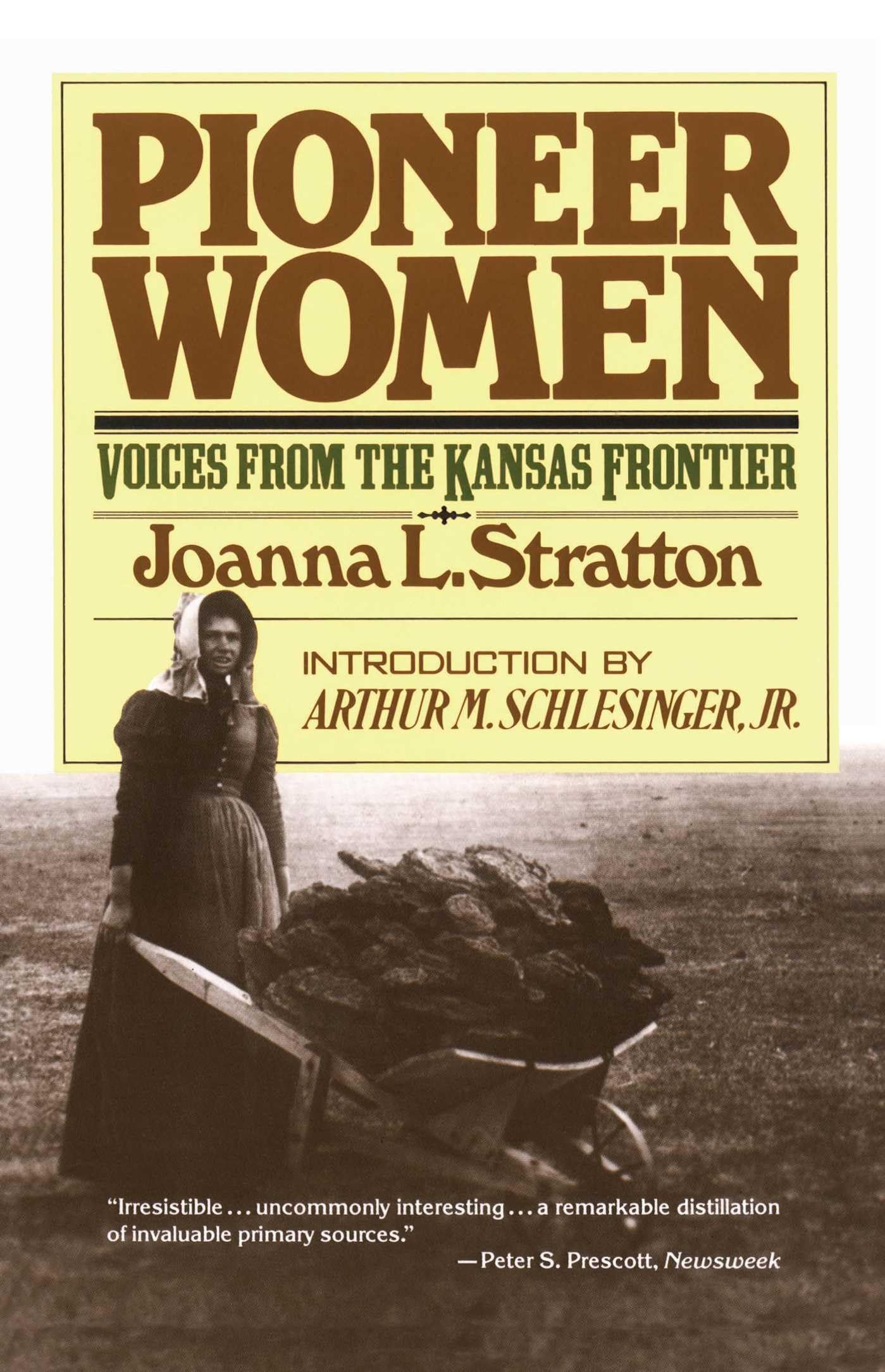



From a rediscovered collection of autobiographical accounts written by hundreds of Kansas pioneer women in the early twentieth century, Joanna Stratton has created a collection hailed by Newsweek as “uncommonly interesting” and “a remarkable distillation of primary sources.” Never before has there been such a detailed record of women’s courage, such a living portrait of the women who civilized the American frontier. Here are their stories: wilderness mothers, schoolmarms, Indian squaws, immigrants, homesteaders, and circuit riders. Their personal recollections of prairie fires, locust plagues, cowboy shootouts, Indian raids, and blizzards on the plains vividly reveal the drama, danger and excitement of the pioneer experience. These were women of relentless determination, whose tenacity helped them to conquer loneliness and privation. Their work was the work of survival, it demanded as much from them as from their men—and at last that partnership has been recognized. “These voices are haunting” ( The New York Times Book Review), and they reveal the special heroism and industriousness of pioneer women as never before. Peter S. Prescott Newsweek Irresistible...uncommonly interesting...a remarkable distillation of invaluable primary sources. Carolyn See Los Angeles Times Book Review Here are the voices of some of the most wonderful women you can imagine calling out from the past, telling about their lives. And no doubt about it, the 'pioneer women' lived eventful lives. All this is wonderful material, wonderful stuff. Cleveland Plain Dealer A striking testimonial to the too often overlooked feminine half of the pioneer experience. Joanna L. Stratton was born and raised in Washington, DC, but considers Kansas and her family there as her second home. She began her work on Pioneer Women while attending Harvard College, from which she graduated with honors in 1976. She is currently pursuing graduate studies at Stanford University. CHAPTER ONE To the Stars Through the Wilderness The Journey "Pioneering is really a wilderness experience. We all need the wisdom of the wilderness -- Moses did, Jesus did, and Paul did. The wilderness is the place to find God, and the city is the place to study the multitude; a knowledge of both makes master builders for the state and nation." Lulu Fuhr They called it "the Great American Desert." In the eyes of early explorers, Kansas appeared to be little more than an arid wasteland, unfit for cultivation and unsuitable for habitation. As a result, the Kansas wilderness remained relatively unknown until the middle of the nineteenth century. Originally a part of the Louisiana Purchase, it had been strictly maintained by the government as an Indian territory and as such was officially closed to any white settlement. Only a trickle of missionaries, soldiers, and surveyors were allowed to penetrate this barren, unfamiliar landscape. But by 1850 an ever-increasing population and a growing economy focused attention on the country's need for new land. Expansive and promising, the Great Plains seemed to answer the call of a nation, and in May 1854 Congress, after considerable debate, passed the Kansas-Nebraska Act. With Kansas and Nebraska now open to settlement, a homesteading fever swept across the country. In Kansas alone, there were nearly fifty million acres of virgin grassland for the taking. People of all backgrounds and nationalities, rich or poor, were entitled to stake their claims and own a share of these untried plains. Within months, settlers from the East, the South, the Midwest and even foreign countries streamed into the prairie heartland. Excited by the cheap land and the new opportunities to be found there, they bravely said goodbye to friends and family and abandoned every routine and comfort of their old lives. "How our friends crowded around us at parting," wrote Lillie Marcks about her family's departure from Tiffin, Ohio, in May 1869. "Some cried and talked of Indians and bears. I was seven years old, had been staying with friends in Tiffin three weeks and they felt so badly about my going west and had me so beautifully dressed that even my father and mother scarcely knew me.... "I recall my mother's headaches on the trip, and many children dirty and cross, and how we longed for the journey's end." Like thousands of other women, Melora Espy gave up the security of family ties and old friendships for the promise of a new life in Kansas. "In the year 1853," wrote her biographer, "a young girl of seventeen, even then the Principal of a Young Ladies School in Toledo, Ohio, joined her fortunes with those of her lover, Henry Jefferson Espy, a young lawyer of Sandusky, Ohio; resigned her position as teacher, and went over the Long Trail to become one of the pioneer women of Kansas. To leave permanently one's home and friends, parents, brothers and sisters; to journey a thousand miles, part of the way in an ox wagon, part of the way in a steamboa