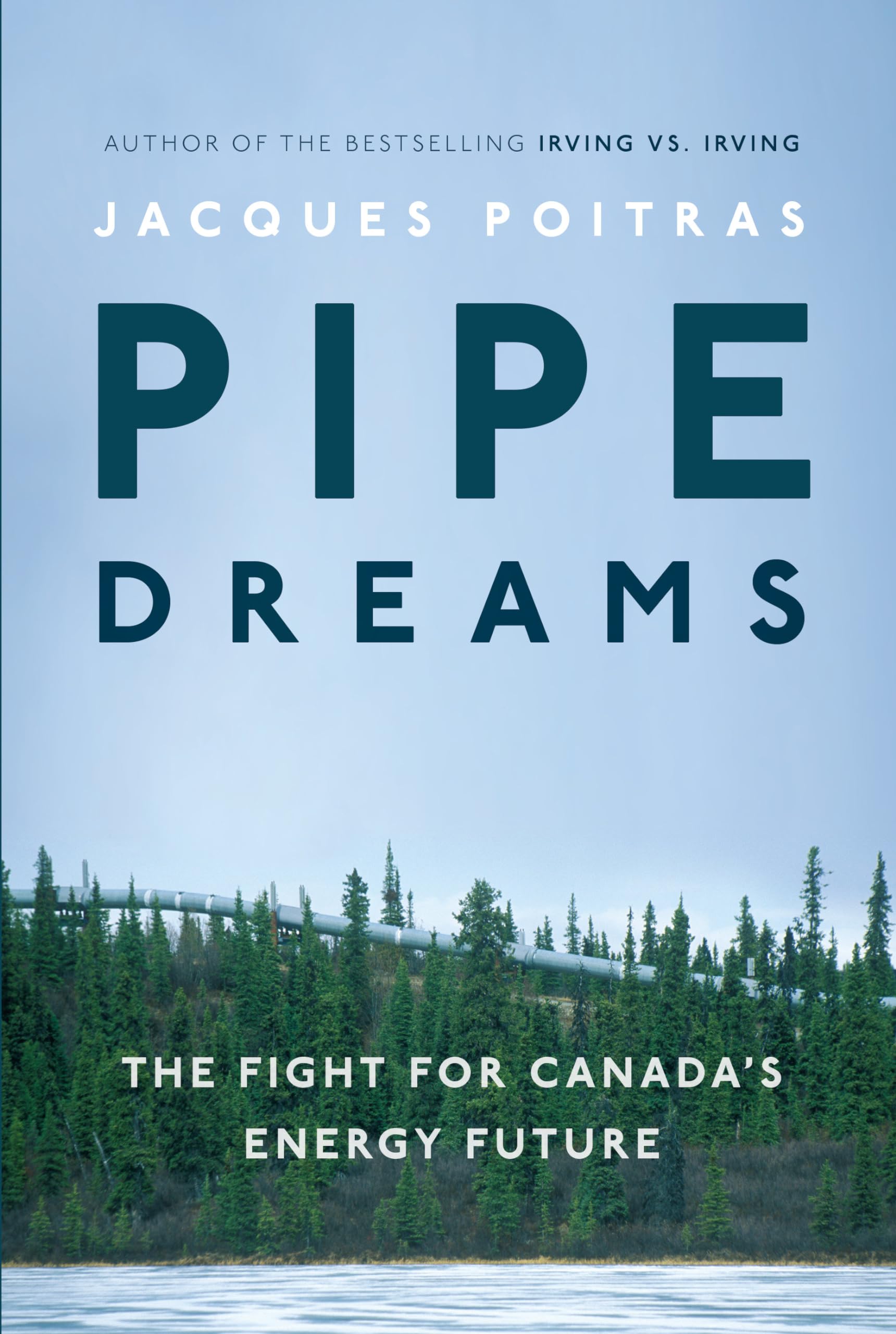



Winner of the 2018 Writers’ Federation of New Brunswick Book Award for Non-Fiction Shortlisted for the 2018 Writers' Trust Shaughnessy Cohen Prize for Political Writing Shortlisted for the 2019 JW Dafoe Book Prize A timely chronicle of how Canada's oil pipelines have become hotbeds for debate about our energy future, Indigenous rights, environmental activism, and east-west political tensions. Pipe Dreams is the dramatic story of the rise and fall of the Energy East pipeline and the broader battle over climate and energy in Canada. The project was to be a monumental undertaking, beginning near Edmonton, AB, and stretching over four thousand kilometres, through Montreal to the Irving Oil refinery in Saint John, NB. Conceived as a back-up plan for the stalled Keystone XL pipeline, it became the crucible for a national debate over the future of oil. In a cross-country journey, Poitras talked to industry executives, prairie ranchers, First Nations chiefs, mayors, premiers, cabinet ministers, and refinery workers. He also explored Canada's perplexing oil relationship with the United States: our industry is literally tied to its American counterpart with sinews of steel. The Energy East pipeline represented a new direction, designed to get Alberta oil sands crude to lucrative world markets. Yet it was promoted in explicitly nationalist terms: the country was said to be reorienting itself along its east-west axis, tying itself together, again, with a great feat of engineering. By the time the journey ended, the story had become a kind of whodunit: Poitras witnessed the slow-motion killing of the fifteen billion dollar project. Unfolding in tandem with clashes over the Trans Mountain pipeline, Energy East's demise heralded a potential turning point not just for a single proposal, but for Canada's carbon economy. Entertaining, informative, and insightful, Pipe Dreams offers a clear picture of the complicated political, environmental, and economic issues that Canadians face. Winner of the 2018 Writers’ Federation of New Brunswick Book Award for Non-Fiction Shortlisted for the 2018 Writers' Trust Shaughnessy Cohen Prize for Political Writing Shortlisted for the 2019 JW Dafoe Book Prize JACQUES POITRAS has been the provincial affairs reporter for CBC News in New Brunswick since 2000. He is the author of The Right Fight: Bernard Lord and the Conservative Dilemma ; Beaverbrook: A Shattered Legacy, which was a finalist for the BC National Award for Canadian Non-Fiction; and Imaginary Line: Life on an Unfinished Border , which was a finalist for the Shaughnessy Cohen Prize for Political Writing. His fourth book, Irving vs. Irving , was shortlisted for the National Business Book Award and won the Atlantic Independent Booksellers' Choice Award for 2015. IN HARDISTY, ALBERTA, PEOPLE get things done . People like Lori Goodrich—who in the fall of 2009 “got wind,” as she put it, that Canadian Pacific Railway would demolish its derelict train station at the edge of town. Word gets around fast in a town of seven hundred people. Goodrich, an amateur historian, was more alarmed than most. The CPR had made Hardisty: in 1904, the railway chose a location near the Battle River as the site of a freight depot where equipment and horses could be loaded onto cars on the new Edmonton–Saskatchewan branch line. People poured in, and in 1911 the town, named for Richard Hardisty, a Hudson’s Bay fur trader who negotiated with Louis Riel and became Alberta’s first senator, was incorporated. “The population then was probably bigger than it is now,” Goodrich told me. Hardisty became a rail–farm hub and a commercial connection to the wider world; the station was a monument to that history. “It was the last one of this design left in Alberta,” she said. “It was the oldest building in Hardisty, and it was rundown. Terrible. We took it upon ourselves to save it.” Goodrich recruited several family members and they went to work. They bought the station for a dollar, had it lifted and trucked a half kilometre to a new location near the town’s main intersection, and then spent most weekends over the next couple of years sprucing it up. “We left the original walls, but we gutted it.” They made one room available for a local wellness program and rented another for conferences. Oil companies used it for meetings. Tea, coffee, and smoothies were served, and the station became a going concern. But in 2012 the labour of love became a burden when Goodrich’s brother-in-law was diagnosed with terminal cancer, and they sold the station to a local entrepreneur. Clayton Hinkey agreed to maintain the building “as close to the original as possible” as he transformed it into a sports bar called the Leaf, which catered mainly to workers in Hardisty’s oil and gas industry. Lori Goodrich had the open, outgoing demeanour typical of the local do-gooder. Her gold jewellery reflected her sunny disposition as the cool light of the early aftern