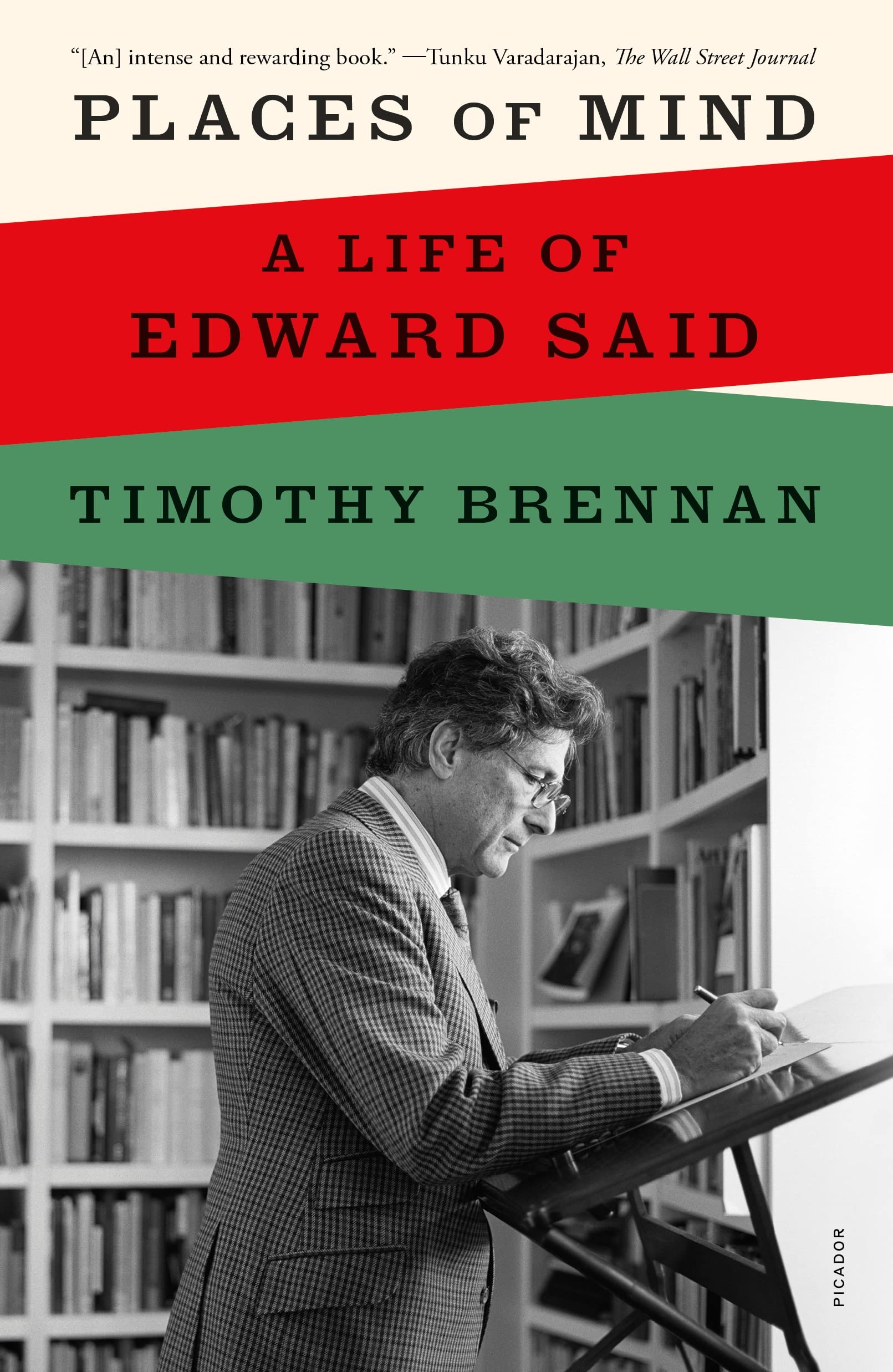



A New York Times Book Review Editors’ Choice The first comprehensive biography of the most influential, controversial, and celebrated Palestinian intellectual of the twentieth century. Both controversial and beloved, Edward Said was the pioneer of postcolonial studies, a tireless champion for his native Palestine, and an erudite literary critic whose books, namely Orientalism , continue to impact students and thinkers today. In Places of Mind , Timothy Brennan―who studied under Said and remained a friend until Said’s death in 2003―provides the first complete biography of his thesis adviser, who emerges as a self-doubting, tender, eloquent advocate of literature’s dramatic effects on politics and civic life. Charting the intertwined routes of Said’s intellectual development, Places of Mind reveals him to be a brilliant iconoclast: a cajoler and strategist, a New York intellectual with a foot in Beirut, an orchestra impresario in Weimar and Ramallah, a raconteur on national television, a Palestinian negotiator at the State Department, and an actor in films in which he played himself. Brennan traces the Arab influences on Said’s thinking along with the tutelage by Lebanese statesmen, offbeat modernist auteurs, and New York literati as Said grew into a scholar whose writings changed the face of university life forever. With both intimidating intellect and charm, Said melded these teachings into a groundbreaking and influential countertradition of radical humanism set against the backdrop of techno-scientific dominance and religious war. With unparalleled clarity, he gave the humanities a new authority in the age of Reaganism, one that continues today. Drawing on the testimony of family, friends, students, and antagonists alike, and aided by FBI files and Said’s unpublished writings, drafts of novels, and personal letters, Places of Mind synthesizes Said’s intellectual breadth and influence into an unprecedented, intimate, and compelling portrait of one of the great minds of the twentieth century. "Brennan’s achievement is to do justice to the many things Said was and to articulate the synapses that connected his different worlds, so ideas that had their birth in one found their use in another. He has provided us with what you might call a manual of Said; a map of his thoughts and his positions, which, change as they did, could always be traced to a core set of ideas and drives and to do this without ever blunting Said’s subtlety or smudging the clarity of his ideas." ―Ahdaf Soueif, The Guardian “[A] rich explication of Said’s trajectory . . . Brennan is very fine on the evolution of Said’s thought and writing, as well as on his return, after his leukemia diagnosis in 1991, to the music that had been central to his youth . . . Said’s vitality and lasting importance as both a scholar and a public figure emerge strongly in these pages.” ―Claire Messud, Harper’s "A remarkably unhindered and often incisive intellectual portrait of its subject . . . The drama of [Said's] mind is given a good airing. Brennan concentrates on what Said most cared about in his work: a wise decision, since those are the reasons we still read him." ―Thomas Meaney, New Statesman " Places of Mind is an intellectual biography for which Brennan enjoyed unprecedented access to Said’s private papers and letters . . . Nuanced [and] intimate." ―Avi Shlaim, Financial Times "Brennan draws on an imposing array of material to write the first comprehensive portrait of one of America’s most distinguished postwar intellectuals." ―Ayten Tartici, The New York Times Book Review "[An] intense and rewarding book." ―Tunku Varadarajan, The Wall Street Journal "Brennan’s book is a rich intellectual history, summarizing the content of Said’s major works, tracing the conditions of their creation, and mapping their influence. In detailing how specific conversations and locations stimulated his writing, and discussing the nature of Said’s unpublished poetry, fiction, and essays, Brennan breathes new life in a crowded field of Said studies." ―Esmat Elhalaby, Boston Review "A sharply incisive portrait. Drawing on abundant archival sources, Said’s hefty FBI file, his published and unpublished works, and hundreds of interviews, Brennan . . . traces the evolution of a boldly transformative, controversial thinker . . . Exemplary scholarship informs [this] absorbing biography." ― Kirkus Reviews (starred review) "[A] meticulous account . . . Brennan’s work will be invaluable reading for students of Said or the postcolonial critical movement his work sparked." -- Publishers Weekly (starred review) "Brennan effectively uses a range of primary sources to provide insight into what influenced Said’s thinking, and how he handled criticism of his noteworthy work . . . Brennan has succeeded in writing an account that is both an act of love and a solid study of a fascinating man." ― Library Journal (starred review) "Given the s