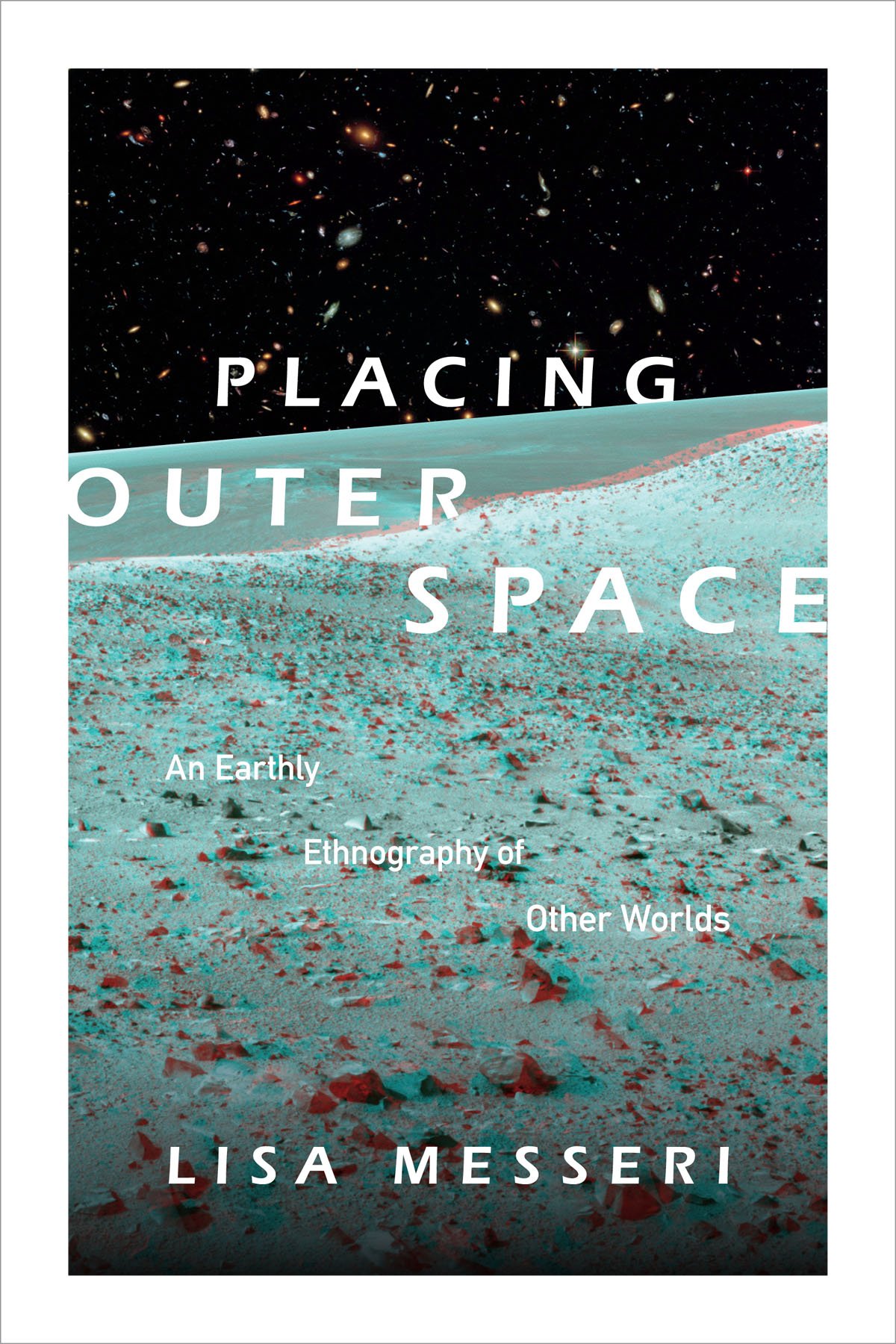
Placing Outer Space: An Earthly Ethnography of Other Worlds (Experimental Futures)
$23.00
by Lisa Messeri



In Placing Outer Space Lisa Messeri traces how the place-making practices of planetary scientists transform the void of space into a cosmos filled with worlds that can be known and explored. Making planets into places is central to the daily practices and professional identities of the astronomers, geologists, and computer scientists Messeri studies. She takes readers to the Mars Desert Research Station and a NASA research center to discuss ways scientists experience and map Mars. At a Chilean observatory and in MIT's labs she describes how they discover exoplanets and envision what it would be like to inhabit them. Today’s planetary science reveals the universe as densely inhabited by evocative worlds, which in turn tells us more about Earth, ourselves, and our place in the universe. "To become an exoplanet scientist, Messeri shows (in part by undergoing some training herself), is to learn to see and convey these abstractions as something more relatable — as 'super-Earths' or 'mini-Neptunes' or such. 'To excite the community about a particular visualization,' as Messeri nicely puts it, 'is to convince them that the image contains a world.' And to really excite the community, presumably, is to convince them that a world contains little green men." -- James Ryerson ― New York Times Book Review " Placing Outer Space is a welcome addition to the literature on planetary science. Not only has Messeri achieved what has eluded so many writers—putting humans at the center of the account—she has also succeeded in crafting a compelling narrative of discovery." -- Matthew Shindell ― Physics Today "Messeri’s book is an excellent addition to both the increasing scholarship concerning the cosmos in science and technology studies and the resurgent field of outer space anthropology. Her thorough analysis of place-making practices by an often insulated community is accompanied by her vivid and absorbing ethnographic writing. Placing Outer Space is an excellent example of academic writing that is supremely beneficial and accessible to both the academy and the public" -- Taylor R. Genovese ― LSE Review of Books "Messeri is to be commended for crafting an engaging account that is fully accessible to an outside audience. Her beautiful ethnographic narrative and clear applications of theory make her readers feel comfortable. . . . For anthropologists attempting to pen a scholarly monograph that engages both the broader public and the community they study, this is a worthy example." -- Janet Vertesi ― American Anthropologist "Lisa Messeri's spirit of adventurous ethnographic contact carries the day, delivering new insights into off-Earth explorations by experts and amateurs alike. In bringing us, up close, to those engaged in fashioning new home worlds and remapping the cosmos, Messeri urges us to follow the future making. That enterprise is in good hands." -- Debbora Battaglia ― American Ethnologist "A thoughtful investigation of planetary science. . . . Students of the history of science and astronomy will find many new ideas here that are worth pondering." -- Maria Lane ― Journal of Anthropological Research "A first-rate example of ethnographic research into the epistemological frameworks that shape the work of astronomers engaged in planetary science. Messeri has produced a superb discussion of how scientists move the unfamiliar into the realm of the familiar." -- John W. Traphagan ― Journal of the Royal Anthropological Institute "Part cosmic travelogue, part scholarly analysis, in Placing Outer Space: An Earthly Ethnography of Other Worlds , Lisa Messeri refreshingly interprets the planetary scientist's methods and tools and orbs-of-interest through the lens of a curious anthropologist. From there we gain insight into who we really are as explorers, and what motivates our endless search for worlds beyond." -- Neil deGrasse Tyson, Astrophysicist, American Museum of Natural History Lisa Messeri is Assistant Professor of Anthropology at Yale University. Flyboy 2 The Greg Tate Reader By Greg Tate Duke University Press Copyright © 2016 Greg Tate All rights reserved. ISBN: 978-0-8223-6203-6 Contents Introduction: Lust, of All Things (Black), 1. The Black Male Show, 2. She Laughing Mean and Impressive Too, 3. Hello Darknuss My Old Meme, 4. Screenings, 5. Race, Sex, Politricks, and Belles Lettres, Sources, Index, CHAPTER 1 The Black Male Show Amiri Baraka 1934–2014 I think about a time when I will be relaxed. When flames and non-specific passions wear themselves away. And my eyes and hands and mind can turn and soften and my songs will be softer and lightly weight the air. — AMIRI BARAKA Nabokov told us that all a writer has to leave behind is his or her style. Amiri Baraka made the reading populace deal with a rowdy, robust gang of style. Miles Davis (whose powers of concentration, condensation, and cool Baraka emulated in his poetics) once said he only had use fo