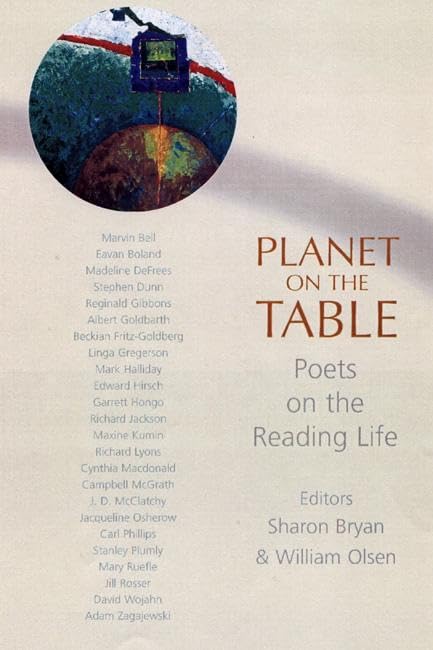



"The tone may vary from one essay to another, but more than anything else, these are love stories, not rose-colored romances, but love that includes doubt, violence, wrestling with angels, and devils."—From the Introduction CONTRIBUTORS: Eavan Boland Madeline DeFrees Stephen Dunn Reginald Gibbons Edward Hirsch Maxine Kumin J.D. McClatchy Carl Phillips Stanley Plumly Mary Ruefle Adam Zagajewski and many others! Reading is a passion, an addiction, and, for poets, one-half of the writing equation. As Marvin Bell states in his contribution to this vital and illuminating collection of essays about reading by poets, "Learning to write is a simple process: read something, then write something," and indeed, there isn't a poet present who doesn't read ardently and unquenchably. Jacqueline Osherow describes reading as "anchored daydreaming." Albert Goldbarth intones, "Read everything." Maxine Kumin confesses that her "personal reading habits are hopelessly eclectic and voracious," and Adam Zagajewski describes himself as a "chaotic reader" drawn to "books of memory and ecstasy." As these quotes suggest, many of the essays are autobiographical, but Edward Hirsch, Linda Gregerson, and Stanley Plumly (the volume's evocative title is his) present brilliant works of literary criticism; Garrett Hongo offers a reading list; and Campbell McGrath conjures a metaphoric visit to the "Republic of Poetry" and the "Kingdom of Fiction." In all, 25 poets share their love for and insights into the fine art of reading in this glowing sphere of an anthology. Donna Seaman Copyright © American Library Association. All rights reserved Planet on the Table is the fifty-fourth title to be published by Sarabande Books, a nonprofit literary press headquartered in Louisville, Kentucky. Founded in 1994 to publish poetry and short fiction, Sarabande's mission is to disburse these works with diligence and integrity, and to serve as an educational resource to teachers and students of creative writing. Since the 1996 debut of the press, our titles have received positive review attention from nationally distinguished media including The New York Times Book Review, Publishers Weekly, Kirkus Reviews, American Book Review, Small Press, The Nation, and Library Journal. Sharon Bryan, coeditor of Planet on the Table: Poets on the Reading Life (Sarabande Books, 2003), is also the author of Flying Blind, her third collection of poems which appeared from Sarabande Books in 1996. The first two collections, Salt Air and Objects of Affection, were published by Wesleyan University Press. She is also the editor of Where We Stand: Women Poets on Literary Tradition (Norton, 1993). Her awards include an Academy of American Poets prize, the Discovery Award from The Nation, and two fellowships in poetry from the National Endowment for the Arts. She was poet-in-residence at The Frost Place in 1993. She teaches as a visiting writer, most recently at Missouri State University in St. Louis. William Olsen is the author of two collections of poetry, The Hand of God and a Few Bright Flowers (Illinois, 1988) and Vision of a Storm Cloud (TriQuarterly, 1996). A third volume, Trouble Lights, will be brought out by TriQuarterly in November, 2001. Olsen is the recipient of a NEA Creative Writing Fellowship, The Nation/Discovery Award, a Texas Institute of Arts Award, a Bread Loaf Fellowship, and poetry awards from Poetry Northwest and Crazyhorse. His poems and essays have appeared in The New Republic, Chicago Review, The Paris Review, The Southern Review, New American Poets of the Nineties, The New Bread Loaf Anthology of Contemporary American Poetry, Poets of the New Century (Godine, November 2001), and many other magazines and anthologies. He teaches at Western Michigan University and in the MFA Program at Vermont College. "Someone Reading a Book Is a Sign of Order in the World" an essay by Mary Ruefle When I was forty-five years old, I woke up on an ordinary day, neither sunny nor overcast, in the middle of the year, and I could no longer read. It was at the beginning of one of those marvelous sentences that only Nabokov can write: Mark felt a sort of delicious pity for the frankfurters.... In my vain attempts I made out felt hat, prey, the city of Frankfort. But the words that existed so I might read them sailed away, and I was stranded on a quay while everything I loved was leaving. And then it was I who was leaving: a terror seized me and took me so high up in its talons that I was looking helplessly down on a tiny, unrecognizable city, a city I had loved and lived in but would never see again. I needed reading glasses, but before I knew that, I was far far away. The book I was reading I was rereading. Because some time before that terrible day I had reached a juncture in my reading life that is familiar to those who have been there: in the allotted time left to me on earth, should I read more and more new books, or should I cease with that vain consumption