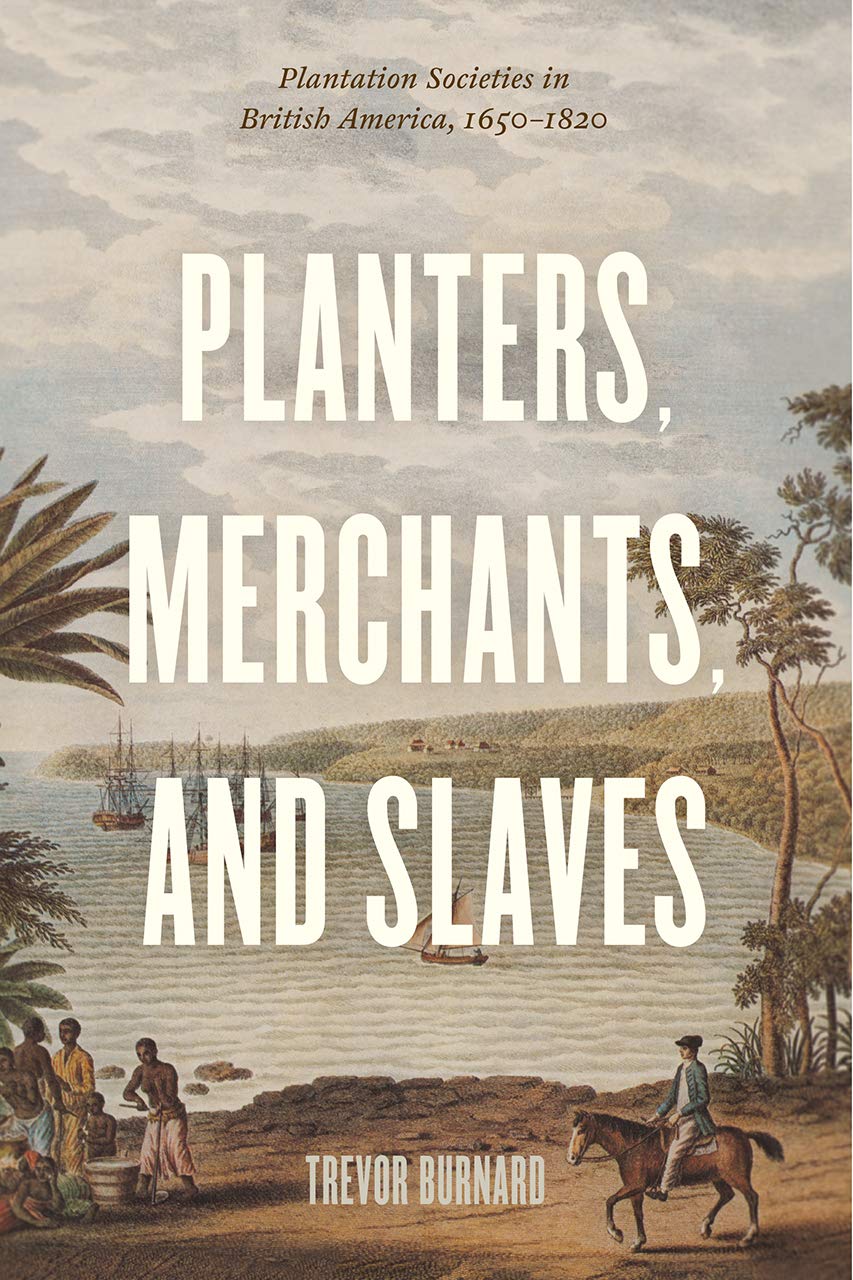
Planters, Merchants, and Slaves: Plantation Societies in British America, 1650-1820 (American Beginnings, 1500-1900)
$35.00
by Trevor Burnard



As with any enterprise involving violence and lots of money, running a plantation in early British America was a serious and brutal enterprise. In the contentious Planters, Merchants, and Slaves , Burnard argues that white men did not choose to develop and maintain the plantation system out of virulent racism or sadism, but rather out of economic logic because—to speak bluntly—it worked. These economically successful and ethically monstrous plantations required racial divisions to exist, but their successes were measured in gold, rather than skin or blood. Sure to be controversial, this book is a major intervention in the scholarship on slavery, economic development, and political power in early British America, mounting a powerful and original argument that boldly challenges historical orthodoxy. “Burnard gives us a commanding work of scholarly synthesis and layers it with original research to offer a provocative meditation on the meaning of plantation societies in the early modern Atlantic world. Planters, Merchants, and Slaves draws the Chesapeake, Carolina Lowcountry, and British Caribbean into a single interpretive frame and, by doing so, highlights British Plantation America’s enormous dynamism and significance.” ― S. Max Edelson, author of Plantation Enterprise in Colonial South Carolina “In this social, economic, and demographic history, Burnard brilliantly anatomizes the British plantation system and plantation slavery. His conspectus ranges over nearly two centuries, from Guyana to the Chesapeake. It bristles with insight and even finds new meaning in the American Revolution. Novice students and grizzled scholars alike will find much to appreciate in Burnard’s pages.” ― J.R. McNeill, author of Mosquito Empires: Ecology and War in the Greater Caribbean, 1620–1914 “Peppered with provocative arguments—regarding the military, what today we would call race hatred, and the American Revolution’s legacy of enslavement—Burnard’s work makes its main contribution in the detail with which he limns out the history of the plantation sector. . . . In following the arc of this history, Burnard’s greatest contribution may be in his careful comparative work across regions that scholars often treat as distinct. . . . Not all readers will agree with each of his interpretations but he offers us a compelling framework for thinking about slavery and its place within the British Empire and the new United States. It is a tribute to his accomplishment that we come away wishing that the book went beyond the various regions within plantation British America to illuminate in addition the plantation societies founded by others.” -- Carla Gardina Pestana ― Journal of Early American History “Burnard’s wide reading, along with his willingness to challenge long-held assumptions, means that his book hews a fresh path across several overlapping fields. He may well prompt disagreements, but those who read him are all likely to benefit from the freshness of his observations and the range of his examples. Readers will come away from this book with plenty of new insights.” -- James Robertson ― Journal of Early American History “Burnard’s synthesis recognizes the distinctive regions of plantation America—the Chesapeake tobacco economy, the Carolina Low Country rice economy, and the Caribbean sugar economy—while also recognizing systemic structural regularities. These included powerful local elites, destructive and violent slave regimes, and wealth that benefited local elites and metropoles but not an entire colony. Burnard especially treats Jamaica, Virginia, and the effects of the American Revolution. He demonstrates that the plantation system was, from an imperial perspective, an economic success, even though its wealth was only a tiny proportion of the metropolitan economy. The author does not intend this demonstration of economic rationality to mitigate the social, demographic, and environmental devastations of the system that have been so well documented. Recommended.” ― Choice “Given Burnard’s extensive experience writing about and researching slavery in various sites across this vast region—Maryland, Jamaica, and Demerara, most notably—it is hard to imagine a guide better positioned to lead an excursion through this vast historiography. And indeed, the book ably draws examples and insights from the whole region, with attention to both commonalities and contrasts. No simple Caribbean-versus-North America binary emerges. Instead, plantation colonies shared broad profitability rooted in their common reliance on violence. Nonetheless, various colonies and regions remained distinct from each other due to variations of crop, size, time of development, geography, internal politics, and degree of economic diversity. It is a tremendous challenge for a work of synthesis to avoid flattening out the picture of the places it covers, and Burnard succeeds in summarizing while keeping local variation in focus.” ― William and