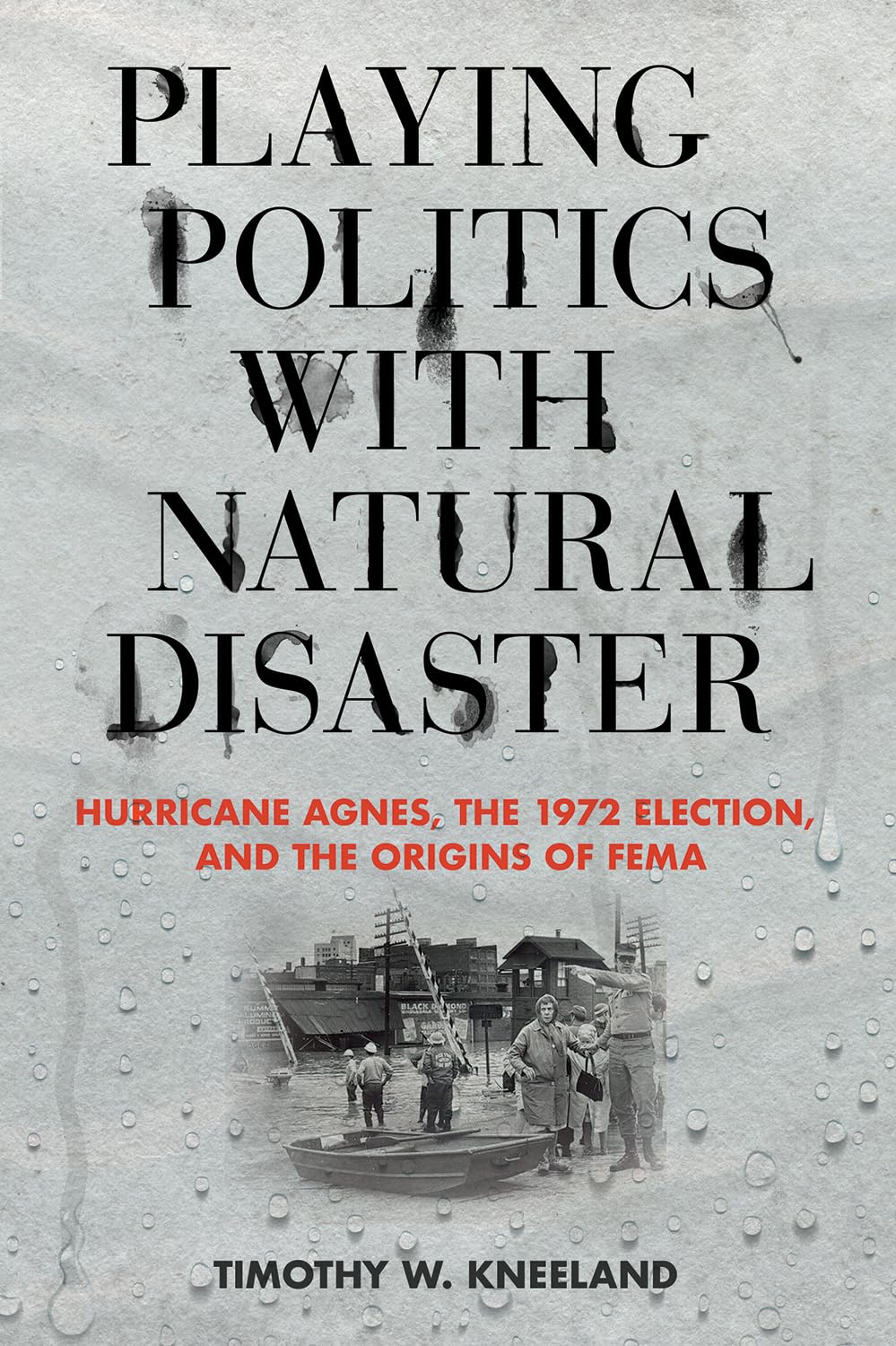
Playing Politics with Natural Disaster: Hurricane Agnes, the 1972 Election, and the Origins of FEMA
$27.64
by Timothy W. Kneeland



Hurricane Agnes struck the United States in June of 1972, just months before a pivotal election and at the dawn of the deindustrialization period across the Northeast. The response by local, state, and national officials had long-term consequences for all Americans. President Richard Nixon used the tragedy for political gain by delivering a generous relief package to the key states of New York and Pennsylvania in a bid to win over voters. After his landslide reelection in 1972, Nixon cut benefits for disaster victims and then passed legislation to push responsibility for disaster preparation and mitigation on to states and localities. The impact led to the rise of emergency management and inspired the development of the Federal Emergency Management Agency (FEMA). With a particular focus on events in New York and Pennsylvania, Timothy W. Kneeland narrates how local, state, and federal authorities responded to the immediate crisis of Hurricane Agnes and managed the long-term recovery. The impact of Agnes was horrific, as the storm left 122 people dead, forced tens of thousands into homelessness, and caused billions of dollars in damage from Florida to New York. In its aftermath, local officials and leaders directed disaster relief funds to rebuild their shattered cities and reshaped future disaster policies. Playing Politics with Natural Disaster explains how the political decisions by local, state, and federal officials shaped state and national disaster policy and continues to influence emergency preparedness and response to this day. Kneeland's prose is sharp, to be sure, and his research quite impressive. The historical context is richly detailed, with comic and tragic anecdotes throughout. Perhaps its greatest strength is its depth at the local level, as Kneeland introduces many actors from the known to the obscure. ― H-Net One of the virtues of Kneeland's account of Hurricane Agnes is his comparative approach. He explores the response to Agnes in two medium-sized New York cities-Corning and Elmira-and in Wilkes-Barre, Pennsylvania. Kneeland's most important contribution may be his emphasis on contingency. [I]t is Kneeland's exploration of the 'local context of disaster' that distinguishes these studies. ― New York History Kneeland's prose is sharp, to be sure, and his research quite impressive. The historical context is richly detailed, with comic and tragic anecdotes throughout. Perhaps its greatest strength is its depth at the local level, as Kneeland introduces many actors from the known to the obscure. Scholarly readers and environmental historians will certainly find much useful here, especially the author's rendering of the political atmosphere in the 1970s and grasp of disaster management's intricacies ― H-Environment Timothy W. Kneeland's Playing Politics with Natural Disaster is much more than a well-researched, definitive account about one of America's most devastating natural disasters. It's a cautionary tale of the potentially brutal personal toll political gamesmanship can levy on our communities. -- Brian Frey, writer and producer of the PBS documentary, Agnes Timothy W. Kneeland is Professor and Chair of History and Political Science at Nazareth College in Rochester, New York, and the author of several other books, including Pushbutton Psychiatry , Today's Social Issues , and Buffalo Blizzard of 1977 . Follow him on X @CPH_Naz.