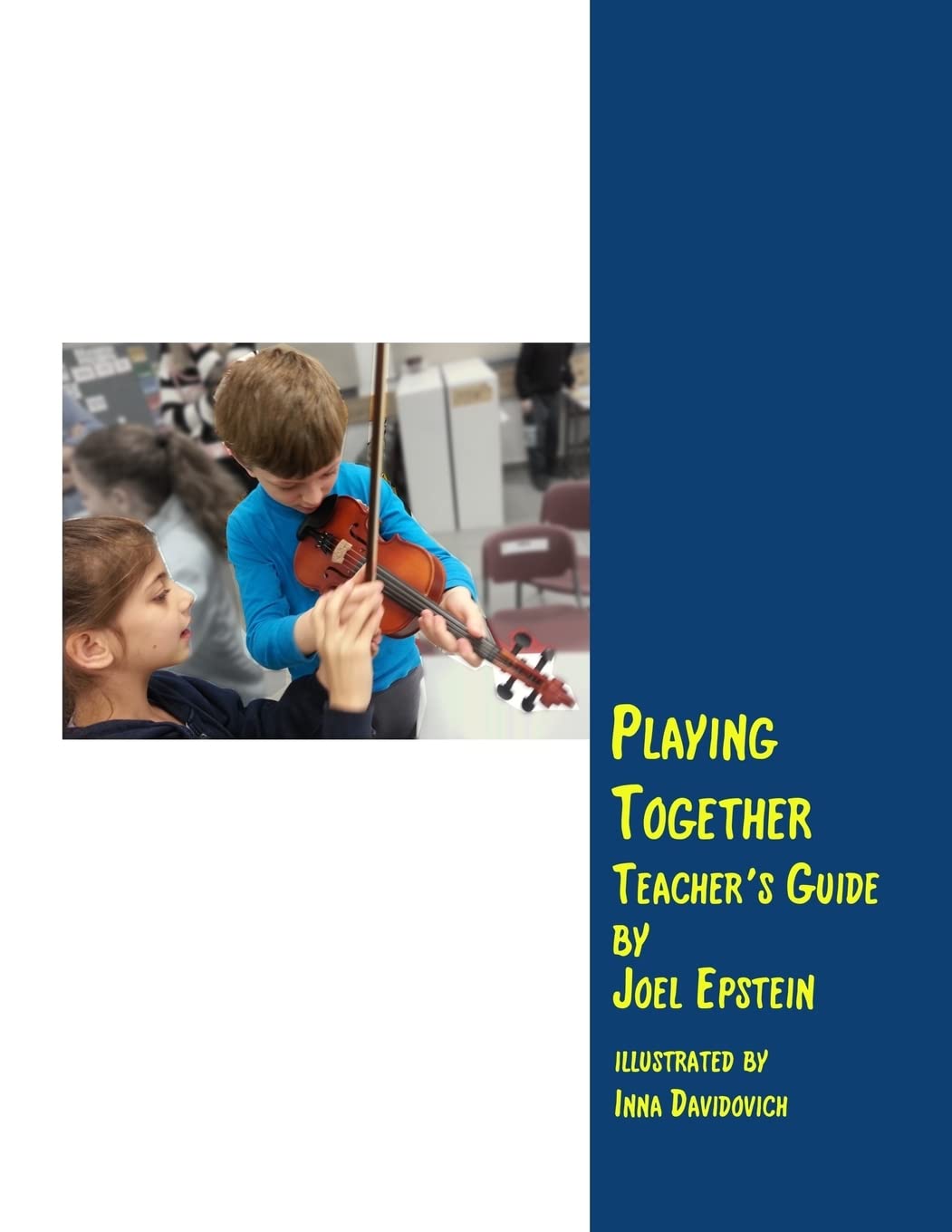
Playing Together Teacher's Guide: A guide for teaching violin in groups
$12.99
by Joel Epstein



This book is a guide for teaching violin in classes. Teaching violin in a classroom is fundamentally different from individual tuition: the students are different, the objectives are different, the challenges and the rewards are different. In this guide, Joel Epstein brings years of experience and research in classroom violin teaching. In a breezy and informal style, he covers all the important topics and resources related to the topic, and offers a 12-step course of instruction, including supplemental materials to make violin class a meaningful and rewarding experience for both students and teacher.The teachers guide is a companion volume to Playing Together: Student Workbook. While the two are meant to be used together, the teacher's guide contains much invaluable information and guidance, even if you don't use the student workbook. "This is a completely fresh approach to classroom teaching of the violin. I have never seen anything like it." - Dana Miller, Director of the String Program, Walther Elementary School, Durham NC "I love your breezy, laid-back approach. My kids just love to play 'The Hiccup Song' and 'Mad, Mad, Mad'." - Sandra Caine, Violin teacher, Chicago IL "Thank you, Mr. Epstein, for this guide and student workbook. It has made my classes a great pleasure for my students and for myself." - David Okoro, School String Teacher, Ilishan Remo, Ogun, Nigeria When I started teaching violin in the Israeli public schools five years ago, I searched everywhere for material on teaching violin in the classroom. I found almost nothing. All the violin methods I found - including many that say on the cover "String Class Method" - are geared to individual tuition. I felt that teaching groups in schools required a fundamentally different approach. And so, I started gathering materials and wrote my own book. Teaching in the Israeli school system violin program is certainly the toughest job in the music industry in this country. The kids are rambunctious, impatient and easily frustrated. And the schools where I teach - in Lod, a mixed Arab-Jewish city near Tel Aviv - are the toughest of the lot. In addition toall the other problems, these kids are largely poor, many speak only Arabic (which I do not), and many of the schools are dilapidated and overcrowded. Some of the schools have no music education program other than the two hours a week the kids spend with me. Never mind. I love it. Every day is a challenge and everyday brings new rewards. After a lot of work and a lot of imagination, I have succeeded in sparking their imagination, in getting them to work together and to make music together. And the techniques, the games and the music that I have gathered and developed over the years, I offer to you in this volume. Juwal Publications was the original publishing house of the St. Petersburg Society for Jewish Folkmusic, a seminal group of Russian Jewish composers at the beginning of the last century who created a new form of Jewish Art Music, combining traditional klezmer melodies with the rich chromatic harmonies of late Russian Romanticism. The Juwal name has been recently revived to bring the public important new books, recordings, and compositions related to music pedagogy and Jewish and Israeli music. After a 35-year career in computer technology, Joel Epstein has returned to his first love - music. Since 2009 he has been teaching violin in public schools in Israel. This book and its companion volume, "Playing Together Student Workbook", is the culmination of seven years of experience in teaching violin to elementary students in groups.