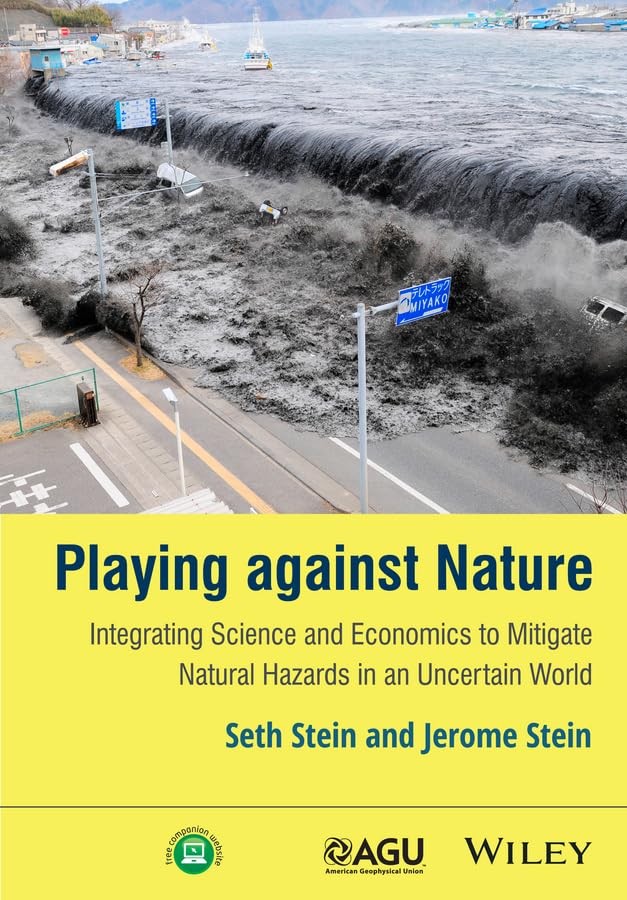
Playing against Nature: Integrating Science and Economics to Mitigate Natural Hazards in an Uncertain World (Wiley Works)
$69.18
by Seth Stein



Defending society against natural hazards is a high-stakes game of chance against nature, involving tough decisions. How should a developing nation allocate its budget between building schools for towns without ones or making existing schools earthquake-resistant? Does it make more sense to build levees to protect against floods, or to prevent development in the areas at risk? Would more lives be saved by making hospitals earthquake-resistant, or using the funds for patient care? What should scientists tell the public when – as occurred in L’Aquila, Italy and Mammoth Lakes, California – there is a real but small risk of an upcoming earthquake or volcanic eruption? Recent hurricanes, earthquakes, and tsunamis show that society often handles such choices poorly. Sometimes nature surprises us, when an earthquake, hurricane, or flood is bigger or has greater effects than expected from detailed hazard assessments. In other cases, nature outsmarts us, doing great damage despite expensive mitigation measures or causing us to divert limited resources to mitigate hazards that are overestimated. Much of the problem comes from the fact that formulating effective natural hazard policy involves combining science, economics, and risk analysis to analyze a problem and explore the costs and benefits of different options, in situations where the future is very uncertain. Because mitigation policies are typically chosen without such analysis, the results are often disappointing. This book uses general principles and case studies to explore how we can do better by taking an integrated view of natural hazards issues, rather than treating the relevant geoscience, engineering, economics, and policy formulation separately. Thought-provoking questions at the end of each chapter invite readers to confront the complex issues involved. Readership : Instructors, researchers, practitioners, and students interested in geoscience, engineering, economics, or policy issues relevant to natural hazards. Suitable for upper-level undergraduate or graduate courses. Additional resources can be found at: http://www.wiley.com/go/Stein/Playingagainstnature This book addresses the elephant in the room; 'why are hazard assessments failing', and 'what strategies can we use to minimize losses from disasters and from efforts to mitigate them?' from the perspective of a father and son, world renowned and prolific scientists in economics and geophysics. If, as a society, we are really interested in winning our game against nature, this book points the way by objectively dealing with uncertainties in natural hazard assessments and being 'careful, thoughtful gamblers.' Ron Harris, Geological Sciences, Brigham Young University This is exactly the book that scientists, economists, and politicians need to read.Urbanization and development make the potential cost and death toll of natural hazards much greater than in past centuries. With limited resources, how should societies respond? How should they allocate funds, limit development, or regulate construction? Playing Against Nature provides a sound evidence-based approach to answering these and related questions, and should be required reading by every political administration." Michael Wysession, Chair of Earth Science Literacy Initiative, Washington University “This is truly an amazing book! The product of a unique collaboration between a renowned economist and renowned seismologist (who happen to be father and son), Playing against Nature lays out a clear story, in easy-to-read prose, of what natural disasters are, what the limitations of risk prediction can be, and how society's response to them has to account for the reality that we have limited economic resources. The authors present fascinating case studies to illustrate examples of where predictions have failed, and why. They also take a bold step by showing how natural disasters and economic disasters provide similar challenges, and provide a clear description of how risk should be assessed, and how it can be mitigated reasonably. This is a book that researchers, policy makers, and the general public should read. It can even serve as valuable text for the new generation of interdisciplinary college courses addressing the interface between science and social science.” (Stephen Marshak, Professor and Director of the School of Earth Society and Environment, University of Illinois at Urbana-Champaign) “I very highly recommend this book for anyone dealing with or interested in natural hazards assessment and mitigation. It is a tour de force with examples, descriptions, illustrations, reference lists, and explanations for understanding natural disasters and negotiating the often perilous and misguided approaches for hazards mitigation. This book is a huge achievement in that it has collected an enormous amount of relevant information, case studies, economics and engineering factors, loss statistics, references, and even study guides and questions