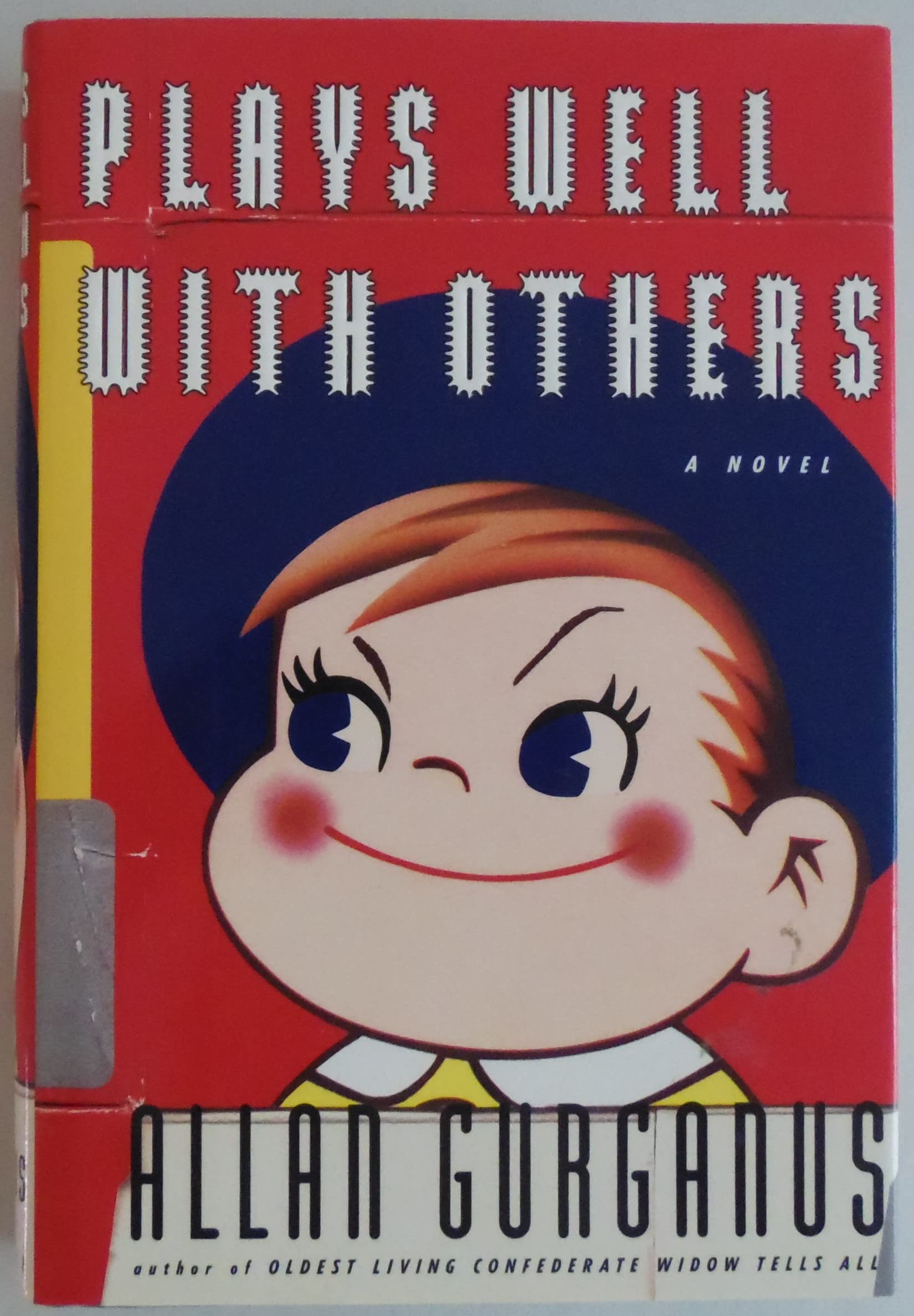



In his widely read, prizewinning Oldest Living Confederate Widow Tells All, Allan Gurganus gave fresh meaning to an overexplored American moment: 1860-65. He now turns that comic intensity and historical vision to another war zone: entry-level artistic Manhattan 1980-95. In his first novel since Widow, Gurganus offers us an indelible, addictive praise-song to New York's wild recent days, their invigorating peaks and lethal crashes. It's 1980, and Hartley Mims jr., a somewhat overbred Southerner, arrives in town to found his artistic career and find a Circle of brilliant friends. He soon discovers both Robert Christian Gustafson, archangelic boy composer of Symphony no. 1: The Titanic, and Alabama Byrnes, a failed Savannah debutante whose gigantic paintings reveal an outsized talent that she, five feet tall, can't always live up to. This circle--sexually venturesome, frequently hungry, hooked on courage, caffeine, and the promise of immortality--makes history and most everybody else. Their dramatic moment in New York history might've been a collaboration begun, as a toast, by Cole Porter and finished, as pure elegy, by Poe himself. Plays Well with Others is a fairy tale. It has a Legend's indoctrinating charm and hidden terrors. It chronicles a ragtag group of gifted kids who come to seek their fortunes; they find the low-paying joys of making art and the heady education only multiple erotic partners can provide. Having mythologized each other through the boom years, having commenced becoming "names," they suddenly encounter a brand-new disease like something out of fifth-rate sci-fi. Friends are soon questioning how much they really owe each other; they're left with the ancient consolation of one another's company and help. We watch this egotistic circle forge its single greatest masterwork: a healthy community. The novel, a sort of disco requiem-mass, divides itself into three symphonic movements: "Before," "After," and "After After." The work concludes in a homemade paradise that resembles Hartley Mims's own starter vision of all that seemed waiting--latent and convivial--in New York itself. This is a work that could've only been written now, in our age of medical advances, written about these unsuspecting unsung heroes of a medieval scourge's first endgame moves among us. Plays Well with Others becomes a hymn to the joys and woes of caretaking (for waning parents and young friends). Allan Gurganus has created a deeply engaging narrative about flawed, well-meaning people who seem lifted from our own address books. His book offers an obsessive love story, a complex vision of our recent past, and an emotional firestorm--a pandemic's long-awaited great novel. Allan Gurganus achieved national fame in 1988 for his award-winning Oldest Living Confederate Widow Tells All . Through this long, garrulous novel, Gurganus retold and explicated almost a century of American history, life, and culture. In Plays Well with Others , Gurganus applies a similar technique to the New York gay art scene in the 1980s, just as AIDS is appearing. Narrated by Hartley Mins, a young artist who "came to New York to write," the novel is an elegiac reminiscence of a culture that, by encouraging personal and sexual freedom, instilled in its artists the ability to create in the face of mortality, love in the midst of loss, and care in a world in which hope is vanishing. Reading Plays Well with Others is a heady experience: its images and emotions spill into our imaginations and lives, forcing us to reexamine how we see the world and how we look at art. In 1980, Southern boy Hartley Mims Jr. heads north to the great, wicked city of New York to do what every young man has ever dreamed of doing there: become a great artist and enjoy love (or at least sex) in all its multitudinous forms. He succeeds on both counts, building a career as a writer (at first living hand to mouth, wondering what his parents would think of the bathtub in his kitchen) and falling in love simultaneously with Robert, a composer, and Angelina, a.k.a. Alabama, an artist whose angry paintings belie her genteel background. In this heady atmosphere, "being a 'good' painter and being 'good in bed' [were] somewhat interchangeable," with Mims and his coterie of like-minded friends all "brave Magellans circumnavigating the belt and what was under it, circumcised or not." And then AIDS strikes, slowly knocking out friends one by one, and Mims becomes a guardian angel to the dying. Rich, protean, profligate, gorgeously written, and occasionally as self-absorbed as its characters, who are redeemed by their devotion and tenderness, this novel runs rampant with sexual and creative energy as it admirably captures an era that was ablaze?until the lights started going out. For all collections. -?Barbara Hoffert, "Library Journal" Copyright 1997 Reed Business Information, Inc. deft mixture of contrasting tones distinguishes this vigorous novel about the New York art scene ``B