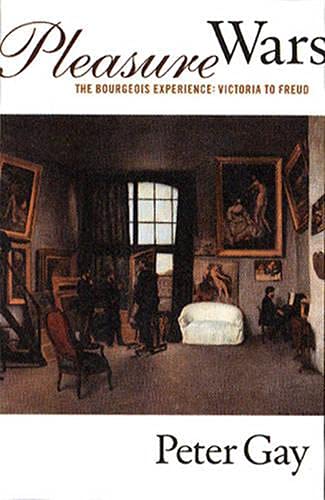



The fifth in the series of the author's accounts on the lives of the bourgeoisie, this final volume uncovers the hidden side of the nineteenth-century Victorians, portraying them as reactionaries, revolutionaries, and middle-of-the-roaders in the passage of high culture toward modernism. The final installment of Gay's multivolume study of the 19th-century bourgeois experience (e.g., Naked Heart: The Bourgeois Experience, Victoria to Freud, LJ 10/1/95) is a welcome addition to the literature. Current historical stereotypes of the bourgeois are rather flat, regarding them as either extremely confident or extremely insecure, depending on which authority is consulted. Gay's work systematically attempts to determine which is correct through an examination of their attitudes toward art, literature, and the concept we know as modernity. Throughout, Gay maintains that to view the bourgeoisie as stiff-necked and incapable of genuine affection or the enjoyment of pleasure is dangerously simplistic. In fact, the bourgeois experience was multidimensional, as were the bourgeois themselves. They were a revolutionary force, notes the author, whether they engaged in reactionary or modern crusades, and their ideas shaped the 20th century. An insightful and challenging book; recommended for general and specialized libraries. -?Frederic Krome, Northern Kentucky Univ., Highland Heights Copyright 1998 Reed Business Information, Inc. National Book Award winner and Freud biographer Gay, in the last volume of his five-part history of the Victorian era, disassociates bourgeois from tasteless and Victorian from prudish. He does so by analyzing art support, which shifted during that era from royal patronage to bourgeois demand. Businessmen associations from Munich to Manchester established museums and orchestras, and clerks demanded affordable reproductions of masterpieces. The wealthier collected art to mimic nobility; the poorer to ward off association with the lower classes. Gay notes that their lack was money, not taste: bourgeois collectors were the first to buy impressionists and modernists. Sometimes, his examples seem sketchy for academia or undigested for laypeople, and he never comments on social ills that still need addressing. But Gay does offer new facts, new sources, and new views about the Victorian age and its anxieties and new interpretations of Flaubert, Freud, Picasso, and others--all of which help present a fuller view of the bourgeois and the Victorian age. Kevin Grandfield The fifth and concluding volume in Gay's reexamination of the 19th-century middle classes, this one focusing--with the author's customary grace and intelligence--on their attitudes toward the arts. The taste of the Victorian bourgeoisie is frequently disdained as conventional and sentimental, their involvement in activities like collecting paintings and attending concerts dismissed as efforts to enhance their status. Gay, emeritus professor of history at Yale, amply demonstrates that this is a gross oversimplification. ``Avant gardes could not have made their way without massive bourgeois patronage,'' he reminds us, profiling pioneering collectors like Russian merchant and Matisse patron Sergei Schukin, and French customs clerk Victor Chocquet, who championed Czanne. In chapters on the development of local symphonies, the rise of criticism as a profession, the differing blends of private enterprise and aristocratic patronage that financed arts institutions in various European and American cities, Gay does not deny that status-seeking played a part, nor that some bourgeois liked safe, insipid art. He simply wants his readers to recognize ``the rich diversity of bourgeois experience in the pleasure wars roiling the Victorian and post-Victorian arts,'' just as he asked them to reconsider the clich of all Victorians as sexually repressed in The Education of the Senses (1984), this series' first volume. Like its predecessors, Pleasure Wars is plausibly arranged rather than coherently organized, and Gay has a habit of announcing some obvious points as if they were revolutionary insights. But he is never less than readable, and he astutely weaves individual stories into a rich, complex tapestry. Sensitively depicting his 19th-century burghers grappling with the increasingly democratic nature of culture--and its funding--he reminds us that these issues are still contentious today. An appealing close to an unfailingly stimulating series that has more than fulfilled Gay's professed aim: ``to rise above melodrama to the far subtler drama that is history.'' -- Copyright ©1997, Kirkus Associates, LP. All rights reserved. Gay obliges us to reconsider our facile prejudice and to recognize the resourcefulness and high spirits of the class we love to mock. The Bourgeois Experience: Victoria to Freud should open the way to further revisionist studies and modify our common pejorative usage usage of the terms "bourgeois," "middle-class" and "Victo