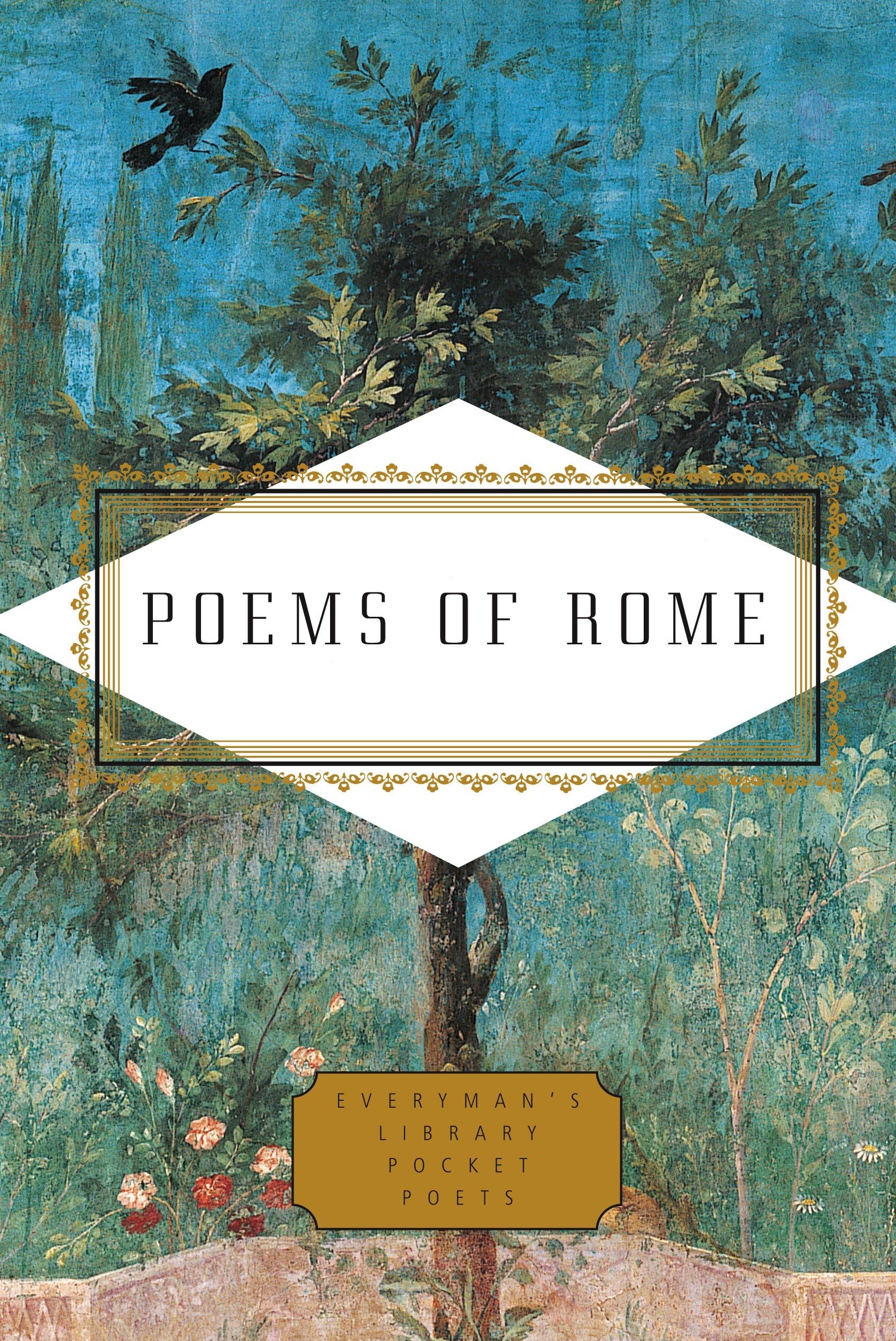



A beautiful hardcover Pocket Poets anthology of poems inspired by the art and architecture of the Eternal City. Poems of Rome ranges across the centuries and contains the work of poets from many cultures and times, from ancient Rome to contemporary America. Designed to accompany readers visiting the city--whether in person or in imagination--the book is divided into sections by place. Its pages lead the reader from the Roman Forum to the Colosseum, from the Vatican to the Villa Sciarra, from the Pantheon to the Palatine Hill, all seen through the eyes of poets who have been dazzled by these glorious sites for centuries. The poets range from Horace and Ovid to Pasolini and Pavese, and from Byron and Keats and Rilke to James Merrill, Adrienne Rich, Derek Walcott, and Jorie Graham, in a collection of international talent as scintillating as the great city itself. Karl Kirchwey is an award-winning American poet whose work is strongly influenced by the Greek and Roman past. He is also a book reviewer, creative writing teacher, translator, arts administrator, and literary curator. He has been a director of the Unterberg Poetry Center of the 92nd Street Y, directed the creative writing program at Bryn Mawr College, served as Andrew Heiskell Arts Director at the American Academy in Rome, and is currently a professor and director of the MFA Program in Creative Writing at Boston University. FOREWORD: A Poet’s Roman Baedeker Even the most hurried visitor to Rome cannot help but be struck by the nonchalant energy with which its modern population inhabits a cityscape of seemingly bottomless stratigraphic history and beauty. Traffic buzzes around a complex of Republican temples, below the level of the modern street, part of which has been repurposed as a community shelter for stray cats (a carved stone cat watches from a second-storey lintel nearby in the appropriately named Vicolo della Gatta). The city moves so easily between life and stone, and so gracefully balances its opposites: pagan luxury and decadence, on the one hand, and spiritual transcendence, on the other; the chaos and noise of its major thoroughfares, on the one hand, and the tranquility of the cloister garden in the Church of the Four Crowned Saints or of the frescoed dining room of the Empress Livia in the Palazzo Massimo, on the other. All is comprehended by the buildings of the historic center, their earth tones flaking in the sun and looped by the muddy S-curve of the Tiber River. The ubi sunt lament over Rome’s fall from greatness is familiar and inevitable. Byron identifies the historical trajectory: ‘‘First Freedom, and then Glory – when that fails, / Wealth, vice, corruption – barbarism at last.’’ This contributes to a ‘‘tyrannous sense of a superincumbent oppression,’’ as one English visitor puts it. But even in the sixteenth century, French poet Joachim du Bellay felt something else in the city, a kind of galvanic energy by which it was constantly reconstructing itself out of its own ruin, with death and life intermingled. ‘‘Compost,’’ the English poet C. Day-Lewis calls it, ‘‘the very type of/ The hugger-mugger of human growth.’’ American poet Robert Lowell, translating du Bellay, concludes that ‘‘Whatever/ was fugitive maintains its permanence,’’ and Charles Wright is echoing du Bellay too when he declares, ‘‘Rome in Rome? We’re all leading afterlives/ of one sort or another . . .’’ Native Romans look on their city with an endless wit and cynicism because of its corruption (as the obscene dialect sonnets of G.G. Belli so splendidly demonstrate); yet they are fiercely proud of Rome too, and they know it is the center of the world. It has never stopped being the center of the world. ‘‘Theatrical, vulgar, rhetorical, fractious, sublime’’: those are Day-Lewis’s adjectives for Rome. Italian artists may feel the burden of all that previous art and history as almost insurmountable. Pasolini speaks of the ‘‘flimsy crust of our world/ over the naked universe.’’ But foreigners, including those perched at the American Academy in Rome across the Tiber on the Janiculum Hill, have often found in the city a reliable inspiration, no proof of its ongoing greatness more persuasive than its ability to provide clues to a postmodern and postcolonial world, even across gulfs of time and its own imperial history. Nineteenth-century English poet Samuel Rogers (a celebrity in his day, forgotten in ours) writes that Rome ‘‘Still o’er the mind maintains, from age to age,/ Her empire undiminished.’’ And the American Julia Ward Howe, author of the ‘‘Battle- Hymn of the Republic,’’ declares in her poem ‘‘The City of My Love’’ that Rome ‘‘rules the age by Beauty’s power,/As once she ruled by armed might;/ The Southern sun doth treasure her/ Deep in his golden heart of light.’’ The rule of beauty is subtle, even insidious. Rome speaks directly to the body. English poet Elizabeth Jennings exclaims, ‘‘O and the heart is drawn to sense,/ Eye and