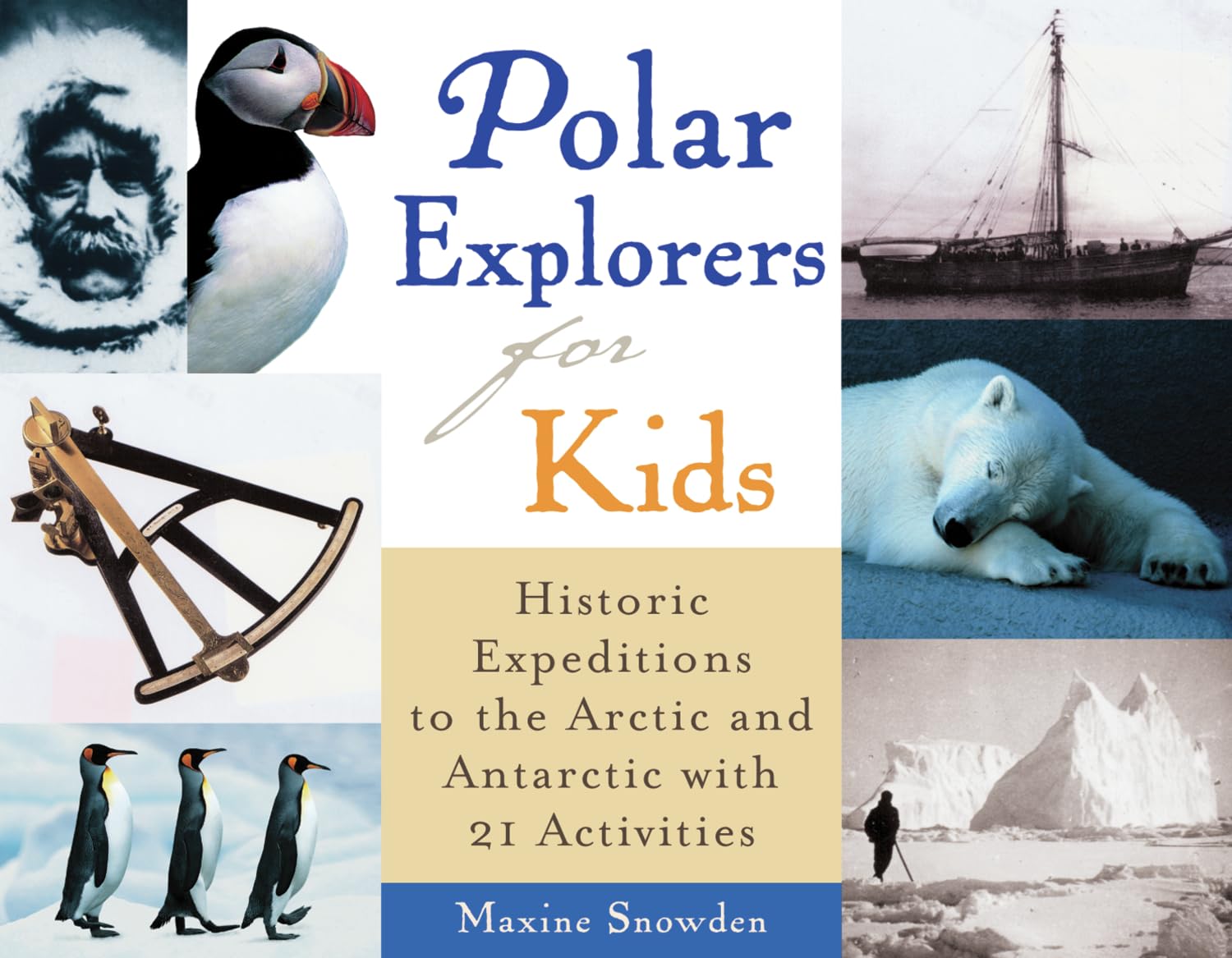
Polar Explorers for Kids: Historic Expeditions to the Arctic and Antarctic with 21 Activities (5) (For Kids series)
$17.00
by Maxine Snowden



Heroism and horror abound in these true stories of 16 great explorers who journeyed to the Arctic and Antarctic regions, two exquisite and unique ice wildernesses. Recounted are the exciting North Pole adventures of Erik the Red in 982 and the elusive searches for the “Northwest Passage” and “Farthest North” of Henry Hudson, Fridtjof Nansen, Fredrick Cook, and Robert Peary. Coverage of the South Pole begins with Captain Cook in 1772; continues through the era of land grabbing and the race to reach the Pole with James Clark Ross, Roald Amundsen, Robert Scott, and Ernest Shackleton; and ends with an examination of the scientists at work there today. Astounding photographs and journal entries, sidebars on the Inuit and polar animals, and engaging activities bring the harrowing expeditions to life. Activities include making a Viking compass, building a model igloo, making a cross staff to measure latitude, creating a barometer, making pemmican, and writing a newspaper like William Parry’s “Winter Chronicle.” The North and South Poles become exciting routes to learning about science, geography, and history. Grade 4-6-This odd work is a combination of biographical information and factual material about explorations of the Arctic and Antarctic regions, ranging from Erik the Red in 981 until the 1994 studies of Antarctic Lakes. The activities, such as making marshmallow-cream covered igloos and building a snow cave, have only tangential connections to the explorations and some require the purchase of some unusual materials such as lodestones. A note to readers incorrectly states: "A.D., which stands for `after death,' refers to a time in history after the death of Christ." There is a lot of interesting and often fascinating information here, but the approach is scattered, and the black-and-white photos are poor and sometimes only vaguely relevant. A marginal purchase. Eva Elisabeth VonAncken, Trinity-Pawling School, Pawling, NY Copyright © Reed Business Information, a division of Reed Elsevier Inc. All rights reserved. "An excellent source for research." — Children's Literature Maxine Snowden is a freelance writer. She lives in Chicago. Polar Explorers for Kids Historic Expeditions to the Arctic and Antarctica with 21 Activities By Maxine Snowden Chicago Review Press Incorporated Copyright © 2004 Chicago Review Press All rights reserved. ISBN: 978-1-55652-500-1 Contents Introduction, Part I The Arctic Arctic Exploration Time Line, 1 Erik the Red Reaches Greenland, 981 or 982, 2 John Davis Dances with Inuit and Explores the Davis Straits and Labrador, 1585–1587, 3 Henry Hudson Ventures Northwest and Northeast in Search of a Passage, 1607–1610, 4 William Parry Explores Lancaster Sound and Beyond, 1819–1820, 1821–1823, 1824–1825, and 1827, 5 John Franklin Leads Arctic Exploration's Biggest Disaster, 1845–1847, 6 Fridtjof Nansen Travels "Farthest North," 1893–1896, and Roald Amundsen Discovers the Northwest Passage, 1903–1906, 7 Robert Peary and Fredrick Cook Race to the North Pole, 1908 and 1909, 8 Gretel Ehrlich Explores Greenland's Nature and Its Native Peoples, 1993–2000, Part II The Antarctic Antarctic Exploration Time Line, 9 Captain James Cook's Three Voyages to Antarctica's Edge, 1768–1775, 10 James Clark Ross Explores Antarctica by Ship, 1839–1843, 11 Robert Scott and Roald Amundsen Race to the South Pole, 1910–1912, 12 Ernest Shackleton Attempts to Cross Antarctica, 1914–1916, 13 Admiral Richard E. Byrd Is First to Fly Over the South Pole, 1929, 14 Scientist Bill Green Studies Antarctic Lakes, 1980–1994, Epilogue, Selected Answers, Glossary, Web Sites, Bibliography, Photo Credits, Index, CHAPTER 1 Erik the Red Reaches Greenland, 981 or 982 You might think that the first person to lay claim to land in the majestic Arctic would be a gallant hero — a nobleman in search of glory for his king, maybe, or a scientist on a quest for discovery and knowledge. That is not the case, however. The person credited with first settling territory in the Arctic was actually a bloodthirsty killer who discovered Greenland, a part of the Arctic, while running for his life. Erik the Red was a Viking. The Vikings were an aggressive group of Scandinavian explorers and warriors who plundered the coasts of Europe in the eighth to tenth centuries. Even by Viking standards, Erik the Red was considered a particularly nasty person, and he was exiled from his native country of Norway after committing murders, according to the Graenlendinga Saga, a medieval Icelandic chronicle. Upon his exile, Erik settled in Iceland with his father, Thorvald. But his taste for blood didn't stop. He murdered two more men in Iceland, which earned him a three-year sentence of outlawry. In the 900s Iceland had no prisons; the punishment for murder was banishment from "civilized" society. Those who were outlawed were forced to surrender their farms and most of their other possessions and run away to