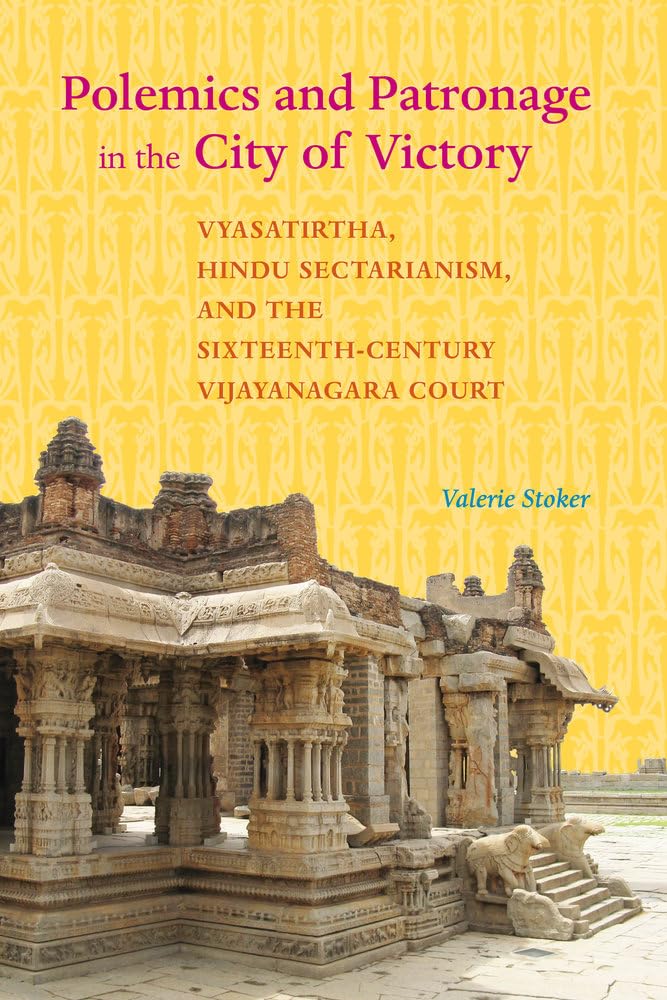
Polemics and Patronage in the City of Victory: Vyasatirtha, Hindu Sectarianism, and the Sixteenth-Century Vijayanagara Court (South Asia Across the
$30.41
by Valerie Stoker



A free ebook version of this title is available through Luminos, University of California Press’s Open Access publishing program for monographs. Visit www.luminosoa.org to learn more. How did the patronage activities of India’s Vijayanagara Empire (c. 1346–1565) influence Hindu sectarian identities? Although the empire has been commonly viewed as a Hindu bulwark against Islamic incursion from the north or as a religiously ecumenical state, Valerie Stoker argues that the Vijayanagara court was selective in its patronage of religious institutions. To understand the dynamic interaction between religious and royal institutions in this period, she focuses on the career of the Hindu intellectual and monastic leader Vyasatirtha. An agent of the state and a powerful religious authority, Vyasatirtha played an important role in expanding the empire’s economic and social networks. By examining his polemics against rival sects in the context of his work for the empire, Stoker provides a remarkably nuanced picture of the relationship between religious identity and sociopolitical reality under Vijayanagara rule. "Stoker's Polemics and Patronage stands as an important contribution to the growing field of Vijayanagara studies, particularly as scholars attempt to piece together the complex religious and political landscape of this extremely influential sixteenth-century polity. Through Stoker's detailed study, readers grapple with the complex political fabric of Hindu sectarian identity in the sixteenth-century City (and Empire) of Victory." -Harshita Mruthinti Kamath Emory University Atlanta, GA, USA in International Journal of Hindu Studies "This not only historically but theoretically informed book is a must-read for those interested in Vijayanagara history or polemics between Dvaita and Advaita schools. It is also an important read for all those sensitive to the problem of finding an appealing language to effectively represent the mutual interdependence of sociopolitical realities, intellectual production and historical thinking." Cezary Galewicz (Professor of Indian Civilization at the Center for Comparative Studies of Civilisations, Jagiellonian University, Krakow) in Reading Religion “Valerie Stoker’s work, with its insightful analysis of the role played by the Madhva sectarian leader Vyasatirtha in the complex and multifaceted interplay of religion and state patronage in sixteenth-century South India, is a valuable addition to the corpus of writings on Vijayanagara.”—Anila Verghese, author of Religious Traditions at Vijayanagara “Never have Hindu philosophical debates and sectarian disputes seemed so lively and so relevant to historical dynamics. Drawing on inscriptional and material evidence as well as texts, Stoker provides us with a skillfully drawn picture of the complex interactions among rulers and religious leaders in sixteenth-century South India.”—Leslie C. Orr, Concordia University, Montreal, and author of Donors, Devotees and Daughters of God: Temple Women in Medieval Tamilnadu “Stoker sets a new standard for the study of religion in early modern South India, recognizing that doctrine does not unfold in a sociopolitical vacuum and providing an insightful account of the relations between sectarian organizations and their political patrons.”—Phillip B. Wagoner, Wesleyan University “In this engrossing and sophisticated book, Stoker brings together fine narrative fluency, careful scholarship across different disciplines, and critical sympathy for ideas and people from a different time and place. She is especially illuminating on the interaction between historical context, institutional imperatives, and philosophical innovation.”—Chakravarthi Ram-Prasad, author of Divine Self, Human Self: The Philosophy of Being in Two Gita Commentaries “Valerie Stoker’s work, with its insightful analysis of the role played by the Madhva sectarian leader Vyasatirtha in the complex and multifaceted interplay of religion and state patronage in sixteenth-century South India, is a valuable addition to the corpus of writings on Vijayanagara.”—Anila Verghese, author of Religious Traditions at Vijayanagara “Never have Hindu philosophical debates and sectarian disputes seemed so lively and so relevant to historical dynamics. Drawing on inscriptional and material evidence as well as texts, Stoker provides us with a skillfully drawn picture of the complex interactions among rulers and religious leaders in sixteenth-century South India.”—Leslie C. Orr, Concordia University, Montreal, and author of Donors, Devotees and Daughters of God: Temple Women in Medieval Tamilnadu “Stoker sets a new standard for the study of religion in early modern South India, recognizing that doctrine does not unfold in a sociopolitical vacuum and providing an insightful account of the relations between sectarian organizations and their political patrons.”—Phillip B. Wagoner, Wesleyan University “In this engrossing an