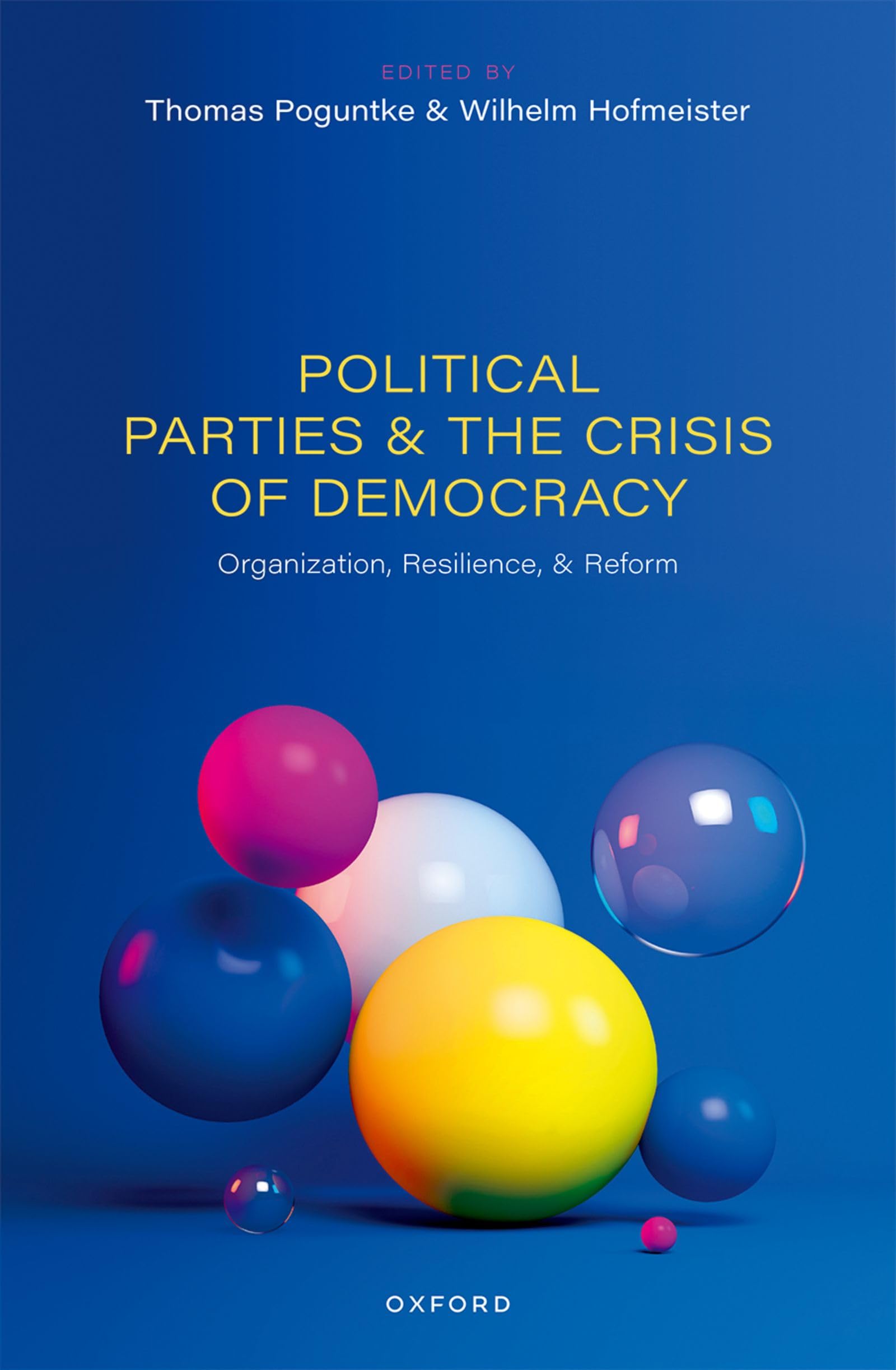
Political Parties and the Crisis of Democracy: Organization, Resilience, and Reform
$101.63
by Prof Thomas Poguntke



Democracy is in decline and the share of world's population living in freedom under democratic government has decreased considerably as authoritarian practices proliferate. Surprisingly, most of the analyses that study these developments give little attention to the role of political parties in the decline of democracy although there is a broad consensus about the relevance of political parties for the functioning of democracy. How parties can contribute to democracy is best understood by looking at a very diverse range of cases in different parts of the world. Instead of taking a regional approach which dominates the literature on political parties, this volume takes a global perspective. It brings together experts from four continents, which opens up fresh comparative perspectives on the role of political parties in the democratic process. Political Parties and the Crisis of Democracy asks how parties contribute to the consolidation of democracy, why they fail today, why new parties emerge and displace old parties, and also what parties need to do in order to survive cutthroat competition, above all with a new (and sometimes not so new) variants of populist parties. It takes a unique global focus, covering old and new democracies in different regions of the world. It covers Western and Central Europe, Asia-Pacific, Latin America and Africa, Turkey and Israel, including presidential, semi-presidential, and parliamentary democracies and also some countries where democracy is seriously threatened or eroding. This volume offers unique comparative perspectives combined with a detailed analysis of individual countries and their party systems. It shows that parties are central actors for the consolidation of democracy, but that organisational reforms are necessary to cope with social change such as individualisation, the decline in party membership and the impact of new media and modern communication, thus counteracting the fragmentation of party systems and the decay of democracy. This is an open access title available under the terms of a [CC BY-NC-ND 4.0 International] licence. It is free to read at Oxford Scholarship Online and offered as a free PDF download from OUP and selected open access locations. "This useful edited collection describes the political party systems in 23 different countries. Included are established democracies in Western Europe and Japan and democratic and semi-democratic systems in Latin America, Africa, and Asia. Readers should come to this volume with some background in comparative politics and a familiarity with at least some party systems." -- D. Schwam-Baird, CHOICE Thomas Poguntke is Professor of Comparative Politics at the Heinrich-Heine University Düsseldorf and Co-Director of the Düsseldorf Party Research Institute (PRuF). Previously, he held chairs at the universities of Keele, Birmingham, and Bochum. He was Visiting Fellow at the European University Institute in Florence and at the Australian National University and is author and editor of numerous publications on political parties and comparative politics including The Presidentialization of Politics. A Comparative Study of Modern Democracies (Oxford University Press 2005; with Paul D. Webb), and Organizing Political Parties: Representation, Participation and Power (Oxford University Press, 2017 edited with Susan E. Scarrow and Paul D. Webb). Wilhelm Hofmeister is a Fellow and lecturer at the Düsseldorf Party Research Institute (PRuF). From 1987 until 2022 he worked with the Konrad Adenauer Foundation as a political consultant in the area of political party cooperation and director of country offices in Chile, Brazil, Singapore, and Spain. He is author and editor of numerous publications on political parties and comparative analysis of political transition and system changes. His last monograph is Political parties shape democracy. Their role, performance, and organisation from a global perspective .