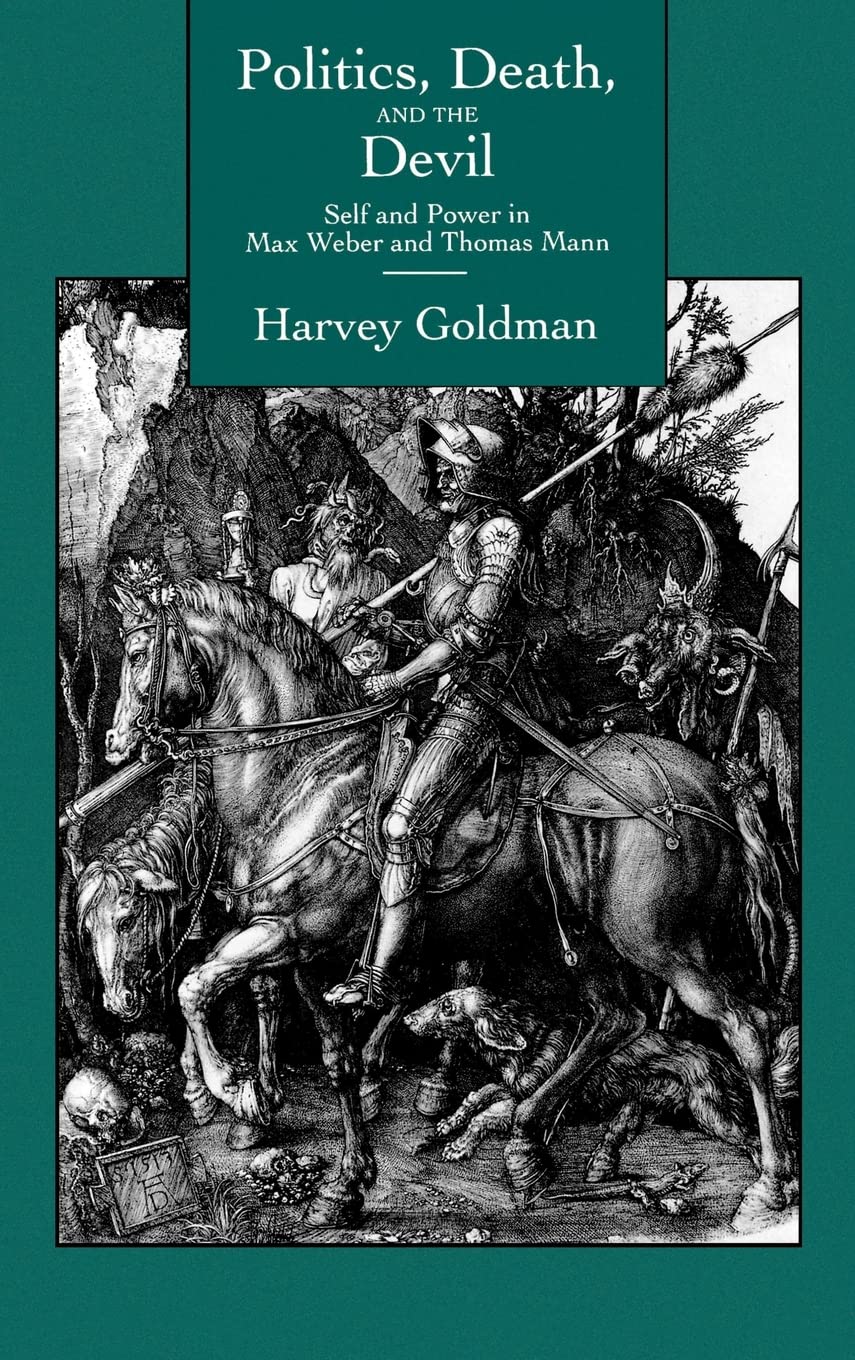
Politics, Death, and the Devil: Self and Power in Max Weber and Thomas Mann
$63.00
by Harvey Goldman



This sequel to Harvey Goldman's well-received Max Weber and Thomas Mann continues his rich exploration of the political and cultural critiques embodied in the more mature writings of these two authors. Combining social and political thought, intellectual history, and literary interpretation, Goldman examines in particular Weber's "Science as a Vocation" and "Politics as a Vocation" and Mann's The Magic Mountain and Doctor Faustus . Goldman deals with the ways in which Weber and Mann sought an antidote to personal and cultural weakness through "practices" for generating strength, mastery, and power, drawing primarily on ascetic traditions at a time when the vitality of other German traditions was disappearing. Power and mastery concerned both Weber and Mann, especially as they tried to resolve problems of politics and culture in Germany. Although their resolutions of the problems they confronted seem inadequate, they show the significance of linking social and political thought to conceptions of self and active worldly practices. Trenchant and illuminating, Goldman's book is essential reading for anyone interested in political theory, social thought, and the intellectual history of Germany. Harvey Goldman is Associate Professor of Sociology at the University of California, San Diego. He is the author of Max Weber and Thomas Mann: Calling and the Shaping of the Self (California, 1988). Politics, Death, and the Devil: Self and Power in Max Weber and Thomas Mann By Harvey Goldman University of California Press Copyright © 1992 Harvey Goldman All right reserved. ISBN: 0520077504 1 Self and Power, Self and Nation What is good?—Everything that heightens the feeling of power, the will to power, power itself in man. What is bad?—Everything that stems from weakness. What is happiness?—The feeling that power increases, that a resistance is overcome. Not contentment, but more power; not peace at all, but war; not virtue, but proficiency. Nietzsche, The Antichrist The discourse of European writers and thinkers in the late nineteenth and early twentieth centuries—and also of the popular imagination—is riddled with professed fears of weakness and impotence, of loss of power as a product of biological decline, decadence, social decay, and disillusion. Ironically, however, that discourse views loss of power and proficiency not only as a consequence of decadence, but also as a product of the great achievements of civilization and rationalization.1 The symptoms of weakness seem to appear in deformed social relations and social roles, in overheated and morbid culture and individual creative life, and in the apparent helplessness and drift of politics. Indeed, "acquired" social weakness now seems to push the "inherited" natural weakness of certain classes and of the self to new extremes. The onset of this obsession with weakness and powerlessness has many causes, among them the shaking of stable patterns of values and purposes through rapid and unwelcome social change; but once the fear takes hold, it works to prevent the emergence of renewed meaning and purpose, of a renewed significance for work within society as it presently exists. With Schopenhauer and Nietzsche as its philosophical chroniclers, one of its symptoms is even an "attack" on life itself and on all remaining forms of strength and power: a fetish is made of death in response to death's apparent meaninglessness and insignificance in modern civilization. In Germany, this is not only a turn-of-the-century phenomenon; it reappears in the longing for escape at the end of World War I and in the culture of the 1920s. From the lack of strength described in Thomas Mann's Buddenbrooks to the willful embrace of illness in The Magic Mountain , from the political decadence diagnosed in Max Weber's "National State and Economic Policy" to the chastisements of escapism in "Science as a Vocation," Mann and Weber confront this decadence with calls for regeneration and renewal in an attempt to rescue the nation and the meaning of death and work from increasing powerlessness. Weber's and Mann's discourse of strength and power is principally concerned with identity and mastery and their basis in ascetic service, but this discourse, as we will see, is also intimately bound up with what seems at first an altogether different problem—their obsession with death and devils. Death is central to Weber as the limiting experience that reveals the genuine helplessness of modern life, but it is also the field on which meaning and power must be conquered. Within Weber's program of recovery, the opposition of God and devil then becomes central, largely from Weber's belief in the enduring need to posit enemy, devilish values as an intimate part of positing one's own godly values, an act that, for him, is the foundation for positing one's self. But Weber also draws on the language of devils from his need to conceptualize the temptation and the da