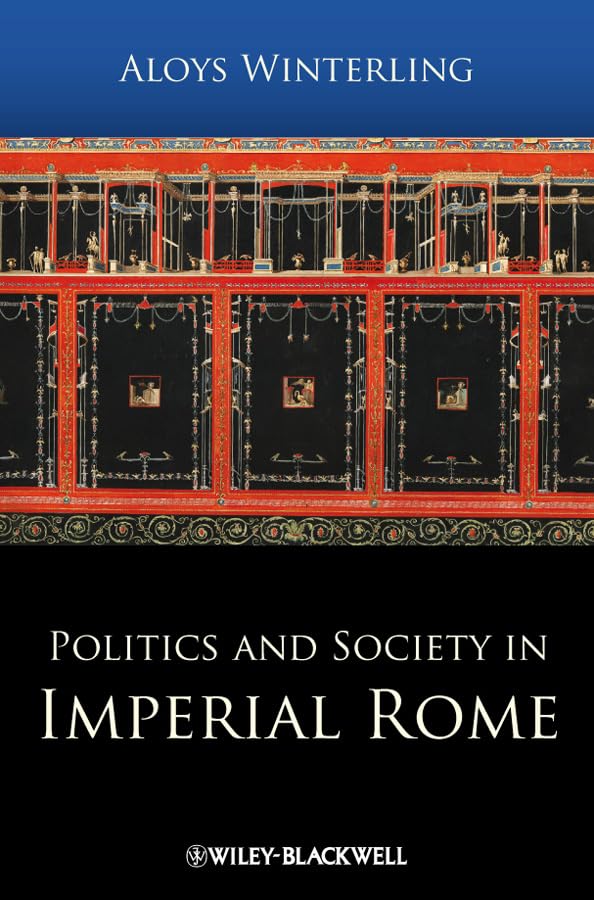



Politics and Society in Imperial Rome offers fresh new interpretations of the politics, society, and culture Rome's imperial era. Argues that the early principate was fundamentally incompatible with the persisting structures of the Roman Republic - Demonstrates how these contradictory systems affected the development of Roman society - Includes case studies on the imperial court and the emperor Caligula, as well as chapters on the scholarship of Theodor Mommsen and Christian Meier “This is, in a nutshell, the argument of Aloys Winterling in this stimulating collection of essays. Winterling's work is well known to German readers and this volume will hopefully bring the attention of a non?]German audience to it. The articles collected in this volume span the last ten years, and although written on different occasions they show remarkable coherence. The thesis presented above is constantly restated from different points of view. Repetition is inevitable, but this is a minor fault: the author's arguments and methodology are new and sophisticated, and deserve to be well understood.” ( Bryn Mawr Classical Review , May 2010) "This valuable book offers a fresh examination of the structure of Roman imperial government. By concentrating on the dual aspect of the imperial regime―the one part descending from the institutions of the Republic, the other emerging from the household of the emperors―Winterling frames his issue with admirable clarity." – David Potter , University of Michigan During the early days of Imperial Rome, Augustus characterized himself as 'the restorer of the Res publica' . On the surface it appeared that the Roman Republic was indeed alive: Consuls were elected, tribunes legislated, and Senators engaged in heated debates in the Roman Curia . But the political integration of Roman society – with its deep social stratification marked by the pre-eminence of Senatorial nobility – was 'old'. And the role of the emperor and his patrimonial structure of imperial rule was 'new'. The consequences of these fundamentally incompatible structures and systems would have profound implications for the future of Imperial Rome. Using this fundamental contradiction between the political order of the republic and patrimonial-based imperial rule as a point of departure, Politics and Society in Imperial Rome offers fresh new interpretations of Rome's imperial era. The essays begin by replicating the paradoxes that were founded in the historical reality of Imperial Rome. Two case studies are then examined in the book's second section: the imperial court and political actions taken during Caligula's reign. Bold academic approaches of the classical historians Theodor Mommsen and Christian Meier are then explored in the book's final section. Original and thought-provoking, Politics and Society in Imperial Rome shines a bright new light on the complexities and contradictions of the glory that was Imperial Rome. During the early days of Imperial Rome, Augustus characterized himself as 'the restorer of the Res publica' . On the surface it appeared that the Roman Republic was indeed alive: Consuls were elected, tribunes legislated, and Senators engaged in heated debates in the Roman Curia . But the political integration of Roman society – with its deep social stratification marked by the pre-eminence of Senatorial nobility – was 'old'. And the role of the emperor and his patrimonial structure of imperial rule was 'new'. The consequences of these fundamentally incompatible structures and systems would have profound implications for the future of Imperial Rome. Using this fundamental contradiction between the political order of the republic and patrimonial-based imperial rule as a point of departure, Politics and Society in Imperial Rome offers fresh new interpretations of Rome's imperial era. The essays begin by replicating the paradoxes that were founded in the historical reality of Imperial Rome. Two case studies are then examined in the book's second section: the imperial court and political actions taken during Caligula's reign. Bold academic approaches of the classical historians Theodor Mommsen and Christian Meier are then explored in the book's final section. Original and thought-provoking, Politics and Society in Imperial Rome shines a bright new light on the complexities and contradictions of the glory that was Imperial Rome. Aloys Winterling is Professor for Ancient History at the Humboldt University of Berlin. He was previously Professor of Ancient History at the University of Basel.