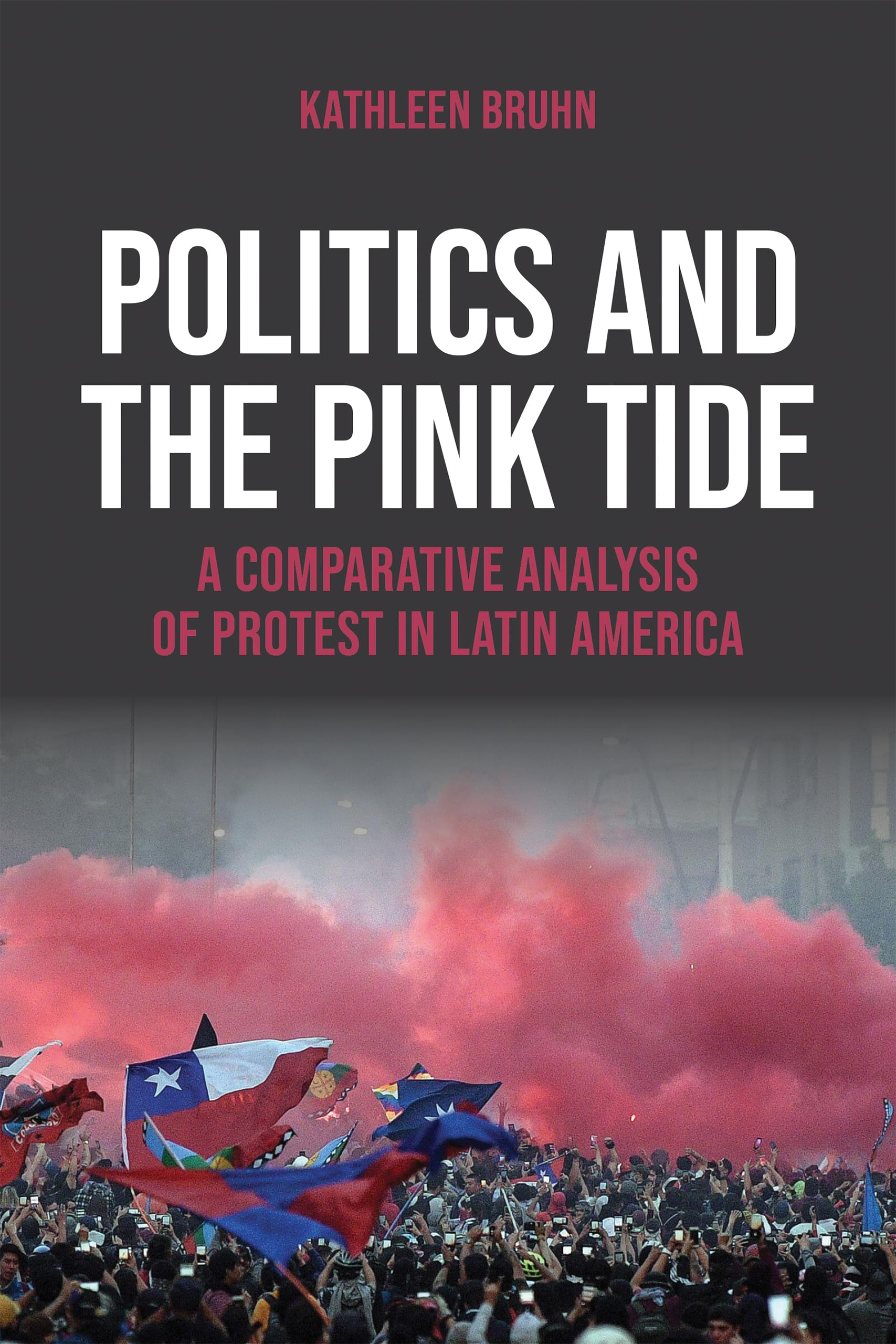
Politics and the Pink Tide: A Comparative Analysis of Protest in Latin America (Kellogg Institute Series on Democracy and Development)
$52.93
by Kathleen Bruhn



Politics and the Pink Tide investigates the ways in which protest varied across five Latin American countries that elected leftist presidents during the Pink Tide. Kathleen Bruhn compares the differences in protest that occurred under the new leftist governments to their conservative, neoliberal predecessors, offering a wide-angle view into the complex relationships between neoliberalism, political party structures, and protest. Using individual and event-level data from Bolivia, Brazil, Chile, Venezuela, and Ecuador, Politics and the Pink Tide shows how economic policy choices and the links between leftist parties and social movements affect patterns of protest. For example, although more orthodox neoliberal approaches did motivate more economic protest, the book demonstrates that neither more radical nor more socially linked leftist governments were better able to contain protest―or to do so without resorting to police violence. Politics and the Pink Tide proposes a sweeping exploration of protest, one that is controlled by economic policy and grievances, the social embeddedness of political parties, and the norms surrounding protest tactics within public life. “ Politics and the Pink Tide is well thought out, structured, and written.”―Margarita López-Maya, author of Democracia para Venezuela “A very important contribution to Latin American studies, to comparative politics, and to social movement theories, both theoretically and empirically. The argument developed throughout the book is particularly relevant to understanding this period of Latin American politics.” ―Françoise Montambeault, co-editor of Legacies of the Left Turn in Latin America "Navigating the gulf between radical left and moderate left governments in Latin America, Bruhn provides a well-written, complete account. In synthesis, its overarching model convincingly shows that―contrary to conventional wisdom―anti-neoliberalism did not constitute a major protest driver and that political parties have maintained a fundamental role in mobilizing people, and can actually deploy protests to recover some lost credibility across the electorate. This leaves little room for other factors to emerge as prominent at the individual level because hurdles to political activity are often too high to overcome without a little help." ― Latin American Politics and Society "Bruhn finds that deeply embedded parties do not necessarily perform better in managing protests. Indeed, taking the long view, Pink Tide parties that first gained traction in part through protest politics often went on to lose momentum or fracture under the pressure of subsequent protest experiences. ― Perspectives on Politics Kathleen Bruhn is Professor and Department Chair of Political Science at University of California, Santa Barbara. She is the author of Urban Protest in Mexico and Brazil (Cambridge University Press, 2008). Over the course of the 1980s and 1990s, many governments in Latin America (and elsewhere) adopted a set of pro-market economic policies known as neoliberalism or the Washington Consensus. Analysis of the social effects of these policies attributed to them a rise in poverty and inequality, as well as an increase in protest and mobilization. Many popular accounts of this time trace explosive protests such as the Water War in Bolivia (1999-2000), the piquetero movement in Argentina (2001-2003) or the Caracazo in Venezuela (1989) to the (misguided) economic policies adopted by neoliberal governments. Between 1998 and 2008, however, a series of leftist governments were elected across Latin America. By 2014, wrote one journalist, “conservative governments have virtually disappeared from the region.” (Miroff 2014, A6). This wave of leftism became known as the Pink Tide. It grew out of rejection of neoliberal governments and was supposed to fix their problems. Much careful research has analyzed the economic and social policy implications of these leftist governments for the poor, the indigenous, and the marginalized (including Balán and Montambeault 2020, Huber and Stephens 2012, Pribble 2013, and Garay 2016, among others). Yet did efforts to address these grievances change political behavior? Specifically, did national moves to the left reduce protest? Presumably, if neoliberal policies drive increases in protest, then protest should die down as policies change. At the same time, the election of leftist presidents brought to power political parties with sometimes deep roots in civil society and often more partisan adherents than their conservative rivals. If parties are designed to channel grievances through institutional means, then protest should become less frequent as an outlet. Moreover, setting aside the idea that people should prefer to channel their grievances through institutional channels (such as partisan connections in the legislature), parties with connections to civil society should be able to take advantage of those connections to peacef