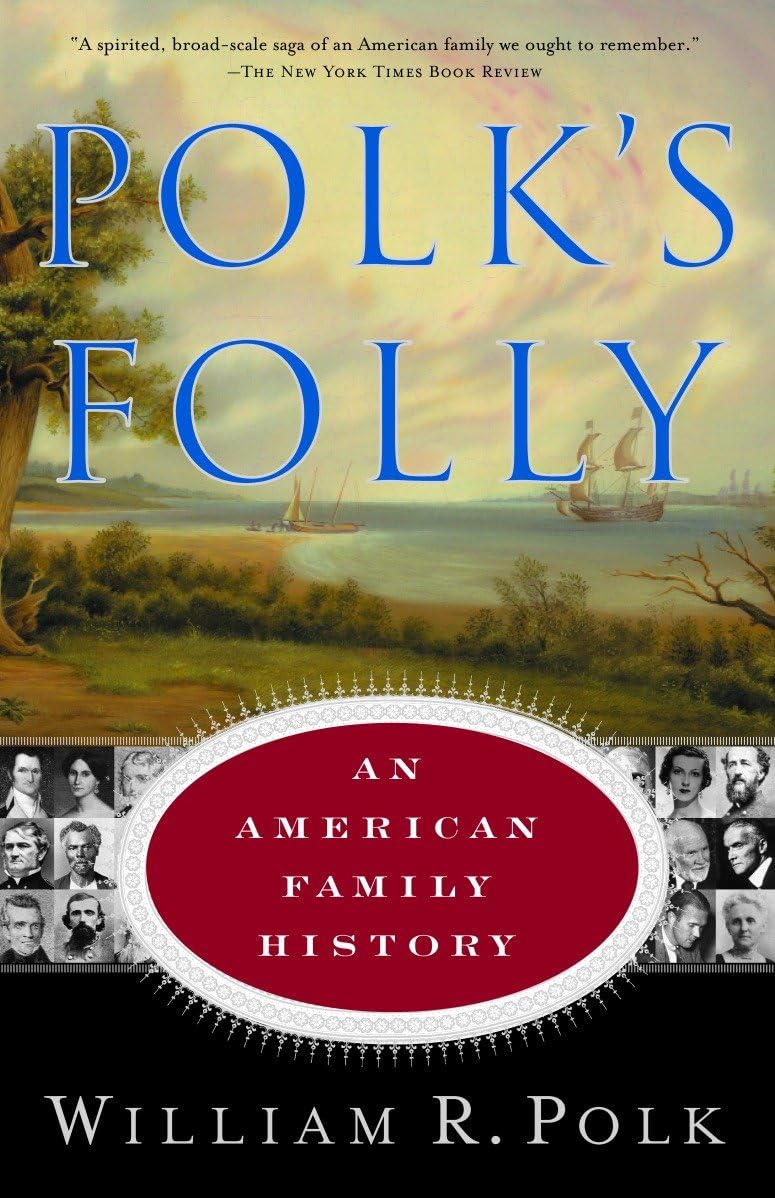



Polk's Folly is William Polk's captivating investigation of his impressive family tree and of the broader American tale it narrates. Growing up in Texas in the late 1930s, listening to his grandmother's memories of her childhood amidst the Civil War, Polk became fascinated by tales of his family's engagement in monumental moments of our nation's history. Beginning when Robert Pollok fled Ireland in the 1680s, Polk's saga includes an Indian trader, an early drafter of the Declaration of Independence, one of our greatest presidents, heroes and rascals on both sides of the Civil War, Indian fighters, a World War I diplomat, and Polk's own brother, a journalist who reported on the Nuremberg Trials. Full of stunning detail and based on primary historical documents, Polk's Folly is a grand American chronicle that allows history to include the lives that made it happen. “A spirited, broad-scale saga of an American family we ought to remember.”– The New York Times Book Review “This lovingly constructed history...evokes...the dynamism of the American past.”– The New Yorker Folly is William Polk's captivating investigation of his impressive family tree and of the broader American tale it narrates. Growing up in Texas in the late 1930s, listening to his grandmother's memories of her childhood amidst the Civil War, Polk became fascinated by tales of his family's engagement in monumental moments of our nation's history. Beginning when Robert Pollok fled Ireland in the 1680s, Polk's saga includes an Indian trader, an early drafter of the Declaration of Independence, one of our greatest presidents, heroes and rascals on both sides of the Civil War, Indian fighters, a World War I diplomat, and Polk's own brother, a journalist who reported on the Nuremberg Trials. Full of stunning detail and based on primary historical documents, Polk's Folly is a grand American chronicle that allows history to include the lives that made it happen. Polk's Folly is William Polk's captivating investigation of his impressive family tree and of the broader American tale it narrates. Growing up in Texas in the late 1930s, listening to his grandmother's memories of her childhood amidst the Civil War, Polk became fascinated by tales of his family's engagement in monumental moments of our nation's history. Beginning when Robert Pollok fled Ireland in the 1680s, Polk's saga includes an Indian trader, an early drafter of the Declaration of Independence, one of our greatest presidents, heroes and rascals on both sides of the Civil War, Indian fighters, a World War I diplomat, and Polk's own brother, a journalist who reported on the Nuremberg Trials. Full of stunning detail and based on primary historical documents, Polk's Folly is a grand American chronicle that allows history to include the lives that made it happen. William R. Polk taught at Harvard and was later Professor of History at the University of Chicago, and he is the founder of the Adlai Stevenson Institute. In the Kennedy and Johnson administrations, he was a member of the Policy Planning Council of the State Department. He is the author of eleven books, including Passing Brave and Neighbors and Strangers , a seminal text on foreign affairs. A native of Texas, he now lives in the South of France. Departure: "All the Tryles, Hardships,and Dangers of the Seas" Brought over from the wild Scottish borderlands to fight in Ireland, Robert Bruce Pollok knew the exhausting and bloody war of the guerrilla all too well. For him, combat became almost a diversion; it was marching that wore men out. Across the mountains and through the bogs that shredded seventeenth-century Ireland, trails were just beaten furrows that stopped abruptly at the many streams and gullies, forcing armies also to stop abruptly because bridges were then more rare than roads. To carry the wounded even a few miles on bullock carts was a wrenching experience which few survived. And to carry food to the soldiers across the rugged land was a tedious and expensive undertaking. As Robert had seen, the only way Cromwell could get food to his troops was off of boats or barges. Indeed, Ireland's first line of defense was its very poverty: no army could live off the land for long, and no army could feed itself at all if it moved far inland. But inland was where the Irish guerrillas were resisting English colonization; so inland the soldiers had to go. Like most soldiers, Robert probably feared and distrusted the sea. True, he had sailed over from Scotland, but on a clear day Scotland was within eyesight of the northeastern Irish coast; so Robert had never been really out at sea. At least not in a sea like the one he would have heard about from sailors in the port of Derry or seen crashing remorselessly against the desolate cliffs of Dunluce Castle on Ireland's northern coast. That coast he certainly knew firsthand in fights against the savage bands of robbers, pirates and even ordinary farmers who built bonfires to lure