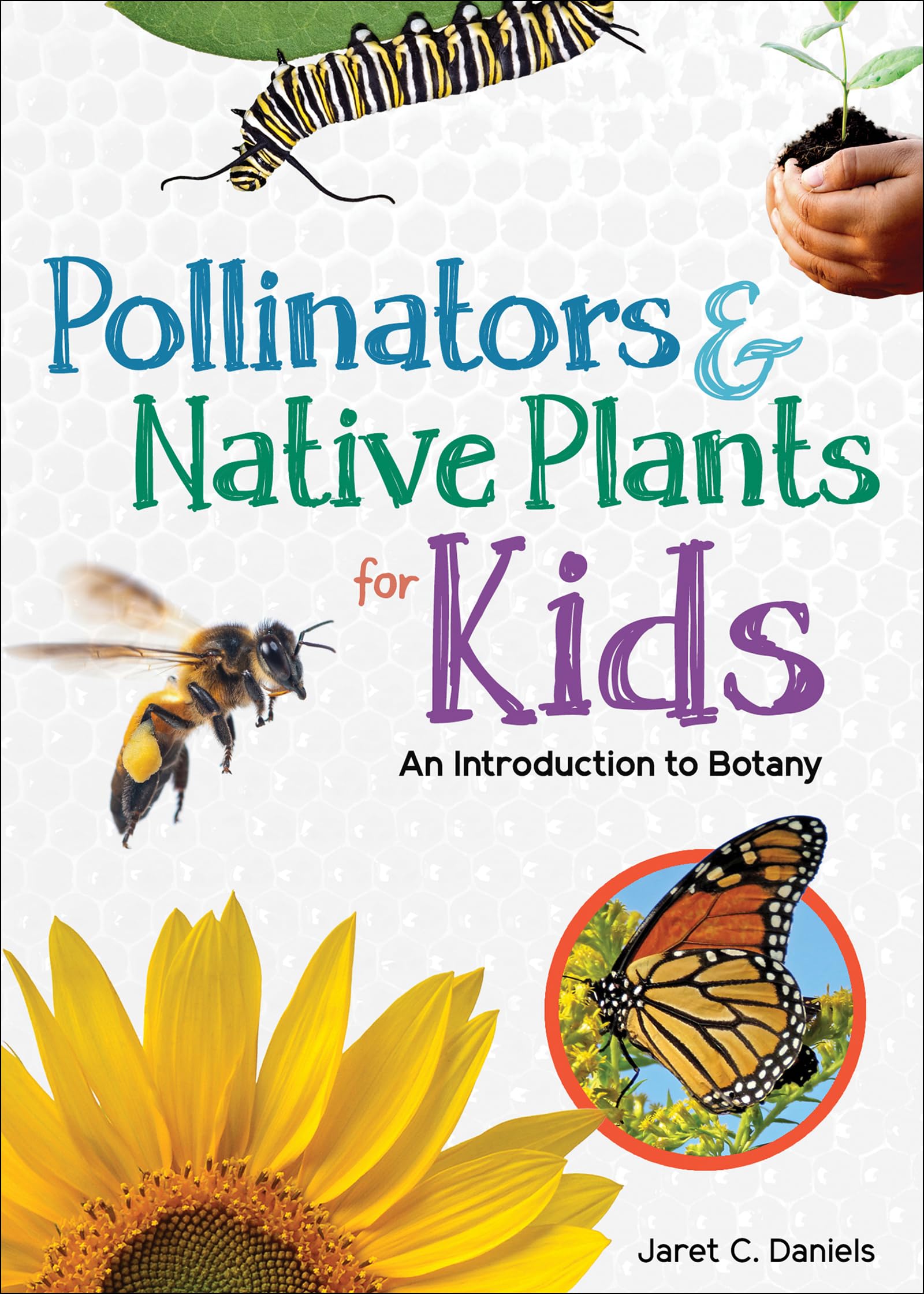
Pollinators & Native Plants for Kids: An Introduction to Botany (Simple Introductions to Science)
$11.90
by Jaret C. Daniels



Learn about the importance of bees, butterflies, and other pollinators in this children’s book that includes an introduction to botany and a plant identification guide. Native plants surround us every day, so it’s easy to take them for granted. But they are vital to the existence of all animals—including humans! Native plants provide sources for food and shelter that wildlife can’t live without. Become a young botanist. Learn all about native plants, wildflowers, trees, and shrubs. Professional entomologist Jaret C. Daniels presents a kids’ introduction to botany. From beautiful wildflowers like the common sunflower to majestic trees like the red maple, this easy-to-understand book is a perfect guide for beginners. Pollinators & Native Plants for Kids begins with an introduction to plants. Then it guides readers through the process of pollination, spotlighting the essential role that bees, butterflies, and other pollinators play. The book further discusses why native plants are important to a healthy ecosystem and outlines how children and families can take action to help them. In the field-guide section, 150 wildflowers, trees, and shrubs are organized by type. Full-color photographs and visual descriptions help readers to identify the species they see in nature. Inside You’ll Find Beginner’s guide to native plants and pollinators - The basics of botany and how pollination works - Identification guide to common wildflowers, trees, and shrubs - Garden plans and bonus activities for the family “This is the perfect book for any child who loves science and nature.” — Breana Johnson , Northern Wilds Magazine Jaret C. Daniels is a curator at the Florida Museum of Natural History’s McGuire Center for Lepidoptera and Biodiversity, and he is a professor in the Department of Entomology and Nematology at the University of Florida. Jaret holds a Ph.D. in entomology and specializes in the ecology and conservation of at-risk butterflies and other native insect pollinators. He is a professional nature photographer and author of many successful field guides, gardening books, and general interest titles on butterflies, insects, wildflowers, native plants, and wildlife landscaping, including Butterflies of the Midwest Field Guide; Native Plant Gardening for Birds, Bees & Butterflies: Upper Midwest; Backyard Bugs; Vibrant Butterflies; and Insects & Bugs for Kids. He lives in Gainesville, Florida, with his wife, Stephanie, and their six cats. Introduction Plants are amazing. They come in many different forms and can be found almost everywhere on Earth. As a group, plants are one of the most common forms of life on the planet. Many, like mosses, ferns, trees, shrubs, grasses, and herbs, are familiar organisms that we see most every day. Others, such as green algae, cycads, and liverworts, are a bit more unusual. In fact, the kinds of plants that are found in an area help define its habitat type. Examples include grasslands, forests, deserts, and savannas. Know Your Taxonomic Names Because so many lifeforms exist on Earth, scientists use taxonomy (say it, tax-on-oh-mee) to put living things in categories. Taxonomy is the science of naming and classifying organisms. It uses a ranked system that’s a bit like a pyramid. At the top of the pyramid, there are big categories called kingdoms. You’ve probably heard of the animal kingdom, and plants belong to their own kingdom: Plantae (say it, plan-tay), the plant kingdom. As you go down the pyramid, the levels get more specific, and there are fewer lifeforms in each category. Kingdom is followed by phylum, class, order, family, genus, and species. In this system, called binomial nomenclature (say it, bye-gnome-ee-ul gnome-en-clay-ture), each organism on Earth has what’s called a scientific name. It has two parts. The first part of the scientific name refers to the genus and is a bit like a last name. It indicates which organisms are closely related, like your other immediate family members and you. The second part is called the specific epithet (say it, ep-i-thet). It’s like a first name, and it separates you from close relatives and identifies you as a unique individual or, in this case, as a unique species . The resulting taxonomic name only belongs to that lifeform. Scientific names are easy to spot because they are always written in italics. The whole system may sound complicated, but it isn’t too hard to learn. In this book, you will see common names, such as purple coneflower, followed by scientific names, such as Echinacea purpurea. Although many people regularly use common names, common names can be confusing. There can be more than one for the same organism, and people may use different names depending on where they live. This can make it hard to know if everyone is talking about the same thing. For example, a common southeastern wildflower, Monarda punctata, has many common names: dotted horsemint, dotted horse mint, spotted horsemint, or spotted beeb