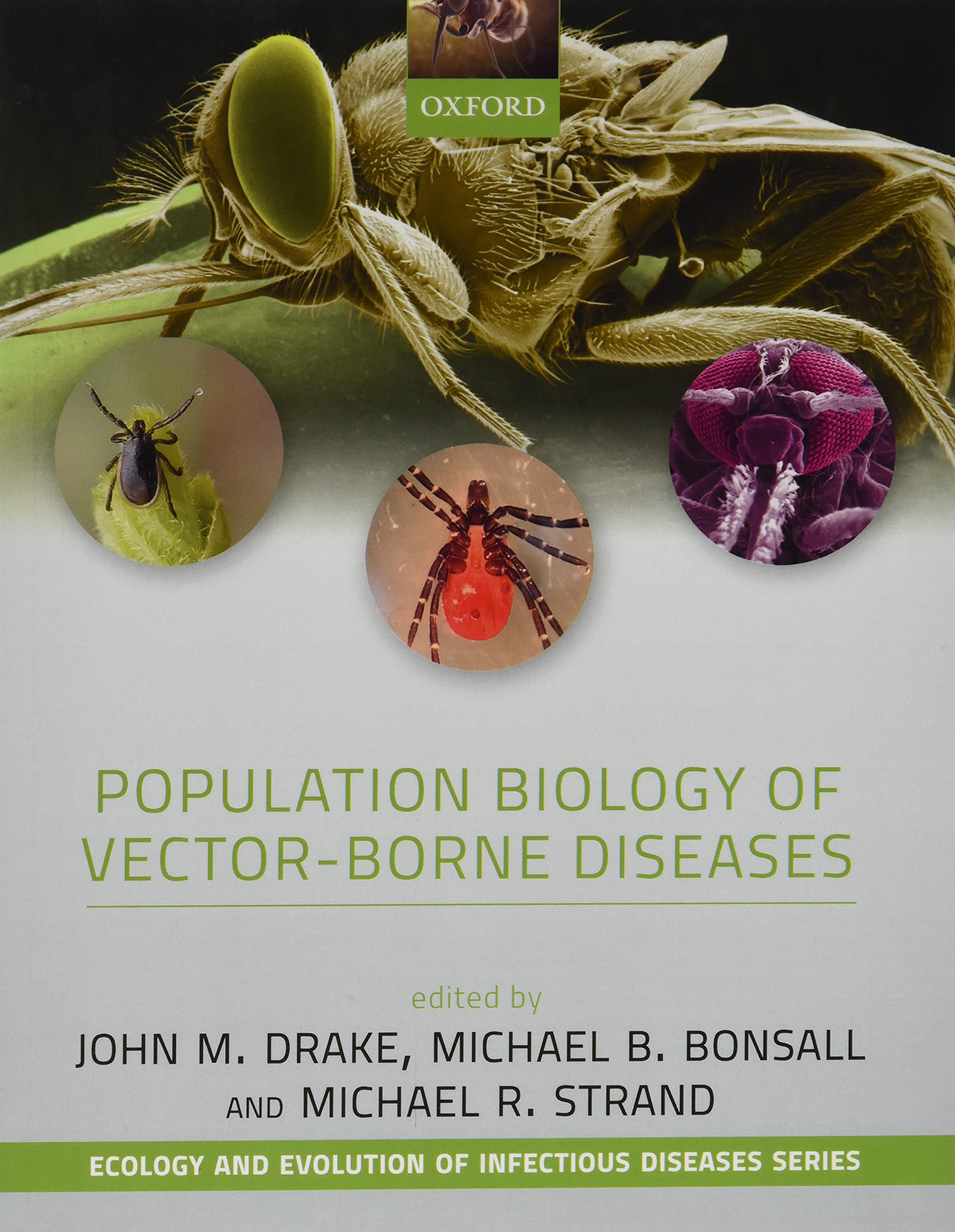
Population Biology of Vector-Borne Diseases (Ecology and Evolution of Infectious Diseases)
$72.00
by John M. Drake



Population Biology of Vector-Borne Diseases is the first comprehensive survey of this rapidly developing field. The chapter topics provide an up-to-date presentation of classical concepts, reviews of emerging trends, synthesis of existing knowledge, and a prospective agenda for future research. The contributions offer authoritative and international perspectives from leading thinkers in the field. The dynamics of vector-borne diseases are far more intrinsically ecological compared with their directly transmitted equivalents. The environmental dependence of ectotherm vectors means that vector-borne pathogens are acutely sensitive to changing environmental conditions. Although perennially important vector-borne diseases such as malaria and dengue have deeply informed our understanding of vector-borne diseases, recent emerging viruses such as West Nile virus, Chikungunya virus, and Zika virus have generated new scientific questions and practical problems. The study of vector-borne disease has been a particularly rich source of ecological questions, while ecological theory has provided the conceptual tools for thinking about their evolution, transmission, and spatial extent. Population Biology of Vector-Borne Diseases is an advanced textbook suitable for graduate level students taking courses in vector biology, population ecology, evolutionary ecology, disease ecology, medical entomology, viral ecology/evolution, and parasitology, as well as providing a key reference for researchers across these fields. "The authors, specialists in their field, create a perfect balance between basic concepts and higher level eco-epidemiological connections. Thus, the book will be understood not only by researchers working with VBDs, but also by graduate students or public health specialists." -- Conservation Biology "The book covers the topic in the widest possible sense, from basics in vector population biology to pathogen-vector interactions, ecoepidemiology, social drivers, and control methods of VBDs. The authors have created a perfect balance between basic concepts and higher level eco-epidemiological connections. Thus, the book will be understood not only by researchers working with VBDs, but also by graduate students or public health specialists." -- Journal of Conservation Biology "Although marketed as a textbook, each article in the collection is thorough and well researched and could easily stand alone." -- J. K. Peterson, Biological Sciences, University of Notre Dame, Notre Dame, Indiana, The Quarterly Review of Biology John M. Drake, Professor and Associate Dean, Center for the Ecology of Infectious Diseases, University of Georgia, USA ,Michael Bonsall, Professor of Mathematical Biology, Department of Zoology, University of Oxford, UK ,Michael Strand, H.M. Pulliam Chair, Department of Entomology, University of Georgia, USA John M. Drake is Associate Dean of Academic Affairs, Distinguished Research Professor of Ecology, and founding Director of the Center for the Ecology of Infectious Diseases at the University of Georgia, USA. Michael Bonsall is Professor of Mathematical Biology at the Department of Zoology, University of Oxford, UK. He heads the Mathematical Ecology Research Group at the department, which undertakes cross-disciplinary research using mathematical approaches to explore novel and rewarding problems in ecology, evolution, health and economics. Michael Strand is Professor at the Department of Entomology, University of Georgia USA. His research laboratory in the department investigates many areas under the broad umbrella of Insect Physiology.