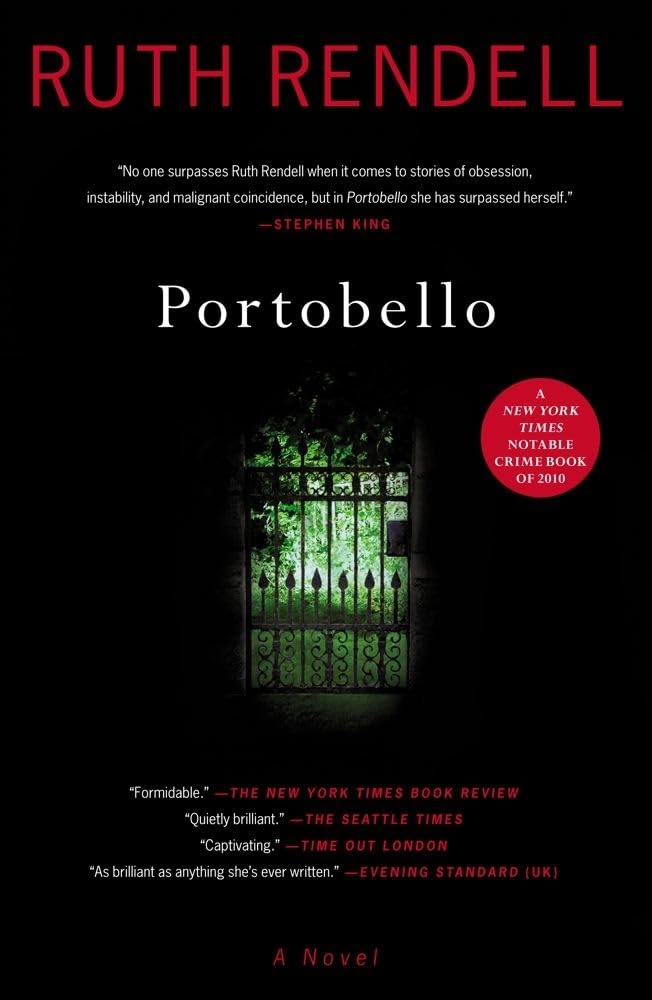



INCLUDES AN EXCERPT OF RENDELL’S FINAL NOVEL, DARK CORNERS Ruth Rendell is widely considered to be crime fiction’s reigning queen, with a remarkable career spanning more than forty years. Now, in Portobello, she delivers a captivating and intricate tale that weaves together the troubled lives of several people in the gentrified neighborhood of London’s Notting Hill. Walking to the shops one day, fifty-year-old Eugene Wren discovers an envelope on the street bulging with cash. A man plagued by a shameful addiction—and his own good intentions—Wren hatches a plan to find the money’s rightful owner. Instead of going to the police, or taking the cash for himself, he prints a notice and posts it around Portobello Road. This ill-conceived act creates a chain of events that links Wren to other Londoners—people afflicted with their own obsessions and despairs. As these volatile characters come into Wren’s life—and the life of his trusting fiancée—the consequences will change them all. Portobello is a wonderfully complex tour de force featuring a dazzling depiction of one of London’s most intriguing neighborhoods—and the dangers beneath its newly posh veneer. “The characters jump off the page. The page-to-page surprises are so clever that the reader is left agape at each twist and turn. The pieces fit together brilliantly.”— Pittsburgh Post-Gazette “An expert dissection of the hazards of human connections and the search for happiness.”— USA Today “A novel that glides along Portobello Road like the lime in a gin and tonic. It's intoxicating.”— Newsday Ruth Rendell (1930–2015) won three Edgar Awards, the highest accolade from Mystery Writers of America, as well as four Gold Daggers and a Diamond Dagger for outstanding contribution to the genre from England’s prestigious Crime Writers’ Association. Her remarkable career spanned a half century, with more than sixty books published. A member of the House of Lords, she was one of the great literary figures of our time. 1 IT IS CALLED the Portobello Road because a long time ago a sea captain called Robert Jenkins stood in front of a committee of the House of Commons and held up his amputated ear. Spanish coast guards, he said, had boarded his ship in the Caribbean, cut off his ear, pillaged the vessel, then set it adrift. Public opinion had already been aroused by other Spanish outrages, and the Jenkins episode was the last straw to those elements in Parliament which opposed Walpole’s government. They demanded British vengeance and so began the War of Jenkins’s Ear. In the following year, 1739, Admiral Vernon captured the city of Puerto Bello in the Caribbean. It was one of those successes that are popular with patriotic Englishmen, though many hardly knew what the point of it was. In the words of a poet writing about another battle and another war: “That I cannot tell, said he, but ’twas a famous victory.” Vernon’s triumph put Puerto Bello on the map and gave rise to a number of commemorative names. Notting Hill and Kensal were open country then where sheep and cattle grazed, and one landowner called his fields Portobello Farm. In time the lane that led to it became the Portobello Road. But for Jenkins’s ear it would have been called something else. Street markets abounded in the area, in Kenley Street, Sirdar Road, Norland Road, Crescent Street, and Golborne Road. The one to survive was the Portobello, and from 1927 onwards a daily market was held there from eight in the morning to eight in the evening and 8 a.m. till 9 p.m. on Saturdays. It still is, and in a much reduced state on Sundays too. The street is long, like a centipede snaking up from Pembridge Road in the south to Kensal Town in the north, its legs splaying out all the way and almost reaching the Great Western main line and the Grand Union Canal. Shops line it and spill into the legs, which are its side streets. Stalls fill most of the centre, for though traffic crosses it and some cars crawl patiently along it among the people, few use it as a thoroughfare. The Portobello has a rich personality, vibrant, brilliant in colour, noisy, with graffiti that approach art, bizarre and splendid. An indefinable edge to it adds a spice of danger. There is nothing safe about the Portobello, nothing suburban. It is as far from an average shopping street as can be imagined. Those who love and those who barely know it have called it the world’s finest street market. You can buy anything there. Everything on earth is on sale: furniture, antiques, clothes, bedding, hardware, music, food and food and more food. Vegetables and fruit, meat and fish, and cheese and chocolate. The stalls sell jewellery, hats, masks, prints, postcards old and new, shawls and scarves, shoes and boots, pots and pans, flowers real and artificial, furs and fake furs, lamps and musical instruments. You can buy a harp there or a birdcage, a stuffed bear or a wedding dress, or the latest bestseller. If you want to eat your lunch in