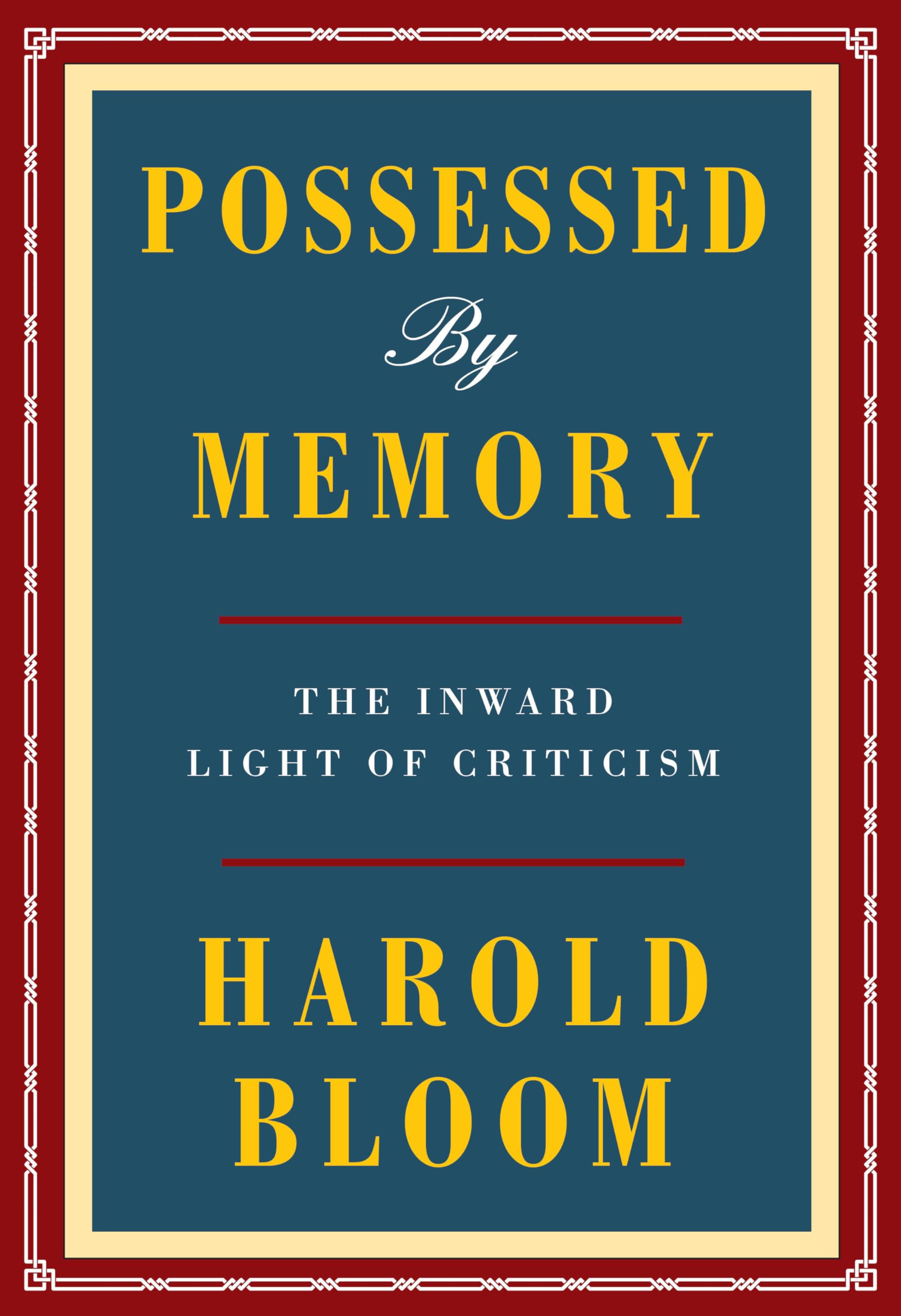



In arguably his most personal and lasting book, America's most daringly original and controversial critic gives us brief, luminous readings of more than eighty texts by canonical authors-- texts he has had by heart since childhood. Gone are the polemics. Here, instead, in a memoir of sorts--an inward journey from childhood to ninety--Bloom argues elegiacally with nobody but Bloom, interested only in the influence of the mind upon itself when it absorbs the highest and most enduring imaginative literature. He offers more than eighty meditations on poems and prose that have haunted him since childhood and which he has possessed by memory: from the Psalms and Ecclesiastes to Shakespeare and Dr. Johnson; Spenser and Milton to Wordsworth and Keats; Whitman and Browning to Joyce and Proust; Tolstoy and Yeats to Delmore Schwartz and Amy Clampitt; Blake to Wallace Stevens--and so much more. And though he has written before about some of these authors, these exegeses, written in the winter of his life, are movingly informed by "the freshness of last things." As Bloom writes movingly: "One of my concerns throughout Possessed by Memory is with the beloved dead. Most of my good friends in my generation have departed. Their voices are still in my ears. I find that they are woven into what I read. I listen not only for their voices but also for the voice I heard before the world was made. My other concern is religious, in the widest sense. For me poetry and spirituality fuse as a single entity. All my long life I have sought to isolate poetic knowledge. This also involves a knowledge of God and gods. I see imaginative literature as a kind of theurgy in which the divine is summoned, maintained, and augmented." "Describe is what he does, perhaps more brilliantly than anyone else alive." -- Esquire "The great critic revisits the literature that has meant most to him. " --The New York Times "Our era’s Samuel Johnson... Possessed by Memory really is a kind of valediction... Bloom has loved literature deeply—and that love is, even in the face of death, a life-giving force." —Commonweal Magazine "These essays reveal a deeply personal attachment and fresh perspective. An eloquent and erudite rereading of the author's beloved works." —Kirkus Reviews (starred review) "A rich lifetime of readership and scholarship can be found within the covers of this equally rich book." —Publishers Weekly Harold Bloom was a Sterling Professor of Humanities at Yale University and a former Charles Eliot Norton Professor at Harvard. His more than forty books include The Anxiety of Influence , Shakespeare: The Invention of the Human , The Western Canon , The American Religion , and The Daemon Knows: Literary Greatness and the American Sublime . He was a MacArthur Fellow, a member of the American Academy of Arts and Letters, and the recipient of many awards and honorary degrees, including the American Academy of Arts and Letters' Gold Medal for Belles Lettres and Criticism, the Catalonia International Prize, and Mexico's Alfonso Reyes International Prize. Part One: A Voice She Heard Before the World Was Made Thresholds to Voice: Augmenting a God in Ruins As I near the end of my eighties, I am aware of being in the elegy season. The majority of my close friends from my own generation have departed. I am haunted by many passages in Wallace Stevens, and one that I keep hearing centers his extraordinary poem, “The Course of a Particular”: And though one says that one is part of everything, There is a conflict, there is a resistance involved; And being part is an exertion that declines: One feels the life of that which gives life as it is. Throughout his final poems, Stevens listens for the voice he heard before the world was made. Though he is not preoccupied with occult and Hermetic modes of speculation, in the manner either of William Butler Yeats or of D. H. Lawrence, he hears voices. Falling leaves cry out, houses laugh, syllables are spoken without speech, the wind breathes a motion, thoughts howl in the mind, the colossal sun sounds a scrawny cry, and the phoenix, mounted on a visionary palm tree, sings a foreign song. Sleepless like many other old men and women, I too dream what Stevens calls a heavy difference: A little while of Terra Paradise I dreamed, of autumn rivers, silvas green, Of sanctimonious mountains high in snow, But in that dream a heavy difference Kept waking and a mournful sense sought out, In vain, life’s season or death’s element. Montrachet-le-Jardin When that saddens me too much, something in my spirit turns to a more intimate Stevens: The cry is part. My solitaria Are the meditations of a central mind. I hear the motions of the spirit and the sound Of what is secret becomes, for me, a voice That is my own voice speaking in my ear. Chocorua to Its Neighbor Frequ